Ashwagandha KSM-66 vs Sensoril for Cortisol Reduction
Two ashwagandha extracts deliver different withanolides at different doses.

Cortisol reduction from ashwagandha depends almost entirely on which extract you're taking and how much of it. KSM-66 and Sensoril come from different plant material, use different extraction methods, and land in different clinical outcome categories. Confusing the two, or assuming any modestly dosed capsule of the herb performs like the trial data, is where most people go wrong before they even swallow the first dose.
Why standardized extracts exist and what generic ashwagandha powder delivers
Ashwagandha's studied effects trace back mostly to withanolides, a family of steroidal lactones that the plant makes as part of its own stress response. Other compounds in the root likely play some supporting role, but withanolides are the ones researchers measure and the ones manufacturers standardize against.
Plain root powder, the kind sold in bulk bins and unbranded capsules, usually runs somewhere between 0.5% and 3% withanolides. Nobody's verifying that number batch to batch, and there's next to no randomized controlled trial evidence backing any specific dose of it. Compare that to the branded extracts, which concentrate the root down to 5% to 10% withanolides, the range where the actual clinical trials operate. That's not a small gap. A product with a research trail differs from one running on the assumption that "ashwagandha" is a single, interchangeable ingredient.
The withanolide percentage is the number that actually matters when you're reading a label, not the milligram count of "extract" printed in bold. A 600 mg product standardized to a low withanolide percentage delivers far less active compound than the 300 mg product described next. A 300 mg product at 5% delivers 15 mg. Anyone comparing products by total extract weight alone is comparing numbers that don't mean anything.
KSM-66 and Sensoril differences: plant part, extraction method, and withanolide profile
KSM-66, made by Ixoreal Biomed, comes from root only, with no leaf material in the mix. It's pulled out using a water-based process, skipping alcohol or synthetic solvents entirely, and standardized to at least 5% withanolides. Ixoreal calls it full-spectrum: the extraction keeps the natural ratio of compounds close to what's in the whole root. At a 300 mg dose, that works out to roughly 15 mg of total withanolides, which happens to sit right in the range most published trials have used.
Sensoril takes a different path. It's made from both root and leaf, which shifts the phytochemical mix right from the start. It's standardized to around 10% withanolides, with particular weight on withaferin A. Because the concentration runs higher, the effective daily dose drops to somewhere between 125 mg and 250 mg, less than half of KSM-66's typical range.
The root-versus-leaf distinction isn't a minor manufacturing footnote. Leaf material brings more withaferin A into the extract, and withaferin A has cytotoxic properties, useful territory for cancer researchers, but a legitimate question mark for anyone taking a supplement daily for years. It's a reason the two extracts get formulated, dosed, and studied differently, not a claim that Sensoril is unsafe. It's a reason the two extracts get formulated, dosed, and studied differently.
The downstream effect of all this is that the two extracts don't just differ by dose, they differ by which biological pathways they lean on. KSM-66's broader, full-spectrum withanolide mix tends to produce more general adaptogenic signaling. Sensoril's higher withaferin A content skews more toward inflammation and metabolic pathways. That's a big part of why their clinical trial results cluster in different places, and it's worth keeping in mind before assuming one can simply substitute for the other at an adjusted dose.
The clinical evidence for KSM-66 on cortisol reduction, stress, and cognitive outcomes
KSM-66 has more than two dozen published human randomized controlled trials behind it, covering cortisol, testosterone, sleep, anxiety, endurance, and cognitive function. Ixoreal puts the number even higher, citing 90 studies across all health domains when everything is counted.
The cortisol data is where the extract's reputation was really built. A 60-day double-blind trial in 64 people with chronic stress found a 27.9% reduction in serum cortisol on 300 mg of KSM-66 twice daily. A separate randomized trial by Lopresti and colleagues, published in 2019, found a 30% cortisol reduction alongside a 44% drop in Perceived Stress Scale scores compared to placebo. And a 2019 trial by Salve and colleagues in Cureus tested both 250 mg and 600 mg doses, finding both significant against placebo, but with 600 mg outperforming the lower dose, giving one of the clearer dose-response signals within a single extract.
Athletic performance is where KSM-66's trial record gets more interesting. A 42-day trial in 56 sub-elite team-sport athletes, spanning rugby, water polo, and football with equal enrollment of men and women, tested 600 mg daily during pre-season training, a period that reliably spikes cortisol in untreated athletes. The KSM-66 group's salivary cortisol stayed stable while the placebo group's climbed, and the supplemented group showed better recovery and strength adaptation. Equal-sex enrollment is still rare enough in ashwagandha research that this trial stands out on design alone.
Cognitive outcomes round out the picture: multiple cognitive domains have shown improvement across KSM-66 trials. A published trial tested 150 mg twice daily for eight weeks in 73 children aged 6 to 12 who completed the study, and found significant cognitive improvements. That trial matters less for the dose and more for what it signals: research on this extract is no longer confined to stressed working adults.
The pooled meta-analytic data and the gap it leaves
Individual trials are useful, but pooled analyses are where a substance either holds up or doesn't. A 2025 systematic review and meta-analysis covering 15 randomized controlled trials and 873 participants found a statistically significant reduction in serum cortisol at eight weeks, with a p-value below 0.0001, about as clean a result as this kind of research produces.
A larger analysis pushed the number further: 23 trials, 1,706 participants, again confirming a significant cortisol reduction (standardized mean difference of -1.18, p < 0.04), with dose-response patterns tracking withanolide content across studies. A 2026 dose-response meta-analysis covering 22 trials found ashwagandha significantly reduced anxiety, stress, and depression scores against placebo, with large effect sizes across all three measures.
None of that is the full story, though. A separate 2025 meta-analysis pooled seven trials measuring cortisol and six measuring perceived stress across 488 participants, and found a significant cortisol reduction but no significant improvement on the Perceived Stress Scale. Cortisol, a blood or saliva marker, moved in the expected direction, but the self-reported experience of stress didn't move with it in every analysis. Biology and subjective experience don't always sync up on the same timeline, and anyone treating cortisol numbers as a stand-in for "feeling less stressed" should hold that assumption loosely.
Sensoril's clinical record compared with KSM-66's deeper data
Sensoril isn't a lesser product standing in KSM-66's shadow. It has its own published research covering stress and anxiety reduction, cortisol lowering, and cognitive support, and both extracts reduce cortisol significantly within their respective trials.
Where Sensoril's research base leans hardest is sleep quality, metabolic outcomes, and body composition, areas that line up mechanistically with its higher withanolide concentration and its more sedating profile. The effective dose is between 125 mg and 250 mg daily, lower than KSM-66's range because the extract itself runs roughly twice as concentrated at around 10% withanolides.
For sleep specifically, Sensoril's calming character makes it a reasonable fit for evening dosing. Research pooling multiple randomized trials has found ashwagandha associated with improvements in sleep quality, with evidence suggesting larger gains among people with insomnia. That pooled dataset covers ashwagandha broadly and root extracts generally, and isn't the result of a single proprietary extract, so it should be read as supportive context rather than a finding specific to one particular formulation.
Shoden, a third standardized extract the label-reader should know exists
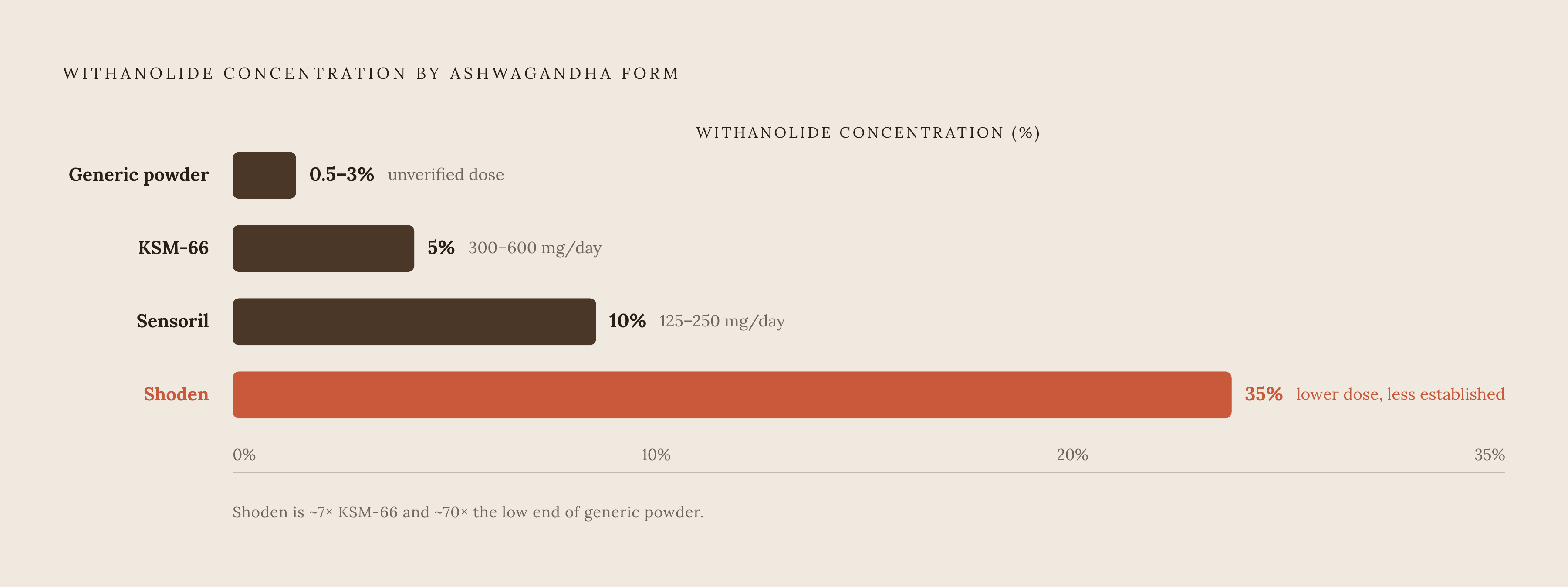
Shoden doesn't get mentioned nearly as often as KSM-66 or Sensoril, but it's out there. It's standardized to a 35% withanolide glycoside concentration, far above KSM-66's 5% or Sensoril's 10%, making it the most concentrated of the three by a wide margin.
Shoden's exceptionally high withanolide glycoside concentration sets it apart from the other two extracts on a compositional level. What Shoden doesn't have is the trial volume. Its research base is smaller than KSM-66's, and the large cortisol and cognitive trials that anchor most of what's known about ashwagandha's effects were run using KSM-66 or Sensoril doses, not Shoden.
That makes Shoden a reasonable pick for someone specifically chasing absorption efficiency, but not the obvious default for someone trying to replicate a named trial's outcome. The trade-off is straightforward: more concentrated, less clinical track record.
Matching extract to goal, a decision framework based on what the trials measured
Daytime stress support, cortisol reduction, cognitive performance, and athletic recovery all point toward KSM-66 at 300 mg to 600 mg daily, since that's the dose range behind the deepest trial record, including both the 2025 meta-analysis of 15 trials and the larger pooled analysis covering 23 trials.
Evening calm, sleep quality, and metabolic support point toward Sensoril, dosed at 125 mg to 250 mg at night, which fits both its higher withanolide load and its calming profile better than a daytime dosing schedule would.
Within either extract, dose affects outcomes more directly than which brand someone chooses. The Salve trial found 600 mg of KSM-66 outperforming 250 mg on stress outcomes, but that doesn't mean doubling or tripling past the trial dose compounds the benefit further. Nobody's run that experiment, so there's no evidence for it.
Timing follows a similar logic. Splitting the dose morning and evening tracks how most KSM-66 trials were actually designed, while Sensoril's profile suits a single evening dose better than a split schedule. The extract someone picks should follow from what they're trying to fix.