L-Theanine for Caffeine Crash and Jitter Reduction
The amino acid pairs with caffeine to smooth out the jitters while keeping alertness sharp.
Caffeine and L-theanine, taken together, don't just add two effects on top of each other. They correct for each other's weaknesses. Caffeine alone drives alertness by blocking the brain's fatigue signal, but push the dose too high and that alertness curdles into anxiety, restlessness, and the familiar crash a few hours later. L-theanine changes the shape of that curve: same stimulation, less overshoot, softer landing. Understanding why requires a look at what this amino acid actually does once it crosses into brain tissue, and what the trial data does and doesn't support.
What L-theanine is and how it reaches the brain
L-theanine is an amino acid, and it comes from a narrow set of sources: green tea, black tea, oolong, white tea, and the other beverages made from Camellia sinensis. It appears in smaller amounts in a few mushroom species too, including Xerocomus badius. Japanese scientists first isolated it back in 1949, and the compound has been studied steadily ever since.
Structurally, L-theanine is a close cousin of L-glutamate, the brain's main excitatory neurotransmitter. That resemblance is the whole story. Because the two molecules look alike at the receptor level, L-theanine interacts with the glutamate system without setting off the same excitatory response that glutamate itself would trigger. But the more important fact is simpler: L-theanine actually gets across the blood-brain barrier. A lot of compounds marketed for "focus" never make that crossing and just sit in the bloodstream doing very little upstairs. L-theanine gets in, and once inside, it partially blocks glutamate receptors while nudging up production of GABA, serotonin, and dopamine. That combination, dial down the excitatory noise, dial up the calming and mood-regulating signals, is what gives it a neurological footprint distinct from a simple relaxant.
The neurochemical mechanism behind the L-theanine and caffeine interaction
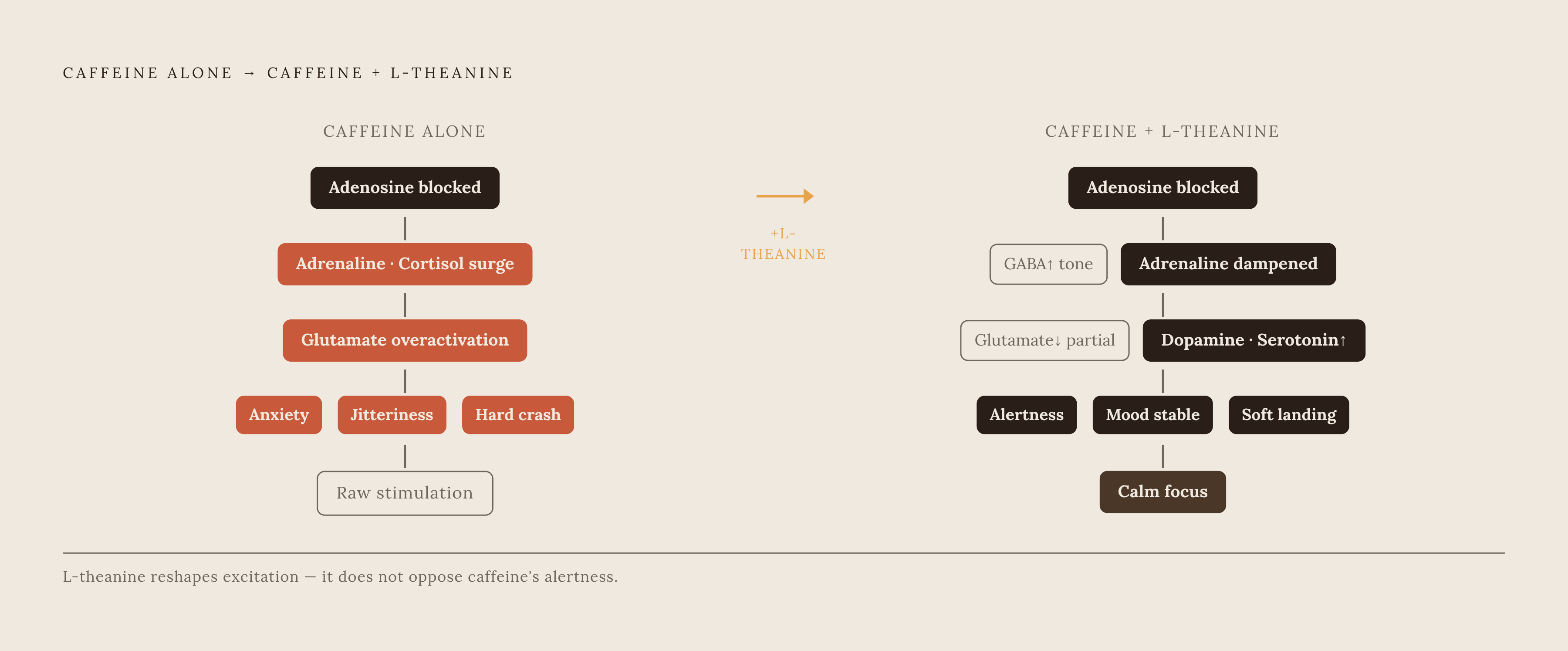
Caffeine works by blocking adenosine receptors. Adenosine is the molecule that builds up over the course of a day and tells the brain it's tired; caffeine occupies those receptors and mutes the signal. That's why a cup of coffee makes fatigue seem to vanish rather than actually removing it. At moderate-to-high doses, caffeine also triggers a release of adrenaline and cortisol. That's useful in small amounts: it's part of why caffeine feels like a lift and not just an absence of tiredness. Pushing past that moderate range, though, causes the adrenaline-cortisol surge to stop producing focus and start producing hypervigilance, a different animal. Restlessness, a racing heartbeat, that jittery, can't-sit-still feeling: all downstream of the same stress-hormone spike that made the first cup feel good.
L-theanine doesn't fight caffeine's excitation. It reshapes it. By increasing GABAergic tone, brain-speak for turning up the volume on the nervous system's primary calming neurotransmitter, L-theanine pushes back against the anxiety-producing side of the adrenaline and cortisol response. At the same time, its partial blocking of glutamate receptors keeps the overstimulation from tipping into the kind of jitteriness that turns a productive morning into a distracted one. L-theanine's effect on dopamine and serotonin, both tied to mood stability, shapes the resulting state into caffeine's alertness redirected into something closer to calm focus than raw stimulation. It's caffeine's alertness redirected into something closer to calm focus than raw stimulation.
What the clinical trials show about focus, accuracy, and subjective alertness
The anchor study here comes from Giesbrecht and colleagues (PubMed: 21040626), who gave 44 young adults either a placebo or a combination of 97 mg L-theanine and 40 mg caffeine, doses on the modest side compared to what a lot of energy products contain. The combination produced a significant improvement in accuracy during task-switching and in self-reported alertness, both at P < 0.01, along with a reduction in self-reported tiredness at P < 0.05. The same trial found no significant effect on visual search, choice reaction times, or mental rotation. The benefit occurred specifically in sustained attention and subjective alertness, not across every cognitive domain tested.
Other trials using higher doses, such as 100 mg caffeine paired with 200 mg L-theanine, have found improvements in both speed and accuracy on cognitive tasks, a slightly higher-dose version of the same pattern. A smaller randomized controlled trial on target detection, run with 16 adults, found that L-theanine on its own had no measurable effect on attentional focus. Pair it with caffeine, though, and cognitive performance improved. This suggests the lift is a genuine synergy between the two compounds, not something L-theanine can produce by itself.
Performance data outside the lab backs this up. A double-blind crossover study on 22 elite curling athletes compared caffeine plus theanine against placebo and found superior performance in guard, draw, and take-out shots, with p<0.001 across all three. Reaction times on the Stroop test, a standard measure of attentional control under interference, were faster in the combined condition than under caffeine alone, theanine alone, or placebo. That's a meaningful data point: the effect held up in athletes performing precision tasks under competitive pressure, not just in university students clicking through a computer task.
How L-theanine reduces caffeine's stress and anxiety side effects
Trials that combine the two compounds consistently report less subjective jitteriness and anxiety than caffeine taken alone, along with smaller spikes in blood pressure. That tracks with what's known about L-theanine's broader physiological effects: studies link it to lower blood pressure and reduced markers of physiological stress.
The cortisol picture is murkier, and that should be reported honestly rather than rounded up. A randomized controlled trial gave 30 healthy adults with a mean age of 48.3 years either 200 mg of L-theanine per day or a placebo for 4 weeks. Subjective stress measures showed improvement in the L-theanine group, though the cortisol biomarker did not show a statistically significant difference between groups. Other trial data has shown a similar shape: a trend toward lower salivary cortisol with L-theanine compared to placebo, but without reaching statistical significance. Across these studies, the pattern is consistent enough to take seriously (people report feeling less stressed) but the cortisol biomarker hasn't caught up to the subjective report. That's a real signal.
The right dose, ratio, timing, and format
The most heavily studied ratio is 2:1, L-theanine to caffeine, commonly dosed at 200 mg L-theanine alongside 100 mg caffeine. The Giesbrecht trial ran lower, at 97 mg and 40 mg respectively, and still produced significant results. The ratio between the two compounds seems to matter more than hitting some high absolute number, an important detail for anyone assuming more is always better.
Across the clinical literature, doses have varied considerably, with 200 mg per day the dose most frequently tested and reported on. As for timing, L-theanine reaches peak blood levels in roughly 30 to 50 minutes. For the combination effect, that means taking it alongside the caffeine source, whether that's coffee, tea, or a supplement, rather than staggering the two. Taken for its calming effect alone, without caffeine, L-theanine works best about 30 to 60 minutes ahead of whatever moment calls for it.
The sleep dimension: how L-theanine affects the recovery side of mental performance
Sleep sits at the center of any stimulant discussion, not off to the side. It's the downstream consequence of how well the day's stimulation was managed. Clinical research has found sleep quality measures improving after L-theanine administration, alongside reductions in stress and anxiety markers, suggesting the same mechanism doing daytime work is also easing the transition into rest.
The physiological logic connecting the two is straightforward, even if it's more of a general pattern than a finding specific to this compound. Sleep loss activates the sympathetic nervous system and raises cortisol; a bad night makes the next day's fatigue worse, which raises the temptation to reach for more caffeine to compensate, which raises the odds of jitteriness, which in turn makes falling asleep that night harder. It's a loop, and it feeds on itself. L-theanine's effect on GABA and serotonin offers a plausible way to interrupt that loop: it eases sleep onset without sedating anyone during waking hours, the same calming-without-dulling mechanism seen in the daytime focus studies.
Who the combination best suits
The clearest fit is for people who already know caffeine doesn't sit well with them: the ones who get anxious after a coffee, who crash hard by 3 p.m., or who struggle to hold focus once real pressure hits. The mechanism addresses each of those complaints directly rather than papering over them.
It's not just a desk-worker's stack, either. The curling study already mentioned tested it under competitive conditions, and a completed trial (NCT07268573), a randomized, double-blind, placebo-controlled study, examined performance outcomes relevant to both physical and cognitive domains. There's also a growing research interest in whether low-dose caffeine paired with L-theanine might help with focus in ADHD, with fewer of the side effects associated with stimulant medication. That's a research direction worth watching, not a treatment claim, and nobody studying it is suggesting otherwise.
What the combination does not do is fix a cause it wasn't built for. Focus problems, chronic fatigue, anxiety, or brain fog that trace back to a sleep disorder, thyroid dysfunction, or anemia need medical attention. L-theanine and caffeine change the texture of stimulation. They don't diagnose or treat the sleep disorder, thyroid dysfunction, or anemia driving the symptoms.
Sources
- Study Details | NCT07268573 | | ClinicalTrials.gov
- Full article: Performance-enhancing effects of caffeine and L-Theanine among Iranian elite wrestlers: a focus on cognitive and specific physical performance
- The combination of L-theanine and caffeine improves cognitive performance and increases subjective alertness - PubMed
- (PDF) The combination of L-theanine and caffeine improves cognitive performance and increases subjective alertness
- alzdiscovery.org
- l-theanine: From tea leaf to trending supplement – does the science match the hype for brain health and relaxation? - PMC
- Full article: Examining the effect of L-theanine on sleep: a systematic review of dietary supplementation trials
- researchgate.net