Bacopa Monnieri Memory Effects and the Timeline to Results
Memory gains from this herb emerge around week four, but require sustained dosing to accumulate.

Bacopa monnieri's memory benefits show up on a specific biological clock, not on demand, because gradual bacoside accumulation, synaptic remodeling, and slow-building cholinergic support produce that delay, and this mechanism is why the people who benefit are the ones who stick with it. The herb itself is old news in one sense: it's been used in Indian traditional medicine for centuries under the name Brahmi, and it grows natively across India, Indochina, Australia, and Sri Lanka. A PubMed Central review confirms this lineage directly, noting that the plant "has been used as a reputed drug in the Indian traditional ayurvedic system for centuries" under that same name https://www.ncbi.nlm.nih.gov/pmc/articles/PMC7238420/. Its active compounds are bacosides A and B, the primary studied constituents, alongside betulinic acid, loliolide, asiatic acid, and quercetin, all flagged for potential brain health relevance. In Ayurvedic tradition the plant is also referred to as "medhya rasayana," or "rejuvenating herbs," a category believed to enhance memory, mental health, and intellect while promoting long life. Ayurveda practitioners historically claimed it could sharpen cognition, extend life, and ease anxiety, depression, chronic fatigue, and insomnia, a use profile broad enough to raise an eyebrow on its own.
That breadth matters more now than it might have a generation ago. Curative pharmacological options for cognitive decline remain limited, and that gap is a documented reason researchers have turned back toward traditional and indigenous medicinal interventions for a second look. Bacopa has been tested in at least 22 clinical trials spanning children with inattention symptoms, healthy adults, and adults with neurodegenerative disease, a spread that puts it well past the fringe-supplement category. None of this should be oversold, though. The ADDF's own review of that evidence notes that the trials have been small and methodologically varied, and that's a feature of the story, not a reason to bury the lede.
The core mechanisms: how bacosides influence the brain
Start with the cholinergic system, because it's the most mechanistically direct piece of the puzzle. Bacosides A and B inhibit acetylcholinesterase, the enzyme responsible for breaking down acetylcholine. More acetylcholine stays available at the synapse for longer, the same biochemical target used by pharmaceutical Alzheimer's drugs. Bacoside A specifically is considered the most researched and pharmacodynamically active fraction of the extract, and beyond acetylcholine levels it also increases activity of choline acetyltransferase, reduces oxidative stress and lipid peroxidation, minimizes β-amyloid aggregation linked to Alzheimer's disease, and inhibits neuronal apoptosis.
A second thread runs through brain-derived neurotrophic factor, or BDNF. Animal studies show Bacopa raises BDNF expression, though that specific effect hasn't been confirmed in human trials yet, and higher BDNF is tied to stronger synaptic connections, more resilient neurons, better mood, and increased neurogenesis. That gap between animal and human data is not a minor caveat: a 2023 Examine.com study summary reports that supplementing with Bacopa monnieri did not increase BDNF in older adults, and the Alzheimer's Drug Discovery Foundation likewise notes that the preclinical BDNF effect "has not been confirmed in humans" https://www.ncbi.nlm.nih.gov/pmc/articles/PMC4564643/. Alongside that sits synaptic remodeling itself: Bacopa enhances synaptic plasticity by upregulating synaptophysin and postsynaptic density protein-95 (PSD-95), proteins essential to efficient neurotransmission and closely linked to learning and memory retention.
The herb also works on the stress axis directly. Bacosides reduce corticosterone secretion through interaction with the HPA axis, and a secondary anxiolytic effect comes through 5-HT1A receptor agonism, producing a calming effect without sedation. Layering on anti-inflammatory and antioxidant action, lower proinflammatory markers, reduced oxidative stress, and less nuclear factor-κB phosphorylation broadens the neuroprotective picture still further. There's a vascular angle too: modulation of nitric oxide pathways appears to enhance cerebral blood flow, reinforcing the idea that Bacopa works across several systems at once rather than hitting one target and calling it done. The newest thread is metabolomic. Alzheimer's patients show disruptions in branched-chain amino acid metabolism, and 12 weeks of Bacopa consumption has been shown to shift metabolites along that same pathway in healthy adults, a lead the 2026 AIIMS trial from Dwivedi and colleagues is now formally chasing. Every one of these mechanisms describes a process, not an event. They need repeated dosing and time for tissue to change, which sets up the timeline directly. AChE inhibition up to a meaningful degree has been observed in clinical populations, primarily at 300 mg/day over 8–12 weeks, per sources, an effect that builds as compounds accumulate.
The earliest credible inflection point at four weeks, and the data at each stage
The clearest data on timing comes from a randomized, double-blind, placebo-controlled trial by Eraiah, Shekhar, Joshua, and Thomas, published in the Journal of Psychiatry and Cognitive Behavior, a citation confirmed independently by Semantic Scholar's listing of the paper's 15 February 2024 publication date https://pdfs.semanticscholar.org/a5db/7997da935be22c91d4298137cbb3bbd3fb20.pdf.
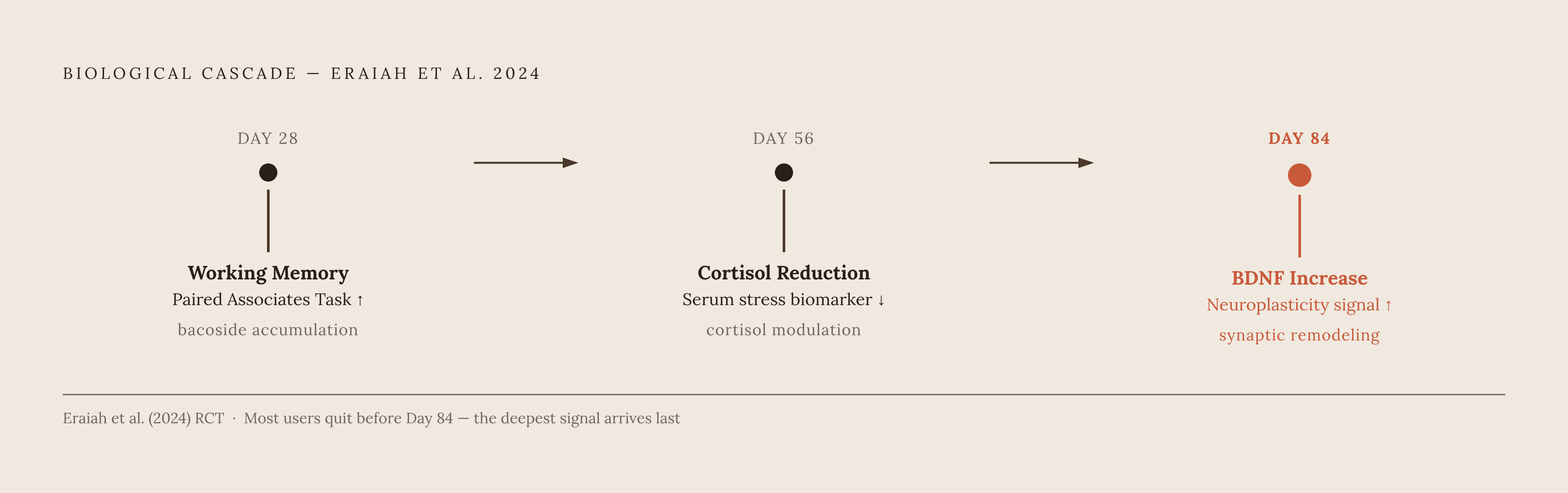
The earliest confirmed shift landed at Day 28. Paired Associates Task scores changed significantly from baseline in the treatment group by that point, the earliest working memory signal the trial picked up. Cortisol came down next, with reductions in serum cortisol showing at Day 56 and again at Day 84, and BDNF increases didn't appear until Day 84, the last marker to move. Read together, that's a cascade rather than a single event: working memory shifts first around week four, stress biomarkers follow around week eight, and the deepest neuroplasticity signal appears last, at twelve weeks, in the order the underlying biology would predict. Older trials back up the general pattern: Stough and colleagues found cognitive effects after sustained supplementation in healthy adults in both a 2001 paper and a 2008 follow-up, both indexed in Cochrane, supporting the same 8-to-12-week window, and the underlying 2001 Psychopharmacology paper is itself confirmed by its PubMed listing, PMID 11498727, alongside the matching Cochrane Library record https://www.researchgate.net/publication/228099046_The_Cognitive-Enhancing_Effects_of_Bacopa_monnieri_A_Systematic_Review_of_Randomized_Controlled_Human_Clinical_Trials.
Nothing meaningful happens in week one or two. That stretch is mechanistic groundwork, not felt results, and impatience is probably the single biggest reason people quit a Bacopa regimen before it has a chance to do anything. That divergence between Lopresti and Eraiah isn't noise. It points squarely at extract quality and bioavailability as the variable that decides whether a given dose actually does anything for a given person, a question the next section takes up directly.
The cortisol barrier (how chronic stress suppresses the very memory gains Bacopa is building)
Prolonged elevated cortisol structurally affects the hippocampus, putting hippocampal tissue at risk, so stress impairs memory not just acutely through distraction or poor focus but structurally as well. That's the barrier Bacopa has to work against, and it's also part of what it treats.
In the Eraiah trial, serum cortisol reductions showed up at Day 56 and held at Day 84. Even in the Lopresti and Smith trial that failed to find a cognitive benefit, the stress reduction and anti-fatigue effects were still there, documented and real. That consistency across two studies with opposite headline findings on memory says something: the anti-stress mechanism is more reliable across extracts than the cognitive one, at least so far. Bacopa modulates serotonergic and GABAergic systems alongside HPA axis downregulation. People so often report improvement in both memory and anxiety simultaneously because these are not separate effects. The 5-HT1A agonism specifically produces calm without drowsiness, a distinction that matters for anyone who needs to function, not just relax, during the day.
Bacopa isn't only adding cognitive horsepower. It's releasing a brake, specifically the cortisol brake that's been slowing the engine down in the first place, and for anyone under sustained professional or competitive pressure, that mechanism may matter as much as the cholinergic one does. Stress reduction doesn't stop at daytime mood, either. It cascades into sleep, and sleep feeds directly back into memory consolidation.
Bacopa's Sleep Effects and Daytime Memory Consolidation
The sleep connection isn't a modern marketing add-on. Ayurvedic texts dating back to the 6th century already referenced Bacopa for promoting rest and tranquility, so this is baked into the herb's original use case, not bolted on later. The modern mechanism lines up with that old observation: GABAergic support combined with lower evening cortisol creates the conditions for deeper, more restorative sleep, and because BDNF production is partly dependent on sleep itself, better sleep translates into better neuroplasticity gains the next day.
A 2026 trial on the B-Lit Bacopa extract from Gowda, Joshua, and Thomas, published in Current Research in Complementary & Alternative Medicine, tested this stress-sleep link directly, a citation the publisher's own article page and an independent report both confirm, dating the study to February 2026 https://www.nutritionaloutlook.com/view/samriddh-s-b-lit-bacopa-demonstrates-clinical-efficacy-for-stress-reduction-and-sleep-quality-in-new-research. Fifty adults with non-chronic stress took either the extract or a placebo once daily for 84 days, and the manufacturer, Samriddh, reported the results as supporting efficacy for both stress management and sleep quality. Earlier work from Lopresti, using a different extract called Bacognize® and published in the Journal of Functional Foods in 2021, examined effects on stress, fatigue, quality of life, and sleep in adults with self-reported poor sleep, adding a second, independent line of evidence pointing the same direction.
When the pieces are put together, a cycle appears: better sleep supports better overnight BDNF production, which strengthens synaptic consolidation, which improves memory retrieval the next day, and the 12-week cognitive gains documented in the Eraiah trial are at least partly the accumulated dividend of roughly 84 nights of improved sleep. That has a practical consequence. Consistency in daily dosing matters partly because these sleep effects are cumulative, and a missed night of good sleep is a missed window for consolidation.
Why different extracts produce different results: the bioavailability problem at the center of the contradictory trial data
Bacosides are fat-soluble compounds. They need lipid transporters to be absorbed properly. Traditional Ayurvedic preparations got around this by combining Bacopa with ghee or other fats, a detail most modern capsule formulas simply ignore. That gap helps explain a lot of the confusion in the trial record. Standardized Bacopa extracts on the market range anywhere from roughly 20% to 55% bacosides, and the Eraiah trial used a specific, documented dose, 300 mg of extract containing 90 mg of total bacosides, precision that separates a real clinical protocol from a vague label claim.
That precision is why the Lopresti and Smith null result deserves a second look rather than dismissal. The Bacumen® extract used in that trial and the BME used in the Eraiah trial are not the same product, and the difference in outcomes most likely traces back to formulation, standardization, and absorption characteristics rather than to dose alone. A newer wave of extracts is trying to close that absorption gap directly. B-Lit Bacopa, made by Samriddh, is standardized to 30% total bacosides and uses a proprietary process called Bio Enhanced Active Technology, or BEAT Tech, built specifically to improve bioavailability and absorption, with the 2026 RCT from Gowda, Joshua, and Thomas backing its stress and sleep claims, a specification independently confirmed by Nutritional Outlook's reporting on the same extract and technology nutritionaloutlook.com. A 2025 review in Nutrients by Gościniak and colleagues, focused specifically on bioavailability research, is a useful reference point for anyone trying to track where this part of the field is heading. That review's full title, "Bacopa monnieri: Preclinical and Clinical Evidence of Neuroactive Effects, Safety of Use and the Search for Improved Bioavailability," and its June 5, 2025 publication date are both confirmed by its PubMed entry, with the same PubMed record also fixing the citation details as volume 17, issue 11, article 1939 https://www.nutraingredients.com/Article/2025/06/17/review-backs-neuroprotective-effects-of-bacopa-monnieri/.
The label dose is not the absorbed dose. A formula is only as good as what actually crosses into the bloodstream, and that principle applies across every Bacopa product on shelves, not just the ones used in published trials. Absorption technology isn't a marketing flourish tacked onto a fat-soluble compound competing for limited lipid transport, it's a real argument about whether the product can do what its label claims. Enhanced-absorption formats are emerging as a 2025–2026 commercial trend. BacoMind® (300 mg/day) is used in an active clinical trial registered with clinicaltrials.gov, with the NCT number confirmed by the Alzheimer's Drug Discovery Foundation, whose primary outcome is change in verbal learning and memory and whose secondary outcome includes BDNF as a blood biomarker, with the trial ongoing and results not yet published.
What the evidence base still cannot tell us
The 2024 systematic review from Valotto Neto and colleagues, cited in the ADDF report, covered all 22 clinical trials and landed on a fair verdict: promising, but the trials varied widely in dose and duration, tended to run small, and often lacked methodological rigor, meaning larger and better-designed studies are still needed before dosing and duration can be pinned down with confidence. The largest meta-analysis identified so far pooled 645 healthy adults, a respectable number but not close to definitive for a compound with this many claimed mechanisms of action.
Several questions remain genuinely open. Whether Bacopa works differently in people with diagnosed cognitive impairment versus healthy adults is also unclear, since most of the studied population skews older, leaving effects in younger high-performers less understood. Durability after stopping is another gap: the Lion's Mane 16-week data showing reversal at 4-week follow-up raises a parallel question about Bacopa's durability. The most active frontier right now is the 2026 AIIMS exploratory trial from Dwivedi and colleagues, testing Bacopa in amnestic mild cognitive impairment and early Alzheimer's disease while tracking blood metabolomics alongside cognitive outcomes. This trial, more than any single number in the existing literature, will show that the mechanistic story holds up in the population that would benefit from it most. Trials typically use between 200 and 600 mg/day, with most using roughly 300 mg, though the ideal dose has not yet been formally determined, per ADDF.
Sources
- Bacopa Monnieri
- JMIR Research Protocols - Efficacy of Bacopa monnieri (Linn.) on Cognitive Function and Alterations in Blood Metabolites in Patients With Amnestic Mild Cognitive Impairment and Early Alzheimer Disease: Protocol for an Exploratory Double-Blind, Randomized, Placebo-Controlled Trial
- Investigating the Neuroprotective and Cognitive-Enhancing Effects of Bacopa monnieri: A Systematic Review Focused on Inflammation, Oxidative Stress, Mitochondrial Dysfunction, and Apoptosis - PMC
- Effects of 12-Week Bacopa monnieri Consumption on Attention, Cognitive Processing, Working Memory, and Functions of Both Cholinergic and Monoaminergic Systems in Healthy Elderly Volunteers
- (PDF) The Cognitive-Enhancing Effects of Bacopa monnieri : A Systematic Review of Randomized, Controlled Human Clinical Trials
- Bacopa monnieri: Preclinical and Clinical Evidence of Neuroactive Effects, Safety of Use and the Search for Improved Bioavailability - PMC
- The Effects of a Bacopa monnieri Extract (Bacumen®) on Cognition, Stress, and Fatigue in Healthy Adults: A Randomized, Double-Blind, Placebo-Controlled Trial | Clinical Drug Investigation | Springer Nature Link
- Does Bacopa monnieri improve memory performance in older persons? Results of a randomized, placebo-controlled, double-blind trial | Cochrane Library