Eleuthero vs Ashwagandha for Stress Adaptation
These herbs lower stress through different pathways suited to different needs.
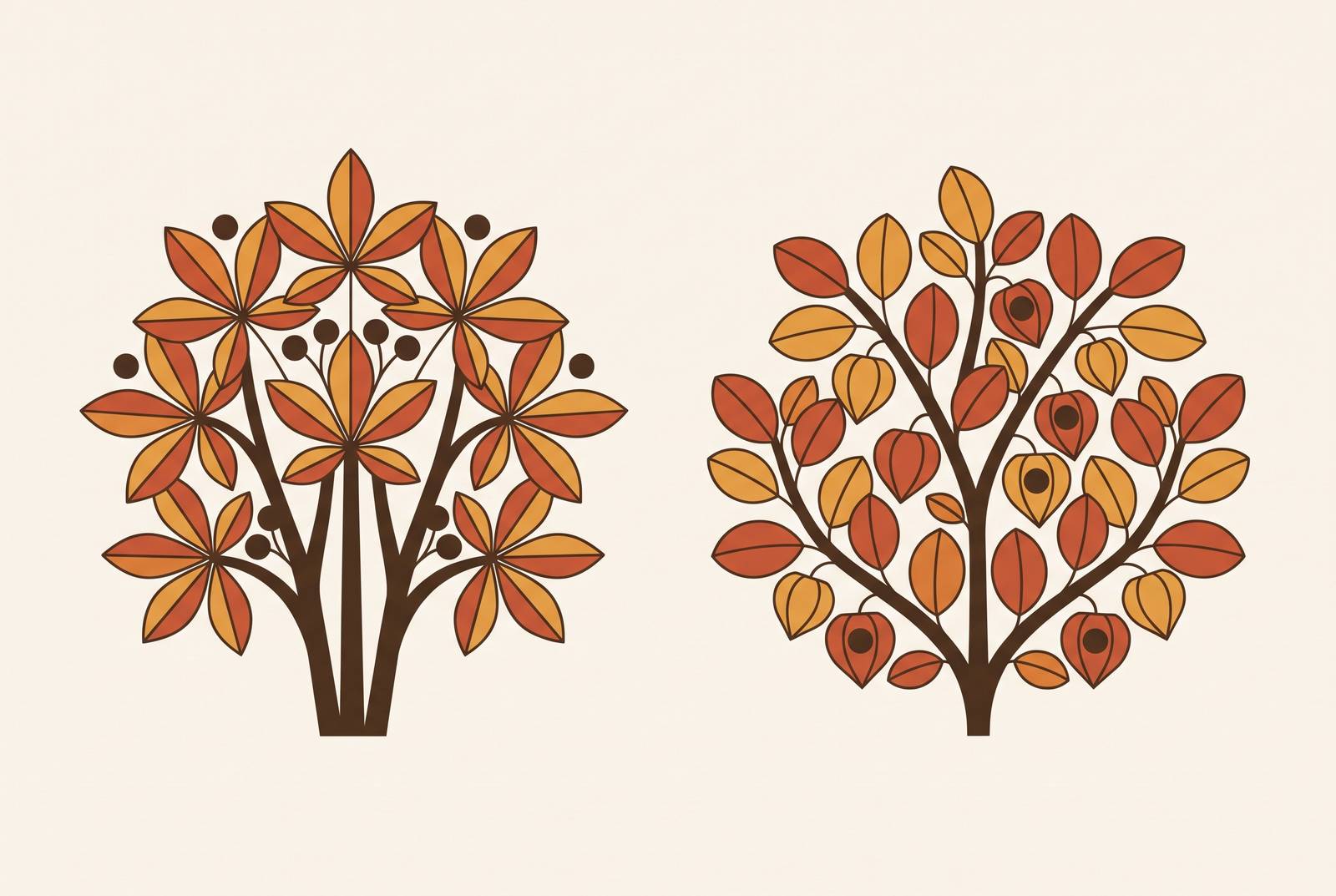
Eleuthero and ashwagandha both get filed under the same word, adaptogen, and that word does a lot of hiding. They work on stress through different biochemical routes, they suit different kinds of depletion, and picking between them (or combining them) depends on knowing which is which.
Adaptogen category label and meaningful differences between what adaptogens do
An adaptogen is a plant or fungus that helps the body hold steady under stress by acting on the HPA axis and supporting adrenal function. It is not a sedative and not a stimulant, which is exactly why people misjudge it the first time they try one. The word itself comes from Nikolai Lazarev, a Soviet pharmacologist working in the 1940s, and the research base behind it grew out of military science: Soviet scientists tested these plants on soldiers, athletes, and cosmonauts who needed to perform under real physical strain.
Stress isn't an abstract concern for the people reaching for these herbs. Reporting from the American Psychiatric Association's data, cited by Mind Lab Pro, found that 43% of U.S. adults said they felt more anxious than they had the year before, and half reported trouble making decisions under pressure Mind Lab Pro®. That's the backdrop that makes picking the right tool matter, not just picking a tool.
The category label starts to mislead at this point. Out of the dozens of herbs marketed as adaptogens, only around nine have evidence solid enough to earn the label without qualification: Asian ginseng, American ginseng, ashwagandha, eleuthero, schisandra, rhodiola, shilajit, rhaponticum, and cordyceps. Everything else is somewhere on a spectrum from probable to merely possible. Grouping all of them under one word implies they're interchangeable. They are not interchangeable. Two of the most established, eleuthero and ashwagandha, work through pathways different enough that swapping one for the other could mean missing the effect you were after entirely.
Where eleuthero's evidence is strongest
Eleuthero comes from Eleutherococcus senticosus, a shrub native to northeastern China, the Russian Far East, the Korean Peninsula, and Japan. It's often sold as Siberian ginseng, a name that sticks around despite being wrong. Botanically speaking, it belongs to a different genus entirely from true ginseng. Its place in the adaptogen story runs deep: this is the plant Soviet researchers gave to Olympic athletes, cosmonauts, and industrial workers, and it's fair to call it the starting point for the whole modern concept of an adaptogen.
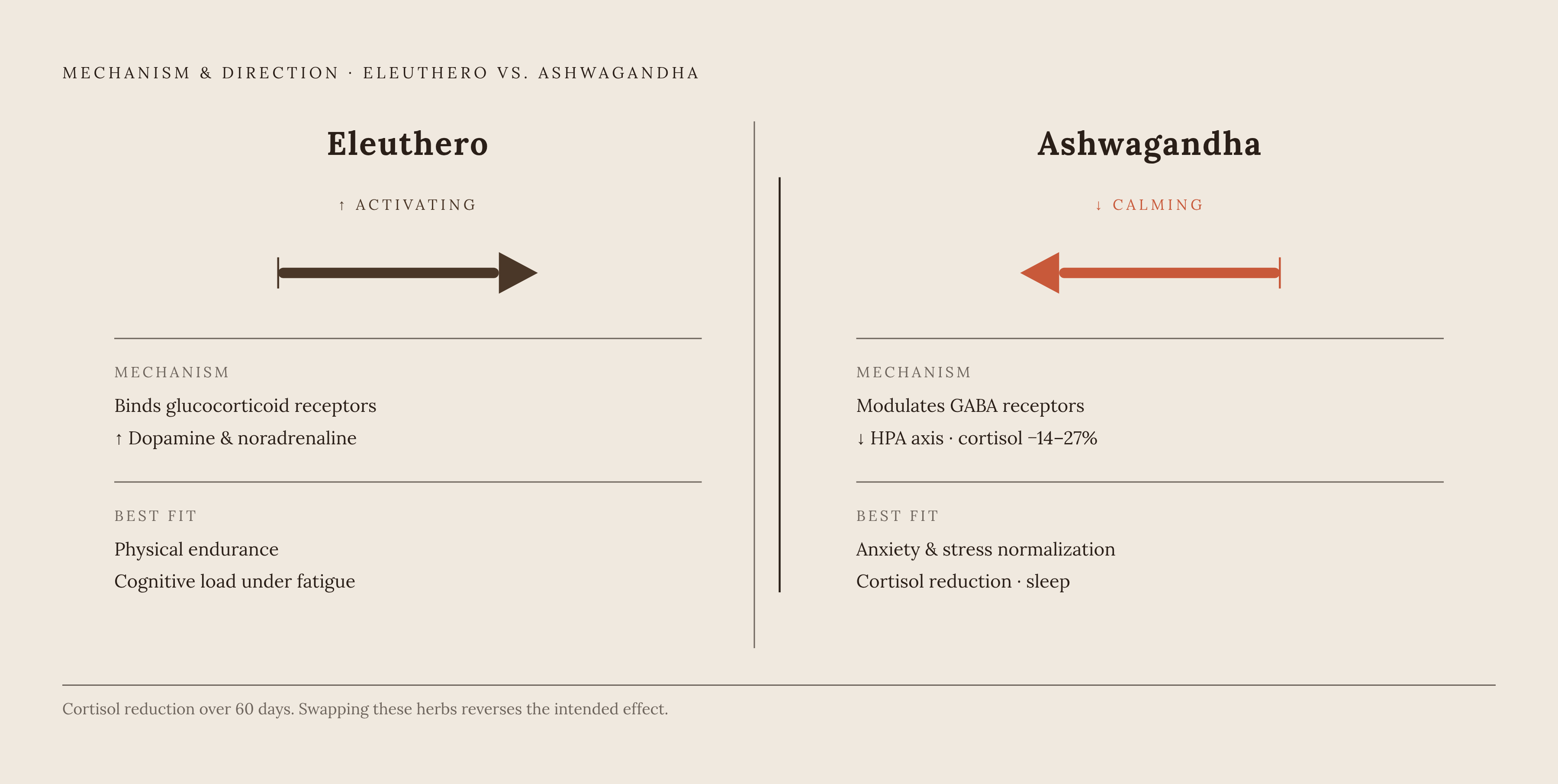
The active compounds doing the work are eleutheroside B (syringin) and eleutheroside E (syringaresinol diglucoside), along with a set of caffeoylquinic acids, and these are the markers used to standardize any credible extract. First, compounds in the extract appear to bind glucocorticoid receptors, which may keep cortisol from fully activating them, and eleutheroside E specifically has been shown in animal studies to blunt stress-induced spikes in corticosterone. Second, eleuthero raises noradrenaline and dopamine levels in animal models, a mild activating effect on alertness that sets it apart from how ashwagandha behaves.
The most interesting clinical signal comes from a Russian study of 357 sailors, where a single dose of eleuthero extract improved mental performance when conditions were calm but reduced adrenal cortex activity when conditions were stressful. That's a bidirectional response, tuned to whatever baseline state the body was already in. A separate randomized, double-blind, placebo-controlled trial using combined extracts of Eleutherococcus senticosus leaf and Drynaria fortunei found real improvements in language performance (p = 0.040), semantic fluency (p = 0.021), figure recall (p = 0.052), and anxiety scores (p = 0.022), with no adverse effects reported.
None of that should be read as an unqualified win, though. Stress management training alone accounted for the gains. And the well-known ADAPT-232 formula, which combines rhodiola, schisandra, and eleuthero and does show anti-fatigue effects, can't tell you how much of that benefit eleuthero itself contributed, since the trial never isolated it.
Weigh it all together and eleuthero comes out with a real historical pedigree and a genuine signal for softening the body's physiological reaction to stress, but a thinner evidence base than ashwagandha's, often hampered by small sample sizes or combination formulas that muddy attribution. Dr. Beata Lewis, in her May 2026 evidence-ranked guide, places eleuthero at a moderate tier, below both ashwagandha and rhodiola. Where it earns its keep is endurance, physical and cognitive stamina under sustained load, the person who feels ground down rather than anxious. It's not the strongest pick for someone whose main issue is anxiety or a cortisol problem specifically. The most commonly used range in clinical studies is 200–400 mg/day of standardized root extract, though some protocols use up to 300–1,200 mg/day Ashwagandha: Is it helpful for stress, anxiety, or sleep? - Health Pr… 7 Adaptogen Herbs for Stress and Anxiety (Ranked by Evidence) - Beata….
Ashwagandha's effects on the stressed body in 2025–2026 research
Ashwagandha's active compounds are withanolides, and standardizing to a specific withanolide percentage isn't a marketing detail: it's the difference between a product that can reproduce trial results and one that can't. A tub of non-standardized root powder is not the same thing as a tested extract, whatever the label implies.
Mechanistically, withanolides modulate GABA receptors and turn down HPA axis activation, a completely different route from eleuthero's glucocorticoid binding and dopamine boost. Ashwagandha is, by a wide margin, the most studied adaptogen for cortisol reduction specifically. Double-blind trials have shown drops in serum cortisol of 14 to 27% over 60 days.
That evidence has climbed high enough to shape clinical guidance. An international taskforce jointly run by the World Federation of Societies of Biological Psychiatry and the Canadian Network for Mood and Anxiety Treatments provisionally recommends 300 to 600 mg a day of ashwagandha root extract, standardized to 5% withanolides, for generalized anxiety disorder, according to the NIH Office of Dietary Supplements fact sheet Ashwagandha: Is it helpful for stress, anxiety, or sleep? - Health Pr…. That's a real clinical credibility marker, not a supplement-industry talking point Ashwagandha: Is it helpful for stress, anxiety, or sleep? - Health Pr….
Still, the picture complicates in an important way. A meta-analysis of eight randomized controlled trials covering 488 adults found that ashwagandha did lower cortisol levels but did not reduce how stressed people said they felt compared to placebo Ashwagandha might reduce cortisol, but not perceived stress - Study S…. That gap between a blood marker and a felt experience deserves to be taken seriously rather than smoothed over: a lab value moving in the right direction doesn't guarantee anyone notices a difference in daily life.
Formulation adds another layer. A 2026 trial (Medicine 2026;105:11 e47990) tested a sustained-release ashwagandha root extract capsule and found that gradual release changes bioavailability, meaning how the compound gets delivered into the body affects outcomes just as much as how much of it you take. Separately, a 2026 cognitive trial in children found improvements across delayed word recall (p = 0.038, d = 0.59), Stroop task accuracy (p = 0.021, d = 0.61), Corsi block span (p = 0.013, d = 0.66), choice reaction time accuracy (p = 0.005, d = 0.75), and sleep quality scores (p = 0.035) over eight weeks, with no significant adverse events, published in Frontiers in Nutrition. It's a pediatric sample, so it shouldn't be over-generalized to adults, but the breadth of cognitive domains touched spans multiple areas.
Not all ashwagandha extracts are the same product wearing different labels. These are formulated for different goals and shouldn't be treated as interchangeable Ashwagandha: Is it helpful for stress, anxiety, or sleep? - Health Pr… 7 Adaptogen Herbs for Stress and Anxiety (Ranked by Evidence) - Beata….
Safety needs a direct mention here. Case reports link prolonged ashwagandha use to elevated liver enzymes and hepatotoxicity. It isn't advised during pregnancy, since animal studies suggest possible fetal effects and human safety data is thin. It can also interact with immunosuppressants and thyroid medications, according to Dr. Lewis's May 2026 guide and the NIH fact sheet. Framed as best suited for recovery from stress (general anxiety, cortisol management, and sleep quality), ashwagandha's benefits accrue over 4–8 weeks of daily use, with consistency being paramount.
The overlap and divergence between the mechanisms
Both herbs act on the HPA axis, both take weeks rather than hours to show their effects, and both push the body toward balance rather than simply suppressing or stimulating it. That's the common ground, and it's real, but it stops there.
Eleuthero leans activating: glucocorticoid receptor binding paired with a lift in dopamine and noradrenaline, which fits it for physical and cognitive endurance under sustained load. Ashwagandha leans calming: GABA receptor modulation paired with direct downregulation of the HPA axis, which fits it for anxiety, cortisol normalization, and sleep. One is a gas pedal, the other a brake, and conflating the two because both wear the adaptogen label is exactly the mistake this whole comparison exists to correct.
The depth of evidence isn't equal either. Ashwagandha carries the largest body of randomized controlled trial evidence of any adaptogen on the market, while eleuthero is a moderate tier, genuinely useful for someone under physical strain but not the first choice for anxiety or cortisol dysregulation specifically. Neither is an acute tool. Both herbs require sustained use before their effects appear, though eleuthero does show some single-dose physiological effect, as in the 357-sailor study, without qualifying as fast-acting in the way rhodiola is sometimes described.
Standardization also works differently for each. Eleuthero gets standardized to eleutheroside B and E content. Ashwagandha gets standardized to withanolide percentage, with KSM-66 and Sensoril standing as the most clinically studied proprietary extracts, each with distinct applications. And the biomarker-versus-experience gap that appears in the 2025 ashwagandha meta-analysis, lower cortisol without lower perceived stress, isn't unique to ashwagandha Ashwagandha might reduce cortisol, but not perceived stress - Study S…. Eleuthero's trials use outcome measures that vary just as widely, so the same caution about mistaking a number on a lab report for a felt change applies across both herbs Ashwagandha might reduce cortisol, but not perceived stress - Study S….
Combining eleuthero and ashwagandha for high-performers
There's no known negative interaction between the two, and the case for stacking them rests on more than just variety for its own sake. It rests on the fact that they push in different directions and complement rather than compete.
Eleuthero in the morning taps its activating mechanism, the dopamine and noradrenaline lift, suited to carrying someone through a demanding day. Ashwagandha in the evening taps its calming mechanism, GABA modulation and lower cortisol, suited to winding down and sleeping better.
Multi-herb formulas back this logic up with real trial data. A 2026 study in Trials (27, 205, doi: 10.1186/s13063-026-09495-9) tested both a multi-herb formula, rhodiola, holy basil, oat, schisandra, and ashwagandha together, and a standalone ashwagandha formula, in 186 stressed adults. Both significantly reduced perceived stress scores against placebo, and both improved sleep quality. The multi-herb version held onto mood benefits longer, while the standalone ashwagandha formula produced bigger gains in stress and sleep specifically. Different formulas, different strengths, no single winner. Trials that pit a multi-ingredient adaptogen formula against both a placebo and an active comparator are genuinely rare in the supplement world, which makes this 2026 study a useful benchmark for how this kind of research should be done.
Absorption technology matters just as much as which herb or how much of it you take. A well-dosed formula built on a poorly absorbed form can underperform a smaller dose delivered through better technology, and the sustained-release AshwaSR trial from 2026 makes that point directly for ashwagandha, though the underlying principle isn't specific to that one ingredient.
Ashwagandha shows up often in multi-ingredient formulas built for cognitive performance, paired alongside other compounds with their own research behind them. Anyone shopping for a finished product rather than building a stack from separate bottles should look for clinically dosed individual ingredients, standardized extracts like KSM-66 or Sensoril named specifically, and full label transparency, not a proprietary blend that hides how much of anything is actually in the capsule. Most people notice effects within 2–4 weeks of consistent daily use. Cycling (6–8 weeks on, 2–4 weeks off) is a practical strategy to maintain effectiveness and prevent habituation.
Choosing between eleuthero and ashwagandha, or using both
The real question is how stress is actually showing up for the person taking it. It's how stress is actually experienced by the person taking it.
If both patterns appear at once, or the goal is broad resilience rather than solving one specific symptom, the combination makes sense: eleuthero in the morning, ashwagandha at night, a rational split based on how each one actually behaves in the body.
Whatever gets chosen, standardization isn't optional. A generic powder or an unstandardized capsule won't reproduce what the trials found. For eleuthero, it means checking that the product is standardized specifically to eleutheroside B and E content. The label on the bottle is where the evidence either transfers to the person taking it, or doesn't. When stress shows up as anxiety, elevated cortisol, poor sleep, or low mood, ashwagandha is better supported by evidence, with 300–600 mg/day of a standardized extract (KSM-66 or Sensoril) as the studied range 7 Adaptogen Herbs for Stress and Anxiety (Ranked by Evidence) - Beata…. When stress shows up as physical depletion, reduced endurance, or mental fatigue from sustained workload, eleuthero's mechanistic profile and endurance-focused evidence are more relevant, with 200–400 mg/day of standardized extract being typical.
Sources
- Adaptogen supplements may ease stress and anxiety and boost sleep quality: RCT
- 7 Adaptogen Herbs for Stress and Anxiety (Ranked by Evidence) - Beata Lewis MD
- Best Adaptogens for Stress Relief & Burnout Support in 2026 | Mind Lab Pro®
- Dual impact of Ashwagandha: Significant cortisol reduction but no effects on perceived stress – A systematic review and meta-analysis - Ahmad Abdualrazag Albalawi, 2025
- Ashwagandha might reduce cortisol, but not perceived stress - Study Summary
- Eleutherococcus root: a comprehensive review of its phytochemistry and pharmacological potential in the context of its adaptogenic effect - PMC
- Ashwagandha: Is it helpful for stress, anxiety, or sleep? - Health Professional Fact Sheet