Caffeine Tolerance Development and Receptor Upregulation
Your brain's caffeine tolerance traces to upregulation of adenosine receptors.
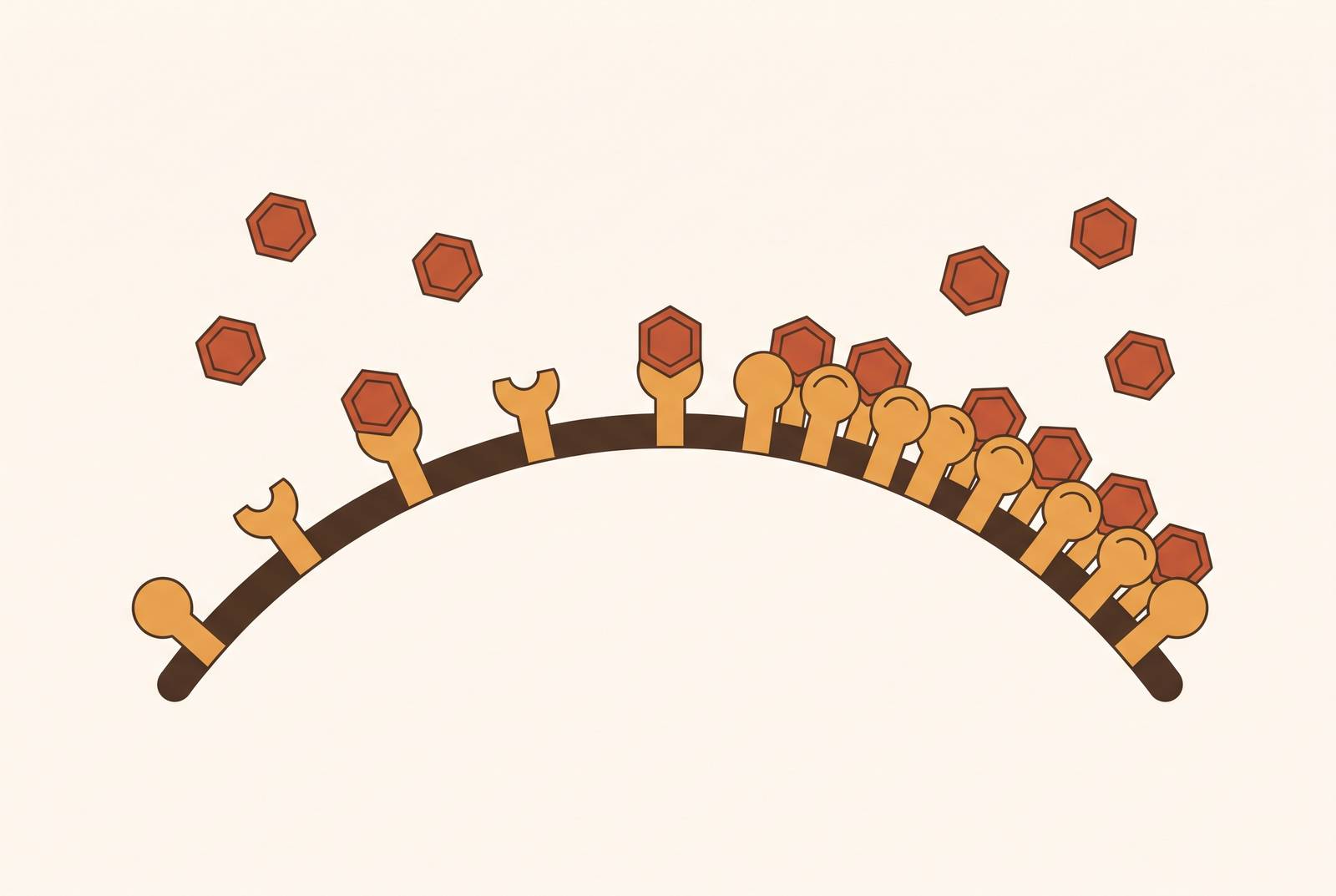
Caffeine does not generate energy, alertness, or focus. It borrows them, temporarily, from a debt the brain was already keeping track of. Over the course of a waking day, a molecule called adenosine builds up in the brain as a natural byproduct of cellular activity. When adenosine binds to A1 and A2A receptors, the brain registers that buildup as drowsiness: it's the signal that tells you it's time to rest. Caffeine's shape is close enough to adenosine's that it can slot into those same receptor sites, but it doesn't activate them. It occupies the parking spot but doesn't turn the engine on, so the tiredness signal gets blocked instead of switched off. This isn't a theoretical model built from indirect measures. PET imaging of living human brains has shown caffeine directly occupying cerebral A1 adenosine receptors, confirming the mechanism in actual brain tissue. The adenosine itself doesn't disappear while caffeine sits on its receptors. It keeps building in the background, and when the caffeine clears, the backlog is still there waiting to bind. A crash after the effect wears off tends to scale with how long and how strongly caffeine was blocking the signal. Every subsequent claim about tolerance, withdrawal, and alternatives in this piece rests on that single fact: caffeine operates on borrowed time.
The brain's physical response to daily caffeine use
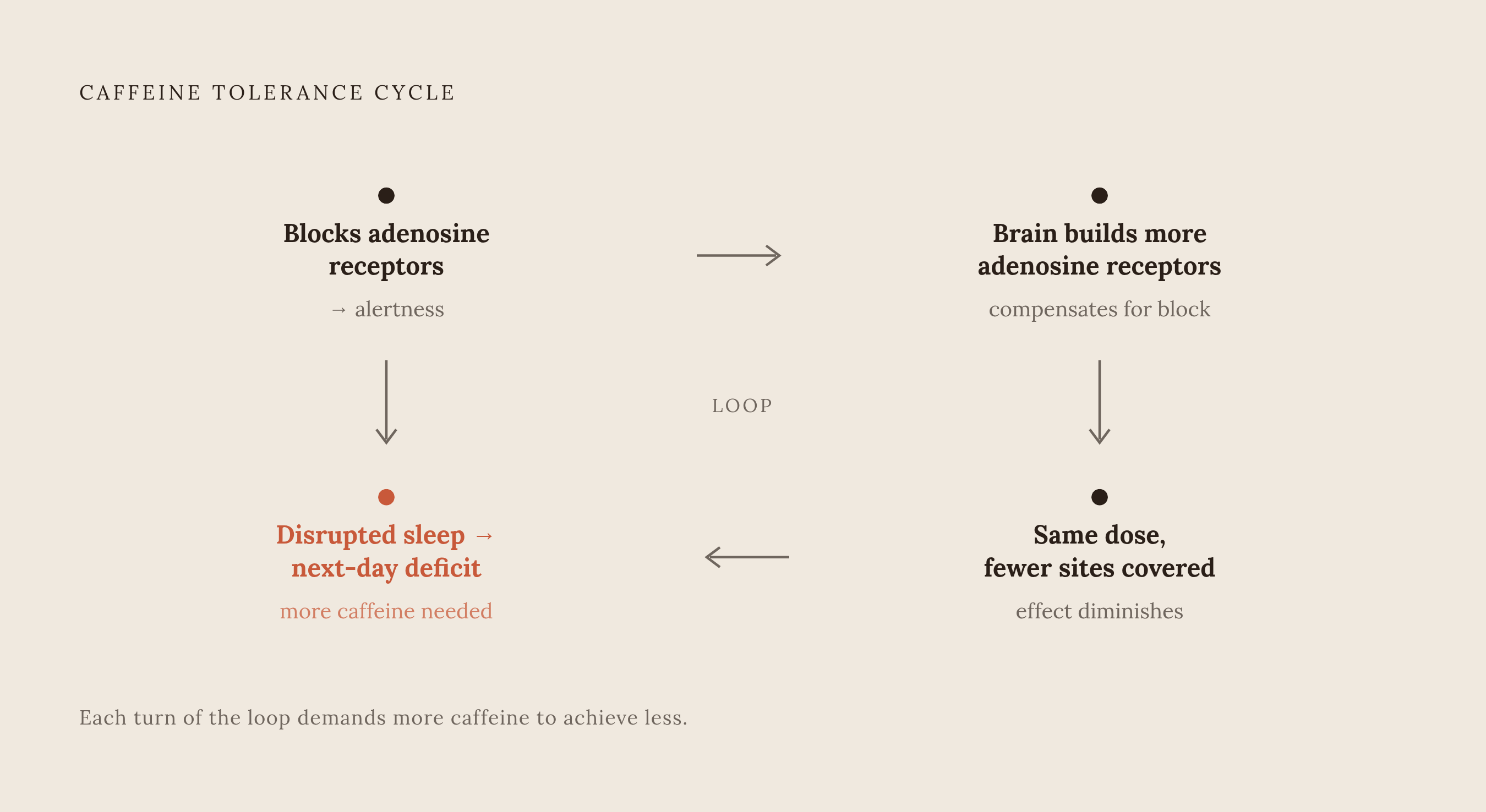
The brain does not sit passively while its adenosine signal gets blocked day after day. It responds by building more receptors, a process called upregulation, in an attempt to restore the adenosine signaling that caffeine keeps interrupting. The practical consequence is straightforward: once the receptor population expands, the same dose of caffeine now covers a smaller share of the total sites available, so its blocking effect shrinks and a larger dose is needed to produce the effect a smaller one used to deliver. This is not limited to the adenosine system alone. Research published in Cellular and Molecular Neurobiology, using animal models, found that chronic caffeine exposure alters the density of adenosine, adrenergic, cholinergic, GABA, and serotonin receptors, along with calcium channels, in the mouse brain. Adenosine remains the headline system, but the neuroadaptation caffeine triggers runs wider than a single receptor class, and it reaches into several of the brain's major signaling networks at once. Separate research on the biochemical mechanism behind caffeine tolerance ties sustained, heavy coffee intake to this upregulation of adenosine receptors, and gene-expression studies cited in receptor-level analysis link the adaptation to changes in gene expression within specific brain regions. The rewiring goes down to how brain cells read their own genetic instructions, as well as how many receptors sit on their surface.
The strongest scientific challenge to this account deserves to be stated directly rather than waved past. Holtzman and colleagues measured the number and binding affinity of adenosine receptors in the cerebral cortex of rats in a 1991 study, and they found no measurable difference between caffeine-treated animals and untreated controls. Their conclusion was direct: receptor upregulation does not explain tolerance to caffeine's locomotor-stimulant effects. Their reasoning rested on a defensible theoretical point: changes in receptor density, under standard competitive-antagonist models, should not by themselves alter how potent a blocking agent like caffeine remains, and their binding data held up that argument. That finding has held its place in the literature for over three decades and should be credited as genuine evidence, not dismissed as an outlier. The evidence that has accumulated since then doesn't erase the Holtzman result so much as surround it. Neuroadaptation to chronic caffeine touches dopamine, norepinephrine, and GABA systems in addition to adenosine, which makes caffeine tolerance a polygenic, multi-system process rather than a single receptor count. Holtzman's data narrow the role of just one adenosine-binding pathway in the cortex. They do not eliminate the broader adaptive picture built from adrenergic, cholinergic, serotonergic, and gene-expression evidence gathered since.
How quickly tolerance sets in
Tolerance to caffeine does not take months to build, and most daily drinkers have already adapted to their usual dose long before they notice anything has changed. Published analysis on the subject establishes that measurable tolerance can develop within days of starting regular use, a timeline far shorter than most casual coffee drinkers assume. A double-blind, placebo-controlled crossover study by Lara and colleagues, published in PLoS ONE in 2019, tracked exactly this process over 20 consecutive days of moderate daily caffeine intake. The performance benefit was there from day one, but its size shrank steadily as the trial went on: only partial tolerance developed, and caffeine kept producing a small-to-moderate ergogenic effect across the entire 20-day window. Translated into the rhythm of an ordinary morning, that pattern maps closely onto what long-term coffee drinkers already sense but rarely name directly: the first cup of a new routine feels sharp and distinct, and each cup after that over the following weeks nudges further toward simply feeling normal. By the time a user reaches full adaptation to their regular dose, the coffee or espresso in hand isn't lifting them above a baseline anymore; it holds off the deficit that would appear without it, restoring what now registers as neutral.
Tolerance doesn't arrive uniformly across every effect caffeine produces. Receptor-level analysis notes that different physiological responses to caffeine adapt at different speeds, so some ergogenic, performance-related benefits can persist longer than the subjective sense of alertness a cup used to deliver. The underlying direction is the same regardless of which effect is being measured: exposure pushes the brain toward adaptation, and adaptation pushes the felt effect back down toward baseline. The pace of that adaptation also depends on individual metabolism. People who metabolize caffeine slowly keep it circulating in the bloodstream longer, which tends to produce a more gradual adjustment, while fast metabolizers clear caffeine quickly and, in doing so, rebuild their receptor populations at a quicker pace.
Withdrawal headaches and brain fog as the same receptor story running backward
The headache, the fog, and the dragging fatigue that appear when caffeine gets skipped are not a separate problem from tolerance. They are the same upregulation story playing out in reverse. Once the adenosine receptor population has expanded to compensate for months or years of regular blocking, removing caffeine suddenly unblocks every one of those added sites at once. Adenosine, which has been building in the background the entire time, floods all of them simultaneously, and the result is drowsiness and mental fog well out of proportion to what adenosine alone would produce in a brain that had never adapted, along with the familiar dull headache that comes from the accompanying vasodilation. The severity of that withdrawal tracks directly with how much upregulation occurred in the first place, which means the heaviest daily drinkers, the ones whose receptor counts have expanded the most to keep pace with their intake, are the ones who feel the worst effects when a dose is missed or delayed.
That detail reframes what caffeine dependence actually is. Describing it as a bad habit or a failure of willpower misdiagnoses what's happening at the level of brain tissue. The receptor landscape has been physically restructured by months of repeated exposure, and the discomfort that follows withdrawal is a direct neurological consequence of that restructuring. Recognizing that distinction doesn't call for moral judgment about caffeine use. It calls for treating the mechanism as a structural fact that determines which solutions can realistically work and which ones are addressing the wrong layer of the problem.
The downstream cost to sleep and cognition that the tolerance loop quietly accumulates
The consequences of this cycle extend well past caffeine simply losing its kick. The same upregulation loop that drives tolerance also degrades the sleep and cognitive performance caffeine was originally brought in to support, which turns a minor inconvenience into a real cost. Caffeine taken late in the day delays the onset of sleep and fragments the structure of the sleep that follows, because the adenosine debt that caffeine suppressed during the day doesn't disappear. It still has to be processed, and the body has no mechanism to simply skip the sleep pressure that caffeine deferred earlier. Timing intake to align with the body's natural cortisol peak, well after waking rather than immediately on getting out of bed, reduces the risk of this kind of sleep disruption, and keeping intake confined to the earlier part of the day appears to slow the pace at which tolerance accelerates. You can trace that straight back to the receptor biology already laid out; it isn't a wellness habit floating free of mechanism.
Once sleep quality takes a hit, the cognitive deficit compounds instead of just persisting. Acute sleep deprivation raises negative emotional states, including anxiety, fatigue, confusion, and depression, and it produces measurable deficits in vigilance and impulse control, the very capacities caffeine is typically used to shore up. Evening caffeine's effect on cortisol adds another layer to the same cascade: elevated evening cortisol delays sleep onset and raises cortisol again the following day, setting up a stress-cognition loop that high performers are often especially exposed to, given that their baseline cortisol tends to run elevated to begin with. The full sequence runs in one direction: caffeine late in the day disrupts sleep, disrupted sleep produces a cognitive deficit the next morning, and that deficit gets answered with more caffeine, which deepens the same cycle on the next turn.
How to reset caffeine sensitivity
If upregulation is what caused tolerance in the first place, the fix follows directly from the same biology: downregulation, giving the brain enough time without adenosine blockade to dismantle the excess receptors it built up. That process is the mirror image of upregulation, and it runs on a timeline just as real as the one that built the tolerance. How that reset is carried out changes how it feels. Stopping caffeine outright brings on the most acute withdrawal, because every excess receptor gets unblocked at the same time, and adenosine floods the entire enlarged population all at once. Tapering down gradually instead lets receptor density fall in step with the dose, so the transition smooths out and the withdrawal response doesn't concentrate into a short window.
For anyone who wants to avoid rebuilding full tolerance in the first place, rather than repeatedly resetting from scratch after it's already set in, caffeine cycling offers a middle path grounded in the same biology. If you use caffeine on weekdays and abstain on weekends, for instance, the receptor population gets repeated partial windows to downregulate before the next round of daily use begins. That doesn't prevent adaptation entirely, and tolerance still builds over longer stretches of consistent use. It slows the rate at which it accumulates, which keeps the gap between a normal dose and a fully tolerant one from closing as quickly as it would under uninterrupted daily use.
Compounds that act outside the adenosine pathway
Everything established about caffeine's receptor biology points toward a clear conclusion: ingredients that support cognitive performance through pathways other than adenosine receptor blockade don't trigger the same upregulation loop, and several of them work directly against the cortisol and sleep disruption that the caffeine cycle creates. These aren't simply substitutes offered because caffeine has downsides. They are mechanistically distinct compounds.
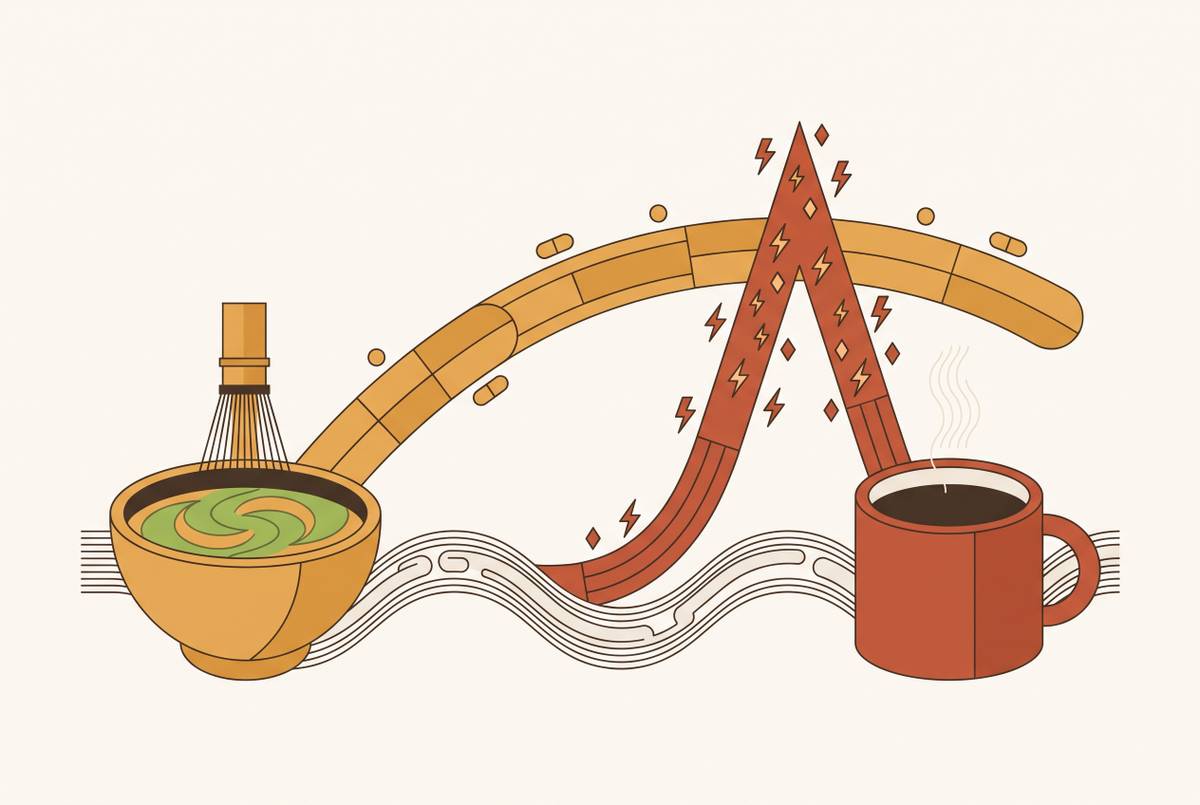
L-theanine illustrates the distinction cleanly. It modulates GABA and glutamate activity and shifts brain-wave activity toward alpha frequencies, and receptor-level analysis shows it builds tolerance slowly if at all, because it runs through a signaling channel the adenosine system doesn't govern. Paired with caffeine, L-theanine moderates the stimulant's sharper edges, so you get sustained alertness without the spike-and-crash pattern plain caffeine tends to deliver, without adding to the adenosine receptor burden that drives tolerance. A 2025 double-blind crossover study from the University of Peradeniya, published in the British Journal of Nutrition, tested a high-dose L-theanine-caffeine combination against neurobehavioral and neurophysiological measures of selective attention in acutely sleep-deprived young adults, and the pairing held up even in that compromised state. A 12-month randomized, double-blind, placebo-controlled trial by Uchida and colleagues, published in PLOS ONE in 2024, tested daily matcha in older adults with subjective cognitive decline or mild cognitive impairment and found significant improvement in social acuity sustained across the full year, an outcome that plain caffeine's tolerance curve would have erased within weeks.
Lion's Mane (Hericium erinaceus) works through an entirely different system: neurotrophin signaling rather than adenosine blockade. Its bioactive erinacines, as distinct from hericenones, which lack confirmed blood-brain barrier penetration, cross into the brain and promote synthesis of nerve growth factor, and human studies have recorded measurable cognitive and mood effects from this pathway. A 2025 randomized controlled trial (PMID: 40276537) found no significant effect on composite cognitive function or mood within hours of a single standardized dose in healthy younger adults, with only an isolated improvement showing up on a psychomotor pegboard task, a result worth reporting alongside the more favorable findings rather than in place of them. A separate trial in adults with mild cognitive impairment found cognitive scores declined four weeks after supplementation stopped, which points to a benefit that depends on continued use, a pattern that holds for any compound working through an active biological pathway, caffeine included.
Ashwagandha addresses a different arm of the same cascade described earlier: the cortisol side of the tolerance-sleep-stress loop. Its clinical evidence is strongest specifically for rehabilitation of the body's stress-hormone regulation in people with elevated cortisol and disrupted sleep, which describes precisely the population that chronic caffeine tolerance tends to create. A 2025 meta-analysis (PMID: 40746175) found that reductions in measured cortisol were not matched by significant improvement in perceived stress scores, showing that the biomarker and the subjective experience of stress can move independently of each other. Ashwagandha's clinical case is targeted toward that specific cortisol-disrupted population rather than a universal cognitive enhancer for every user.
Set against the receptor biology laid out across this piece, the pattern across these compounds is consistent: each works through a channel the adenosine system doesn't touch. None of them reproduce the upregulation loop that defines caffeine's long-term trajectory. Caffeine still works as an effective short-term tool for borrowing against the adenosine signal. Sustained cognitive performance, by contrast, depends on pathways that don't require that loan to be repaid.
Sources
- Role of adenosine receptors in caffeine tolerance (Journal Article)
- Biochemical mechanism of caffeine tolerance - PubMed
- Time course of tolerance to the performance benefits of caffeine
- Pathways and Mechanism of Caffeine Binding to Human Adenosine A2A Receptor
- The Stimulatory Action and the Development of Tolerance to Caffeine Is Associated with Alterations in Gene Expression in Specific Brain Regions
- Effects of Chronic Caffeine Consumption on Synaptic Function, Metabolism and Adenosine Modulation in Different Brain Areas
- Role of adenosine receptors in caffeine tolerance. - ScienceDirect