Caffeine Withdrawal Symptoms and Timeline in Regular Users
Caffeine withdrawal follows a predictable neurochemical timeline with peak symptoms around day two.
Caffeine withdrawal has a known mechanism and a known timeline, so it is not a random bout of bad luck that hits some quitters and spares others. The DSM-5 formally recognizes it, requiring three or more symptoms within 24 hours of cutting back on intake, which places it in the same category as other well-characterized withdrawal syndromes rather than in the realm of vague complaint. The headache, the fog, the irritability follow a receptor-level sequence that plays out the same way in habitual users generally. The discomfort can be anticipated and planned around rather than endured as a mystery. If you understand the adenosine dynamics behind the syndrome, the timeline stops feeling arbitrary, and you can read it like a map.
How chronic caffeine use rewires adenosine receptors and sets up withdrawal
Caffeine's main job in the brain is blocking adenosine, the neurotransmitter responsible for drowsiness and relaxation, at receptors concentrated in the cortex, basal ganglia, and brainstem arousal centers. Daily use does not leave that system alone. The brain responds to constant blockade by building more adenosine receptors to compensate, so habitual users need larger doses over time just to feel the alertness a single cup used to deliver. A 2025 review in ScienceDirect, titled "Neurobiology of chronic caffeine use and withdrawal: Mechanisms, effects and implications," lays out the same logic at a broader level: chronic use drives neuroadaptive changes that explain both the dependence and the withdrawal syndrome that follows it.
The problem appears the moment intake stops. All those extra receptors, built specifically to work around caffeine's blockade, are suddenly exposed to adenosine with nothing standing in the way. Drowsiness and discomfort signaling arrive all at once, at a volume the brain was not calibrated for the day before. The dopamine system compounds the effect. Caffeine normally raises dopamine release in the nucleus accumbens by removing adenosine's inhibitory brake on dopaminergic neurons, largely through adenosine-dopamine receptor interactions on striatal neurons, so when caffeine disappears, that dopamine boost disappears with it, and mood and motivation take the hit along with alertness.
None of this amounts to addiction in the clinical sense. Johns Hopkins researchers, as described by Manhattan Medical Arts, classify "caffeine use disorder" as a condition warranting further study rather than a standing diagnosis, so withdrawal symptoms on their own do not mean a person has a substance use problem. What they do mean is that the nervous system adapted to a daily input and now has to adapt back.
The hour-by-hour and day-by-day withdrawal timeline
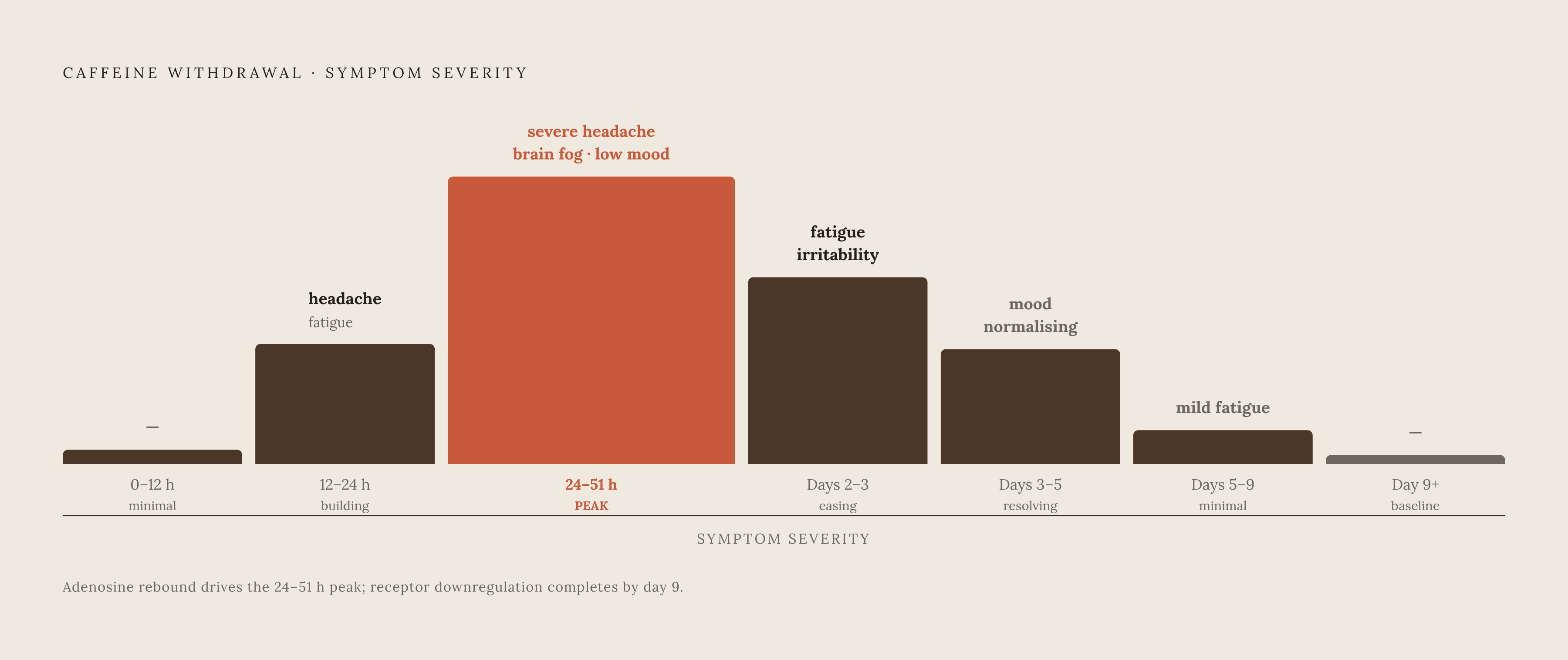
The clearest picture of how this plays out comes from a timeline published by Nectr, corroborated by Recovery Centers of America and by StatPearls. In hours 0–12 after the last dose, symptoms stay minimal, because caffeine takes hours to metabolize out, and adenosine receptors only start to rebound. Between hours 12 and 24, the headache typically begins, fatigue builds, and mild irritability sets in, driven by fully unblocked adenosine receptors, dilating blood vessels in the brain, and falling dopamine.
The peak arrives between hours 24 and 51: severe headache, significant fatigue, trouble concentrating, a depressed mood, and brain fog all converge, reflecting maximum adenosine rebound alongside a drop in norepinephrine. Days 2 and 3 bring some relief, though not full relief: the headache persists but eases, fatigue and irritability continue, muscle stiffness can appear, and the brain starts downregulating the excess receptors it built up. By days 3 through 5, the headache is resolving, fatigue is improving, mood is normalizing, and receptor counts and neurotransmitter balance are both moving back toward baseline. From days 5 through 9, symptoms stay minimal, and you might notice just an occasional mild stretch of fatigue while brain chemistry settles. Past day 9, neuroadaptation is typically complete and baseline energy is restored.
The headache deserves particular attention because of how mechanically direct it is. Chronic caffeine use keeps cerebral blood vessels constricted, and stopping triggers rapid vasodilation that activates pain receptors in the meninges, the membranes surrounding the brain. The connection is tight enough that researchers can reliably induce the same headache in a lab simply by swapping a habitual user's usual dose for a placebo.
How hard any of this hits depends heavily on how much caffeine someone was taking. Recovery Centers of America notes that most people consuming more than 100 mg daily develop some degree of physical dependence, while those above 300 mg daily face a more severe withdrawal course. Adolescents, students, and shift workers often fall into that heavier-use bracket, and when they also run irregular sleep schedules, the combination deepens both the dependence and the withdrawal that follows it.
Cognitive performance during the peak withdrawal window
The mental fog that shows up during peak withdrawal is a specific drop in dopamine and norepinephrine activity below a person's normal baseline, and those two neurotransmitters support sustained attention and executive function. That is why multitasking and complex problem-solving get disproportionately hard during this window, well beyond simple sleepiness.
A randomized, double-blind, placebo-controlled crossover trial published in Nature Scientific Reports in 2023 tested this directly, comparing reaction times on working memory tasks across caffeine, placebo, and withdrawal conditions. Reaction times were longer in the withdrawal condition than in either the placebo or caffeine condition. A separate crossover study found acute caffeine withdrawal impaired cognitive performance, worsened headache, and reduced alertness, and in that same study, caffeine did not push performance above an ordinary baseline. It only stopped performance from deteriorating further in people who were already withdrawn.
That finding supports what researchers call the withdrawal hypothesis: the mental lift many coffee drinkers attribute to their daily cup is largely the restoration of a baseline that caffeine dependence had depressed in the first place, not a genuine boost above normal function. It reframes the entire habit. The jolt from a morning cup may not make you sharper so much as undo the deficit caffeine itself created overnight.
StatPearls notes that this functional impairment can meaningfully affect your work, school, and social activities for several days, but it is self-limited and resolves on its own. For anyone managing a demanding work week, it can be scheduled around rather than discovered the hard way in the middle of an important deadline.
How withdrawal disrupts sleep before sleep improves
Quitting caffeine produces a strange early effect: sleep gets worse before it gets better, even though the person quitting is often more tired than usual. The same flood of unblocked adenosine that drives your daytime fatigue also knocks your homeostatic sleep drive out of its normal rhythm, so in the first few days you can feel excessive daytime drowsiness alongside real trouble falling asleep at night.
Chronic caffeine use delays the normal promotion of REM sleep by disrupting the usual back-and-forth between non-REM and REM cycles. When intake stops, the same hypersensitive, adenosine-flooded receptors that drive daytime symptoms also leave sleep architecture in an unstable state before it can reset. That instability explains why the first nights after quitting can feel wrong in a way that plain exhaustion doesn't fully account for.
The recovery happens in stages rather than all at once. Around days 4 and 5, adenosine receptor density starts normalizing, and this is typically when you notice your first real improvement in sleep quality, as melatonin timing gradually stabilizes too. By around the two-week mark, sleep architecture continues improving for most people, though the research here carries some nuance: peer-reviewed studies indicate REM sleep changes can reverse within days of stopping caffeine, and controlled studies find that caffeine and its cessation have little effect on circadian amplitude overall.
Neither sustained heavy use nor an abrupt stop offers a clean path through, since habitual caffeine use that suppresses REM sleep already degrades daytime memory consolidation, and withdrawal temporarily degrades focus as well, a genuine catch-22. That tension is what makes a managed taper the more defensible approach, leading into the question of how to quit without concentrating all of this damage into one bad week.
Why tapering is mechanistically superior to abrupt cessation
Everything established so far points to the same conclusion: gradual reduction, not sudden cessation, is how to avoid the worst of this syndrome. Receptor upregulation took time to build up in the first place, so receptor downregulation needs time too, and quitting all at once short-circuits that process and concentrates the full adaptation burden into the peak window.
Nectr's timeline lays out a practical version: cut intake by roughly a quarter every few days, a pace slow enough that the brain can start downregulating excess receptors before the next reduction hits.
Executing a taper accurately depends on knowing actual milligram intake rather than guessing by cup count, since cup size and strength vary enormously. Tapering matters most if you drink more than 300 mg daily, if you face high psychosocial stress or work irregular schedules (both raise dependence and withdrawal severity), or if your job can't absorb several days of impaired focus. The logic here works the same way, just applied on purpose instead of left to chance.
Exercise, Sleep Strategy, and Targeted Ingredients for the Acute Window
The most effective tools during acute withdrawal work because they engage the same neurotransmitter systems the withdrawal itself disrupts.
Exercise can stand in for some of what caffeine normally gives you. The mechanism lines up with what's already been established: aerobic exercise acutely raises dopamine and norepinephrine, partially replacing the neurotransmitter support that withdrawal removes. So a workout during the peak window protects your productivity; it isn't just a wellness suggestion tacked on at the end.
Sleep timing matters just as much. Because early withdrawal disrupts sleep in this paradoxical way, if you keep consistent sleep and wake times, even while the homeostatic drive feels off, you anchor circadian timing and speed up the normalization of melatonin synthesis. Avoiding other stimulants during a taper also protects the receptor downregulation process already underway, rather than resetting the clock on it.
A few specific ingredients have evidence behind them: they can sustain cognitive function without restarting caffeine dependence. If you pair L-theanine with low-dose caffeine, brain wave patterns shift within under an hour, and the pairing smooths out caffeine's dopaminergic effect, reducing the steep drop-off that drives withdrawal severity, so this combination suits tapering rather than quitting outright. Rhodiola rosea has data behind it too: a randomized, double-blind study in Phytomedicine found significant reductions in mental fatigue, along with improved associative thinking, short-term memory, and calculation ability, in medical students during exam periods, using a dose standardized to specific concentrations of rosavins and salidroside, useful during the transition window when cognitive demands stay high. Bacopa monnieri supports cognitive performance and memory, including in people who already test high on cognitive measures, mainly by reducing distractibility, but it takes 8 to 12 weeks of daily use to take effect, making it a long-term addition rather than something to reach for during an acute withdrawal week.
Taken together, the exercise, the sleep anchoring, and the ingredient choices all follow from the same receptor-level story told throughout this piece: withdrawal is a predictable neurochemical event, and the tools that help are the ones that address the actual deficit rather than mask it.
Sources
- Caffeine Withdrawal: Symptoms, Timeline, Recovery Tips & Long-Term Benefits
- Caffeine Withdrawal
- Caffeine Withdrawal - StatPearls - NCBI Bookshelf
- How Long Does Caffeine Withdrawal Last? Timeline and Relief
- Neurobiology of chronic caffeine use and withdrawal: Mechanisms, effects and implications - ScienceDirect
- Effects of caffeine and caffeine withdrawal on mood and cognitive performance degraded by sleep restriction - PubMed