Matcha vs Coffee Caffeine Pharmacokinetics
L-theanine in matcha smooths caffeine's effects where coffee delivers an unmodulated spike.
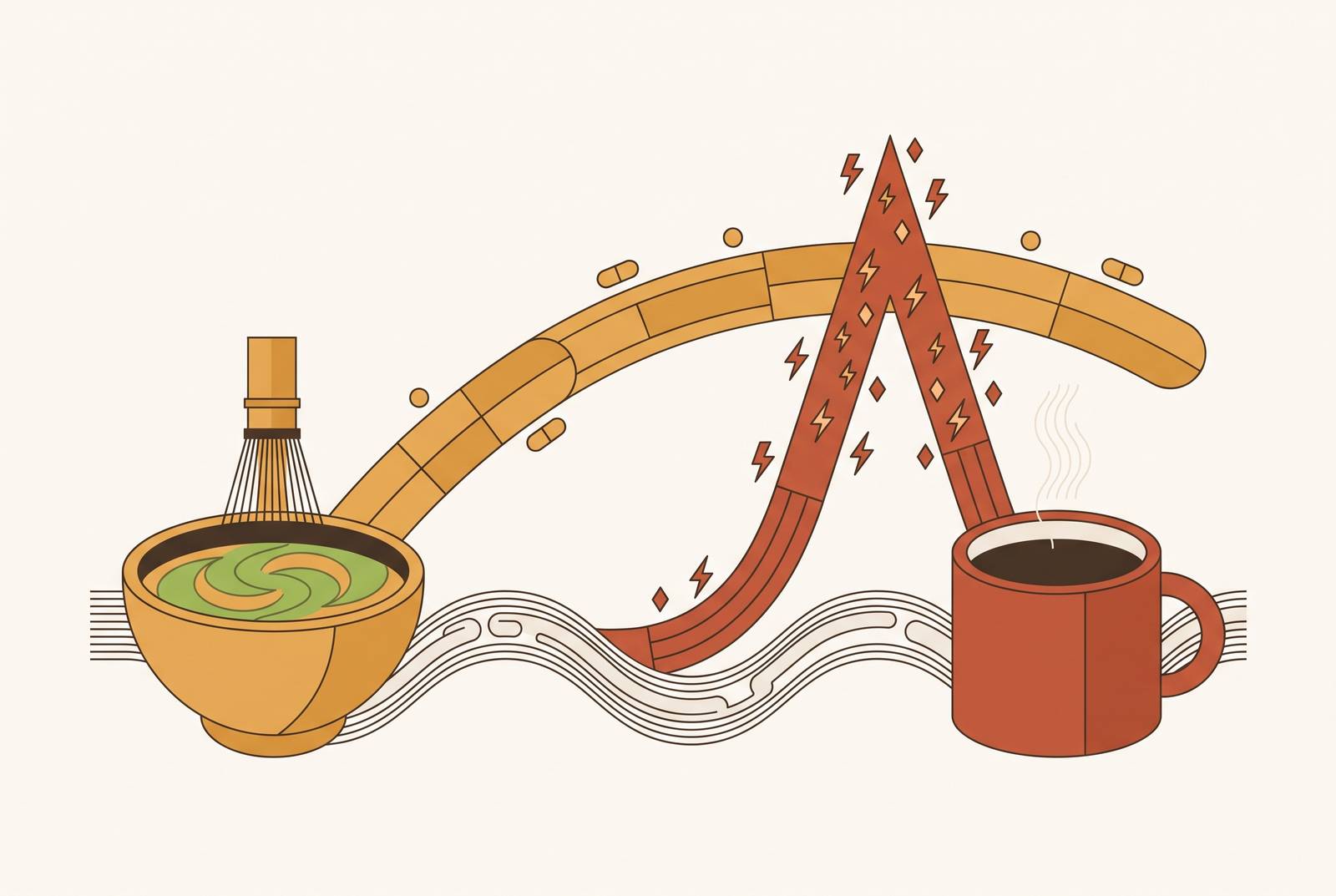
Matcha and coffee can deliver nearly identical doses of caffeine, yet the two drinks produce noticeably different experiences in the body and mind. That gap is the subject of this piece, and dose is not where the explanation lives.
Most people treat matcha as the gentle alternative, the drink recommended to anyone who gets jittery on coffee or wants to taper off espresso while keeping some caffeine. That framing has earned a label from Steadymatcha's caffeine reference, which calls it "mostly a myth". Matcha drinkers consume the whole powdered leaf rather than a steeped infusion that gets discarded, and a 2 g ceremonial serving delivers roughly 70 mg of caffeine, a number that sits comfortably next to a single espresso shot at approximately 63 mg. A strong bowl of matcha, in other words, belongs in espresso range, not in the soft-stimulant category most people assume it occupies.
Lay the numbers out together and the overlap becomes harder to ignore. FDA guidance cited by Steadymatcha puts an 8 oz serving of drip coffee at a substantial dose of caffeine. Mayo Clinic figures put a single 1 oz espresso shot at a meaningful dose on its own. A 2 g ceremonial matcha serving runs roughly 38 to 68 mg, often landing at 60 to 70 mg, based on USDA FoodData Central figures cited by both Steadymatcha and Matcha Tower. Steeped green tea, by contrast, runs approximately 20 to 45 mg, a much lower range that reflects the fact that the leaf itself gets thrown away after steeping while matcha drinkers consume it whole.
So the question the rest of this piece has to answer is simple: if the caffeine ranges overlap this much, why does a cup of matcha feel so different from a cup of coffee? The answer sits not in the caffeine but in what matcha carries alongside its caffeine that coffee never does.
What L-theanine is and why coffee has none of it
The compound responsible for that difference is an amino acid called L-theanine, found almost exclusively in the tea plant. Its presence in matcha and its total absence in coffee amount to the single structural difference that determines how each beverage's caffeine actually behaves once it enters the body.
Matcha carries as much L-theanine as it does partly because of how the plant is grown. Shade-growing the tea plant before harvest stresses it, and that stress upregulates the synthesis of both caffeine and L-theanine. Ceremonial-grade matcha, which is shaded longer than lower grades before picking, ends up at the higher end of the L-theanine range as a result. Steadymatcha's review of published quantification studies places L-theanine content at roughly 5 to 46 mg per gram of matcha powder, with shade-grown ceremonial grades consistently topping that range.
Coffee has none of this. The coffee plant simply does not produce L-theanine, so every cup of coffee, regardless of bean origin, roast level, or brew method, delivers its caffeine with nothing to modulate it. It's a basic property of the plant itself, which never synthesizes the compound in the first place.
L-theanine is an amino acid found almost exclusively in the tea plant, and its presence in matcha and total absence in coffee is the single structural difference that makes the two beverages' caffeine behave differently. Matcha Tower's figures put the ratio for ceremonial matcha at roughly 1.5 parts caffeine to 1 part theanine. For coffee and espresso, there is no ratio to speak of in any meaningful sense, because theanine is zero and caffeine acts alone. That framing matters because it points toward how L-theanine actually works once it's in the system. The right way to think about L-theanine's role is synergy with caffeine, not subtraction from it.
How Caffeine Reaches the Brain
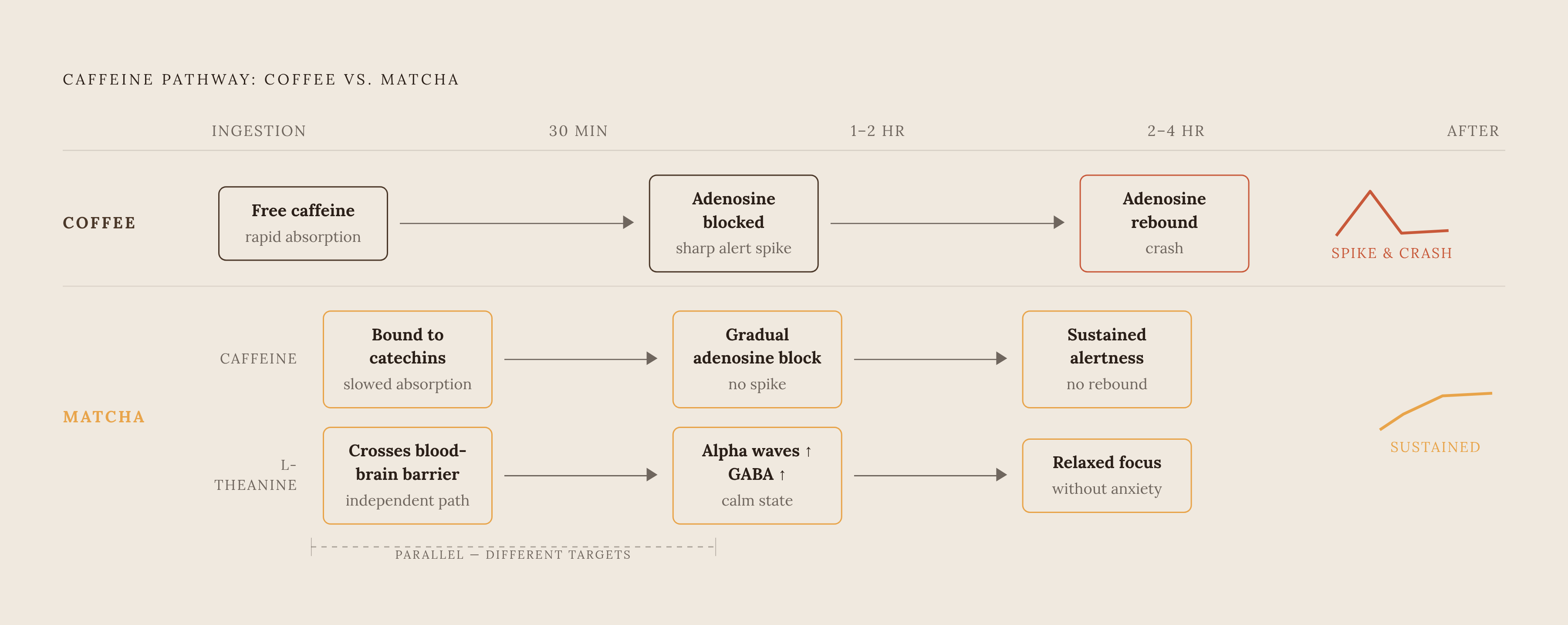
Caffeine's effects begin with a straightforward piece of neurochemistry: it blocks adenosine receptors in dopamine-rich areas of the brain, suppressing the signals that would otherwise tell the body it's getting drowsy, while also stimulating dopaminergic activity and increasing norepinephrine activity, which drives wakefulness and attention. In coffee, this process runs unopposed. With no L-theanine present to modulate the signal, caffeine from coffee arrives as a single, unmodified spike, producing a full cortisol and adrenaline response within approximately 30 minutes. Caffeine's half-life in adults spans several hours, but the subjective peak that people actually feel is considerably shorter, and it is typically followed by a noticeable drop in alertness. As the caffeine clears from the system, the adenosine that had been held back by receptor blockade rebounds, and that rebound is the mechanism behind the familiar fatigue wall that follows a cup of coffee a few hours after drinking it.
Matcha's caffeine takes a different route into the body before it ever reaches the brain. Because the caffeine in matcha is bound to catechin molecules present in the whole-leaf powder, its absorption through the digestive tract is slowed, producing what amounts to a delayed release rather than a rapid flood. The onset of matcha's effects is measurably slower than coffee's across multiple independent sources.
Once that caffeine does reach the brain, something else is happening at the same time that never occurs with coffee. L-theanine crosses the blood-brain barrier on its own, independent of caffeine's pathway, and increases alpha brain wave activity, the specific brain state associated with relaxed, meditative alertness rather than jittery stimulation. L-theanine also promotes activity along GABA pathways, which are associated with calmness. These two processes, caffeine's adenosine blockade and L-theanine's alpha-wave elevation, are not competing for control of the nervous system. They are complementary mechanisms acting on different targets at the same time: caffeine suppresses drowsiness signals while L-theanine promotes calm focus, and the two run in parallel rather than in opposition.
The practical result of these two processes running together is a different shape of energy over time. Matcha's gradual absorption combined with L-theanine's modulation produces a sustained energy curve, in contrast to coffee's sharper spike followed by a crash. That description deserves one honest qualification. Steadymatcha notes that this "longer smoother curve" is consistent with what is known about L-theanine's pharmacology and matches what a large number of users report experiencing, but it functions more as a widely reported experience than as a single physiological endpoint that has been measured and published with precision. The mechanism gives a clear reason to expect a smoother curve. Whether controlled research on cognitive performance actually bears that expectation out is the next question.
What controlled trials show about the L-theanine and caffeine combination on cognitive performance
Controlled human trials consistently find that pairing L-theanine with caffeine improves specific outcomes, particularly sustained attention and task-switching accuracy, in ways that neither compound achieves alone.
The clearest demonstration of this synergy comes from Haskell et al. (2008), a randomized, double-blind, placebo-controlled crossover trial. Taken together, L-theanine and caffeine improved speed and accuracy on attention-demanding tasks and reduced self-reported tiredness while increasing alertness. L-theanine administered alone told a different story: it produced little measurable benefit and, in some cases, actual decrements, including higher headache ratings and lower scores on serial subtraction tasks. Only when combined with caffeine did L-theanine's contribution turn into a net positive, a pattern that supports the synergy argument rather than a simple additive one.
Owen et al. (2008) reinforces the same pattern from a different angle. The combination improved both speed and accuracy on an attention-switching task and reduced how susceptible subjects were to distracting information during a memory task, compared against placebo. Caffeine alone also improved attention-switching accuracy at the 90-minute mark, which suggests caffeine carries real standalone value on this particular measure, even as the combination outperforms it on others.
Giesbrecht et al., publishing in Nutritional Neuroscience, with a sample of 44 participants, found that the combination significantly improved accuracy during task switching along with self-reported alertness, and reduced self-reported tiredness. That same study found no significant effects on visual search, choice reaction times, or mental rotation tasks, a pattern that points toward a combination that sharpens focus during demanding cognitive work rather than one that improves every cognitive domain uniformly.
More recent research extends these findings into physical performance contexts. A 2025 randomized controlled trial on elite wrestlers, led by Razazan and published in the Journal of the International Society of Sports Nutrition, found that co-supplementation with moderate doses of caffeine and L-theanine enhanced both physical and cognitive performance more effectively than either supplement taken alone, with particular improvement in attention and reaction time under conditions of fatigue. A 2025 meta-analysis examining L-theanine against placebo found a small-to-moderate difference favoring L-theanine on choice reaction time within the first hour after intake, though the overall result also included findings of little-to-no difference depending on the study, along with dose-dependent effects on rapid visual information processing during the second hour.
Taken as a whole, the evidence supports a fairly specific claim rather than a sweeping one. A systematic review concluded that the combination is likely a safe and effective cognitive enhancer, with favorable results across attention, memory, and broader cognition measures, while noting that effect sizes in healthy populations remain reliably modest rather than dramatic. The benefits concentrate in sustained attention, task-switching accuracy, and reductions in subjective tiredness, not across every cognitive domain researchers have tested.
Two caveats deserve direct statement rather than a passing mention. One frequently cited study on anxiety reduction used a purified 200 mg dose of L-theanine, a figure that runs five to seven times higher than the amount of L-theanine in a single bowl of matcha. Claims that a cup of matcha calms anxiety are stretching a small, high-dose laboratory finding well past what an actual serving of tea delivers. Separately, acute administration of L-theanine produces measurable short-term benefits for attention and relaxation in healthy adults, but studies examining chronic, repeated dosing have not shown improved cognitive function over time, the Alzheimer's Drug Discovery Foundation notes. The mechanism described in the previous section is real and the acute trial data back it up, but neither should get oversold into a claim about long-term brain benefit that the research doesn't currently support.
Where Coffee Has the Genuine Advantage
None of this mechanism argument makes coffee the lesser beverage. Coffee's rapid absorption, the same property that produces its sharper crash later on, is what makes it superior for acute, time-sensitive alertness. When caffeine needs to act fast, whether before an early meeting, a workout, or a task that demands an immediate jolt of focus, coffee's faster onset delivers that jolt more reliably than matcha's catechin-slowed release ever will. Espresso in particular compresses this advantage into a small, concentrated dose, an efficient way to get a meaningful amount of caffeine into the bloodstream quickly without drinking a large volume of liquid.
The trade-off is the same one described in the mechanism section: caffeine's adenosine-blocking effect wears off, adenosine rebounds, and the resulting drop is a predictable consequence of how coffee's caffeine arrives unmodulated. For a single burst of alertness, that later drop is an acceptable cost. For work that stretches across a full day, or across several consecutive days of reliance on the same mechanism, the repeated cycle of sharp peak followed by sharp decline becomes the pattern working against the user rather than for them. Each crash creates pressure toward another dose, and each subsequent dose arrives on top of a nervous system that has not fully cleared the adenosine buildup from the one before it.
This is the honest shape of the comparison. Neither pattern is a flaw to correct. Each is a predictable consequence of what the beverage actually contains, and the right choice between them depends on what kind of cognitive work the next few hours actually demand.
Sources
- Matcha vs Coffee: Which is Better for Focus and Energy
- Matcha vs Coffee: Which Is Better for Energy, Focus, and Health? - Senbird Tea
- Matcha vs Coffee Caffeine: Head-to-Head Comparison
- Matcha vs Coffee Caffeine: How They Actually Compare
- Caffeine in Matcha — Content and Absorption — Matcha Tower
- L-Theanine Cognitive Vitality For Researchers