Panax Ginseng Cognitive Effects Compared to American Ginseng
Asian ginseng sharpens memory recall while American ginseng boosts working memory and focus.

A consumer who picks up a bottle labeled "ginseng" off a shelf has almost no way of knowing which of two distinct plants is inside, and that ambiguity has real consequences for what the supplement will and won't do for cognitive performance. Panax ginseng, often called Asian ginseng, and Panax quinquefolius, or American ginseng, are frequently marketed as though they were the same substance with the same effects, but they are not. Traditional Chinese medicine drew a behavioral distinction between the two plants long before modern pharmacology had the tools to explain why, and the current blurring of that line in supplement marketing is a recent, commercial development rather than a historical one. What follows is an explanation of why that's true, and how to use it.
Ginsenoside ratios and their effect on ginseng extracts
Ginsenosides are the active compound class responsible for ginseng's effects on the brain, a group of triterpene saponins believed to influence neurotransmitter signaling, neuroinflammation, synaptic plasticity, and cholinergic function. The important detail is that ginsenosides are not a single uniform substance. Individual members of this compound class differ substantially in how well the body absorbs and uses them. Two extracts can report identical total ginsenoside content on their labels and still behave in completely different ways, depending on which specific ginsenosides make up that total. The review also surfaced a quality signal that matters enormously for anyone shopping for a supplement: studies that used ginseng extracts without specifying which ginsenosides the extract actually contained failed to report cognitive benefits at all. Standardization is the condition under which the science holds. That said, the exact mechanisms driving these cognitive effects in humans are still being worked out, and findings from cell and animal studies do not automatically carry over into firm guidance for people.
How Panax ginseng acts on the brain
Panax ginseng's ginsenoside profile engages several neurotransmitter systems at once, including acetylcholine, serotonin, dopamine, and glutamate, and this multi-pathway action is thought to support synaptic plasticity, neuronal communication, and the formation of memory. That distinction matters. P. ginseng's strongest evidence is for getting recall right, not for making someone faster or more alert, and the review even found a speed-accuracy trade-off at certain doses, meaning gains in accuracy sometimes came paired with a cost in response speed. That kind of nuance shows the evidence cuts both ways rather than pointing in one clean direction. The single most robust acute result in the review followed a 400 mg dose of the standardized G115 extract, a formulation that has anchored much of the clinical work on this species. Four studies included chronic assessment, ranging from a few days to 12 weeks, three of which combined acute and chronic assessments in the same design. Both short-term and sustained use have real evidence behind them for P. ginseng, even if the chronic evidence base is thinner than the acute one. This review covered non-clinical populations, so the memory benefit documented here applies to healthy adults looking for a short-term boost in recall accuracy, not to the treatment of diagnosed memory impairment.
How American ginseng outperforms its Asian counterpart
American ginseng's distinct ginsenoside profile shifts its primary cognitive action toward attentional processing and working memory, the executive functions behind multitasking, decision-making under pressure, and sustained focus. Bell and colleagues (2026, Nutritional Neuroscience) identify the mechanisms behind this advantage: greater activation of frontoparietal neural circuits, changes to the composition of the gut microbiome by way of the gut-brain axis, and effects consistent with cholinergic modulation. The gut-brain axis finding deserves a caveat. It's an emerging line of mechanistic evidence rather than an established, well-mapped pathway, and it should be read as a promising direction for future study rather than settled fact.
The clearest single piece of evidence behind this claim comes from the Cereboost trial, a randomized, double-blind, placebo-controlled crossover study of 32 healthy young adults. The crossover design means each participant served as their own control across conditions, which strengthens confidence in the result. Researchers tested three doses, 100, 200, and 400 mg, of a P. quinquefolius extract standardized to a defined ginsenoside content, and found a robust enhancement of working memory following administration. American ginseng has drawn considerably less research attention overall than P. ginseng, and only three of the studies in the 2026 systematic review used standardized American ginseng extracts. The evidence base is smaller, but the signal within it, favoring attention and working memory, has been consistent across the trials that exist.
Standardization as the dividing line for whether a ginseng supplement works
Everything described so far, the memory gains from P. ginseng, the working memory and attention gains from P. quinquefolius, depends on one condition holding true: the extract has to be standardized and its ginsenoside content has to be disclosed. The 2026 Scholey review makes this link explicit. Studies that used ginseng extracts without specifying their ginsenoside constituents did not report cognitive benefits, so label transparency about ginsenoside content directly affects whether an effect appears in the data. Species alone cannot tell a buyer what a product does. Differences in extract composition, dose, and ginsenoside profile all complicate any comparison between products, and a genus name on a label carries almost no information without these specifics attached. Clinical trials that produced reliable results commonly used doses in the range of 200 to 400 mg of standardized extract, and doses outside that range, or products that don't state their standardization at all, have produced inconsistent findings. This connects back to the bioavailability point raised earlier: a high total ginsenoside count on a label guarantees nothing about whether the specific, cognitively active compounds are present in meaningful, absorbable amounts. None of this favors one species over the other. A standardized P. ginseng extract aimed at memory and a standardized P. quinquefolius extract aimed at working memory are both defensible choices built on real evidence. An unstandardized product sold simply as "ginseng," with no disclosed ginsenoside content, is not a defensible choice under either species. Learning to check a label for that single detail, standardized ginsenoside content, is the practical skill this entire body of research points toward.
Choosing the right ginseng for the goal: a decision framework based on the evidence
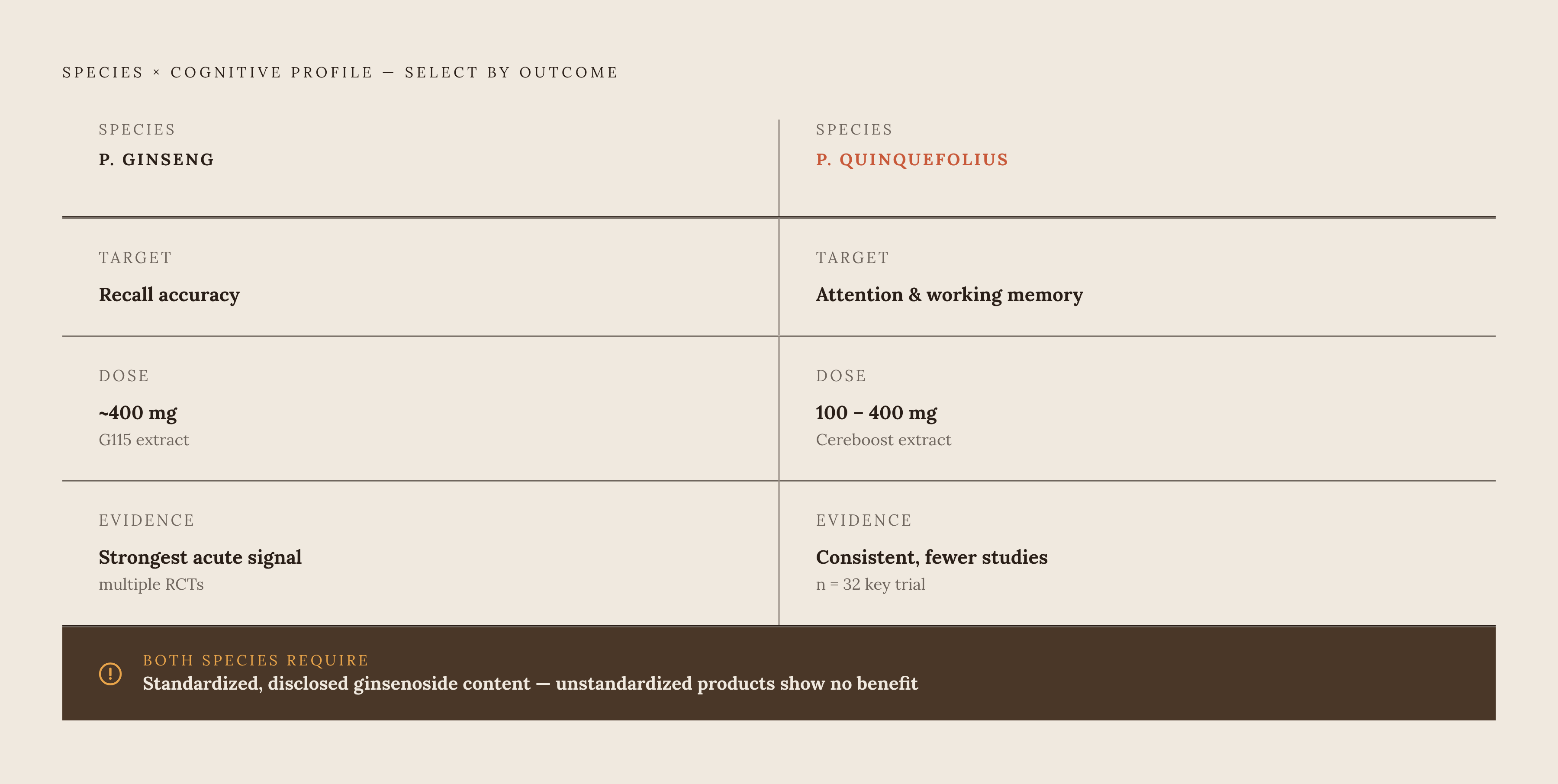
The framework starts with naming the target. Someone focused on recall accuracy, the sort of memory task that depends on retrieving specific details correctly, should look toward P. ginseng, and the evidence points specifically to standardized extracts at around 400 mg. Someone whose goal centers on attention and working memory, the mental bandwidth behind multitasking, holding several things in mind at once, and making decisions under load, should look toward P. quinquefolius, dosed in the 100 to 400 mg range of a standardized extract.
Timing is the next variable in the framework. Both species have supporting evidence in acute settings, a single dose taken before a specific cognitive demand, and in chronic settings extending out to 12 weeks of regular use. The acute evidence is the stronger and better-established of the two, so someone weighing when to expect results should treat the single-dose effect as the more reliable one, with sustained use as a secondary, less thoroughly tested benefit. The final check in the framework is population match: this entire evidence base concerns healthy adults, and stretching its conclusions to cover clinical conditions or extreme performance states such as severe fatigue or active illness goes beyond what the randomized trials actually tested.
A natural objection follows from the shared mechanisms described earlier: if both species act on overlapping neurotransmitter systems, does the species choice actually matter, or would any available ginseng do? The systematic review data answer this directly. The cognitive profiles of the two species do not overlap cleanly. P. quinquefolius produced attentional and working memory effects that P. ginseng did not match with the same consistency, and P. ginseng produced secondary memory effects that P. quinquefolius did not match with the same consistency. Traditional Chinese medicine already differentiated the behavioral effects of the two species long before modern pharmacology confirmed the distinction, with the conflation of the two as recent and commercial.
Ginseng's place in the broader stack of cognitive ingredients
Ginseng, in either form, addresses neurotransmitter modulation and, in the case of P. quinquefolius, working memory on a fairly immediate timescale. A complete approach to cognitive support needs more than that single lever. It needs something to handle the cortisol load that chronic stress and sustained high performance generate, and something to support neuroplasticity over a longer stretch of weeks, neither of which ginseng directly addresses.
Ashwagandha's best-documented benefit is lowering cortisol, and chronically elevated cortisol is itself a known driver of impaired memory, weakened focus, and mood disruption. It also carries a secondary benefit for sleep quality, and better sleep supports the overnight consolidation of memory, a mechanism ginseng does not reach. Rhodiola Rosea works on serotonin and dopamine and helps balance cortisol release, supporting mental stamina and resilience under stress in a way that complements ginseng's neurotransmitter effects rather than duplicating them. L-theanine acts within about an hour, and research on the combination of caffeine and L-theanine shows it sharpens attention while keeping the mental state calmer and more sustained than caffeine alone, in part by reducing jitteriness through upregulation of alpha brain waves. This gives it a role as the fast-acting complement to ginseng's slower memory and attention effects.
Lion's Mane, or Hericium erinaceus, is at the opposite end of the timescale. It's a chronic nootropic whose effects build over eight to twelve weeks through nerve growth factor-mediated neuroplasticity, and preclinical work suggests it may raise nerve growth factor levels in the body. No one should expect an acute effect from Lion's Mane. Its value lies in the long-arc neuroplasticity support that ginseng, built for shorter-term action, does not provide. One quality caveat applies here just as it does to ginseng: mycelium-based Lion's Mane products often contain a large share of grain starch filler and considerably less of the active beta-glucan content than their labels imply, so the same standardization scrutiny buyers apply to ginseng belongs here too.
Bacopa Monnieri has evidence in a narrower population. One clinical study of older adults with mild cognitive impairment found improvement in attention and verbal fluency after roughly two months of oral extract use, while the evidence in healthy adults without impairment is mixed. It is a useful tool for the right population rather than a universal addition to every stack.
Timing governs how these ingredients fit together. L-theanine takes effect within an hour, and both Rhodiola and ginseng are best taken in the morning. Bacopa should be taken with fat to aid absorption. Lion's Mane and Bacopa each require eight to twelve weeks of consistent daily use before their neuroplasticity-level effects emerge, and cycling protocols, such as weekdays on with weekends off, or eight weeks on followed by one week off, are recommended for adaptogens to prevent tolerance. Ginseng, understood through the specific lens of its ginsenoside profile, occupies a well-defined place in that structure: a precise tool for memory accuracy or working memory, built to be paired with ingredients that cover the stress load and the slower neural rebuilding it was never designed to touch.
Sources
- Effects of American ginseng (Panax quinquefolius) extract on human neurocognitive function: a review: Nutritional Neuroscience: Vol 29, No 2
- Effects of Panax ginseng and >Panax quinquefolius> on Cognitive Function: A Systematic Review - Northumbria University Research Portal
- Effects of Panax ginseng and Panax quinquefolius on Cognitive Function: A Systematic Review | Journal of Cognitive Enhancement | Springer Nature Link
- Effects of American ginseng (Panax quinquefolius) extract on human neurocognitive function: a review - Northumbria University Research Portal
- Effects of American ginseng (Panax quinquefolius) on neurocognitive function: an acute, randomised, double-blind, placebo-controlled, crossover study - PubMed