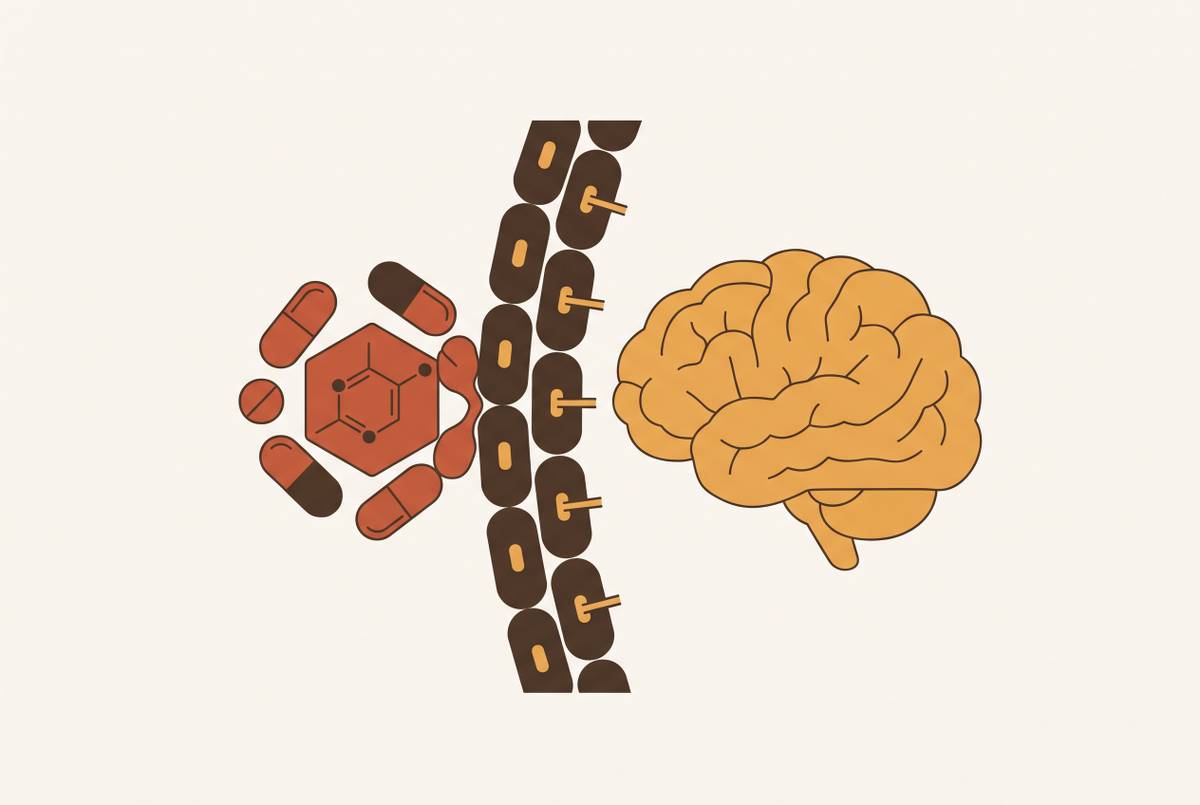
Acetylcholine's Role in Attention and Learning Consolidation
The neurotransmitter governs when your brain encodes memories and when it consolidates them.
Acetylcholine’s role in attention and learning consolidation is not simply to boost memory. It helps govern when the brain records new information and when it stabilizes what it has learned. That makes acetylcholine regulation the central issue. How much choline is available, how well a person sleeps, and chronic stress each affect a different part of this same cycle.
What acetylcholine actually does — the encoding-consolidation switch
A familiar commute can leave almost no distinct memory, while a first visit to a foreign city can feel vivid and detailed. Much of that contrast traces to whether the cholinergic system is engaged. Novel or important events activate the basal forebrain, a cluster of neurons that sends acetylcholine, or ACh, across virtually the entire cortex. High ACh favors encoding, the process of recording new information. When that signal falls during rest, daydreaming, or non-REM sleep, the brain can turn to sorting the memories it already has.
This is more specific than being alert. Norepinephrine raises overall arousal, like turning up brightness, while ACh improves signal clarity and contrast. It strengthens incoming sensory signals relative to the brain’s existing expectations, giving new information a better chance to register. Through muscarinic M1 receptors, it also activates processes that let synapses strengthen or weaken with experience. It helps coordinate hippocampal theta rhythms during active learning, too.
Synapses can pass signals along without changing much in response to them. So even trying hard may fail to make learning last when the cholinergic signal needed for encoding is weak.
How the hippocampus uses ACh to decide what spatial and behavioral information is worth encoding
The hippocampus shows how closely this signal follows what an animal is doing. The study “Modulation of speed-dependent acetylcholine release in the hippocampus by spatial task engagement” found that ACh release rose with locomotion speed in mice. In a new environment, release stayed high over many laps and still rose with speed. The signal adjusted with movement, novelty, and engagement.
When the mice voluntarily disengaged from the task, the speed-linked ACh signal weakened. At the same time, fewer place cells participated, and the spatial maps became less precise. These cells help track location, so their changes show what happens when encoding fails. The hippocampus was building a less accurate map of the environment.
Blocking muscarinic receptors with scopolamine led to much the same changes in behavior and in the measures of place cells. That result points to the cholinergic signal itself, rather than movement alone, as a driver of encoding quality. ACh signaling was also spatially uniform across the measured volumes, suggesting a coordinated broadcast.
ACh as a timing gate — how it works with dopamine to direct learning to the right neurons
Recording an event is only part of learning from it. The brain also has to connect an outcome to the action that produced it, without changing every neuron active nearby. ACh helps by opening short windows in which learning can take place. In cooperation with dopamine, it allows neurons involved in the just-executed action to update from the reward signal. That timing limits interference from competing activity.
Within the striatum, two types of neurons have complementary jobs in this process. One strengthens patterns of action that work, while the other helps hold back those that are out of date. Fast-acting nicotinic receptors and slower-acting muscarinic receptors mediate different parts of cholinergic coordination. Learning needs the right signal to reach the right cells at the right time.
A biologically realistic model built around ACh–dopamine cooperation improved performance across complex tasks. That computational result supports the coherence of the timing-gate idea, but it is not evidence that a supplement improves human learning. The biological argument remains narrower. ACh helps select which neural events are changed by experience, rather than simply turning memory strength up or down.
Why the consolidation side of the switch depends on sleep, and what ACh does during NREM
During NREM sleep, ACh needs to fall. Low ACh lets synaptic strength fall overall while connections that were active recently stay more active than the rest. This supports the stabilization and replay of what was learned during waking.
The structure of that sleep matters. Cortical slow oscillations and thalamocortical spindles are consistently associated with better memory consolidation. Their precise timing relative to each other helps support plasticity and stabilize memory traces. Total sleep hours do not, by themselves, describe whether this process is intact. Sleep architecture, especially the integrity of NREM, is the relevant condition.
That is why strong daytime encoding cannot fully compensate for a disrupted night. Elevated evening cortisol, fragmented sleep, or pharmacological suppression can interfere with the consolidation phase after information has already been recorded. High-quality NREM sleep is the second phase of the ACh-governed cycle that began during the day.
How chronic stress degrades ACh-dependent consolidation through cortisol and sleep disruption
Sustained cortisol elevation disturbs circadian rhythm, inhibits melatonin synthesis, and fragments deep sleep. That damages the NREM structure on which low-ACh consolidation depends. Stress can undermine the conditions needed to stabilize information that was successfully encoded.
Short bursts of stress are different. Cortisol and arousal-related neurotransmitters, including norepinephrine, ACh, and dopamine, appear to help tag important events for memory. That response can be useful when it is brief. But when stress stays high, the system loses the quiet time it needs for consolidation. A signal that helps mark an urgent event becomes a problem when it never properly subsides.
The disruption can also compound. Poor sleep raises next-day stress hormones, which can further impair the following night’s sleep. For knowledge workers, treating sleep only as time deducted from productive work misses this mechanism. Reducing chronic stress has a place in supporting learning because it helps preserve the consolidation window.
What ACh decline looks like across a lifespan, and why cholinergic circuits are early targets in aging
The ability to regulate this cycle also changes with age. ACh levels usually start to fall slowly around middle age. In both humans and mice, compromised cholinergic input to the entorhinal cortex occurs early in aging and predicts poorer cognitive performance, particularly on tasks that depend on that region. This makes cholinergic function relevant to long-term attention and memory.
The same circuit is also vulnerable in pathological decline. Familial Alzheimer’s-related genes and associated pathology accelerate the loss of cholinergic integrity in the entorhinal cortex. Even though the circuit is at risk in both cases, ordinary lapses in a healthy adult need not be signs of disease.
Clinical treatment offers evidence of the system’s importance, but also of its limits. Acetylcholinesterase inhibitors can partially reverse cognitive deficits in clinical populations, yet their benefits are modest and they do not halt underlying disease progression. Peripheral side effects also lead some patients to discontinue treatment. These interventions are intended for clinical use. The case for proactive support instead centers on choline availability, sleep, and stress load.
Why choline availability is the rate-limiting step for ACh synthesis, and how Alpha-GPC addresses it
To make ACh, a nerve terminal must take up choline through high-affinity transporters. Choline acetyltransferase then converts that material into acetylcholine. The amount of choline reaching the brain limits how much ACh can be synthesized. Common dietary sources do not all cross the blood-brain barrier efficiently.
Alpha-GPC supplies a substantial proportion of choline by weight and makes choline available for brain ACh synthesis. Its glycerophosphate backbone also helps repair neural membranes. Citicoline, marketed in branded form as Cognizin®, supplies cytidine as well as choline. Cytidine converts to uridine, a building block used in phosphatidylcholine and neuronal membrane repair. The relative benefits of these related precursors for healthy adults remain unestablished.
Delivery matters as well as ingredient identity. Poor gut absorption can limit what ultimately becomes available to the brain, whatever the proposed mechanism looks like on paper. But clearing a supply bottleneck is not the same as proving a performance gain. Whether more choline helps depends in part on whether there was too little to start with.
How Bacopa Monnieri, Lion's Mane, and cholinergic-adjacent ingredients support the ACh system through different mechanisms
A choline precursor addresses raw material, but not every condition needed for learning. Bacopa Monnieri, Lion’s Mane, and L-Theanine belong in a broader discussion because their proposed roles are not interchangeable. Bacopa’s 8–12 week timeline makes it a longer-term consideration. That timeline does not, by itself, establish a specific cholinergic mechanism. Distinguishing the evidence for each ingredient is more useful than treating them all as ACh boosters.
Lion’s Mane, or Hericium erinaceus, is better framed as neuroplasticity support. It contains hericenones and erinacines, with animal evidence for nerve growth factor synthesis and secretion and neuroprotective effects. Erinacines can cross the blood-brain barrier, while that ability has not been conclusively established for hericenones. Hericene A administration has increased brain BDNF in mice, whereas human supplementation has increased circulating pro-BDNF. Those findings measure different things and do not show a direct choline-precursor effect.
L-Theanine supports relaxed focus through alpha brainwave activity and GABA systems, with an acute onset of approximately 30–45 minutes. Its role differs from both precursor supply and structural support. These distinctions provide a rationale for considering complementary ingredients, but they do not prove that combining them produces greater benefits.
How Ashwagandha and Rhodiola Rosea protect the ACh consolidation window by targeting the stress-cortisol axis
Ashwagandha (KSM-66) and Rhodiola Rosea target the stress-cortisol axis. Their proposed relevance is through the HPA axis, the hormonal system involved in the stress response. By reducing the hormonal conditions that degrade NREM sleep, they may help preserve the setting in which consolidation occurs.
Koozehchian et al.’s 2025 randomized, double-blind crossover trial at Jacksonville State University included 27 adults who were resistance-trained. It found that taking Rhodiola rosea for a short time improved scores on the Stroop test, a measure of executive attention, whatever the dose or gender. That is a specific human attention finding. It is not a direct demonstration that Rhodiola improves ACh-dependent memory consolidation during NREM sleep.
The proposed connection runs through stress-system modulation and fatigue resistance. This connects these ingredients to the way elevated cortisol disrupts sleep and consolidation, as established earlier, without making them duplicates of Alpha-GPC. It also keeps the claim in proportion. Protecting the conditions for consolidation is a plausible and relevant intervention point, but an attention result alone does not establish the whole chain.
The honest limits — what the evidence does and does not establish about cholinergic support in healthy adults
The strongest objection is straightforward. If a healthy adult already has enough choline, adding a precursor may do little to improve attention or learning. The clearest benefits may be in people who have a deficiency or clinical decline. Even with a real mechanism, a supplement may help only some people, and results in those groups do not show that it will also help healthy adults.
The encoding switch, timing gate, and place-cell changes under cholinergic blockade establish why ACh matters. Studies in humans at the right dosages must show what a given treatment actually does. The most defensible approach therefore rests on adequate substrate, intact NREM sleep, and manageable chronic stress.
For supplements, transparent dosing and third-party testing are appropriate standards because they allow the product to be judged against the evidence. Proprietary blends make that relationship harder to assess. Expectations about timing also matter, since consistent use is more relevant than a single dose for ingredients such as Bacopa.
Sources
- Augmenting learning in neuro-embodied systems through neurobiological first principles
- Modulation of speed-dependent acetylcholine release in the hippocampus by spatial task engagement - ScienceDirect
- The role of acetylcholine in learning and memory - PubMed
- Lifelong Reinforcement Learning via Neuromodulation
- A central role for acetylcholine in entorhinal cortex function and dysfunction with age in humans and mice - ScienceDirect