Citicoline vs Alpha-GPC for Choline Delivery to the Brain
Alpha-GPC prioritizes acetylcholine; citicoline supports membrane repair.
Citicoline and Alpha-GPC both supply choline to the brain, but they are not two versions of the same supplement. They enter through different pathways, act on different systems, and fit different goals. That split, once understood, makes the choice between them straightforward.
Why citicoline and Alpha-GPC are not interchangeable choline sources
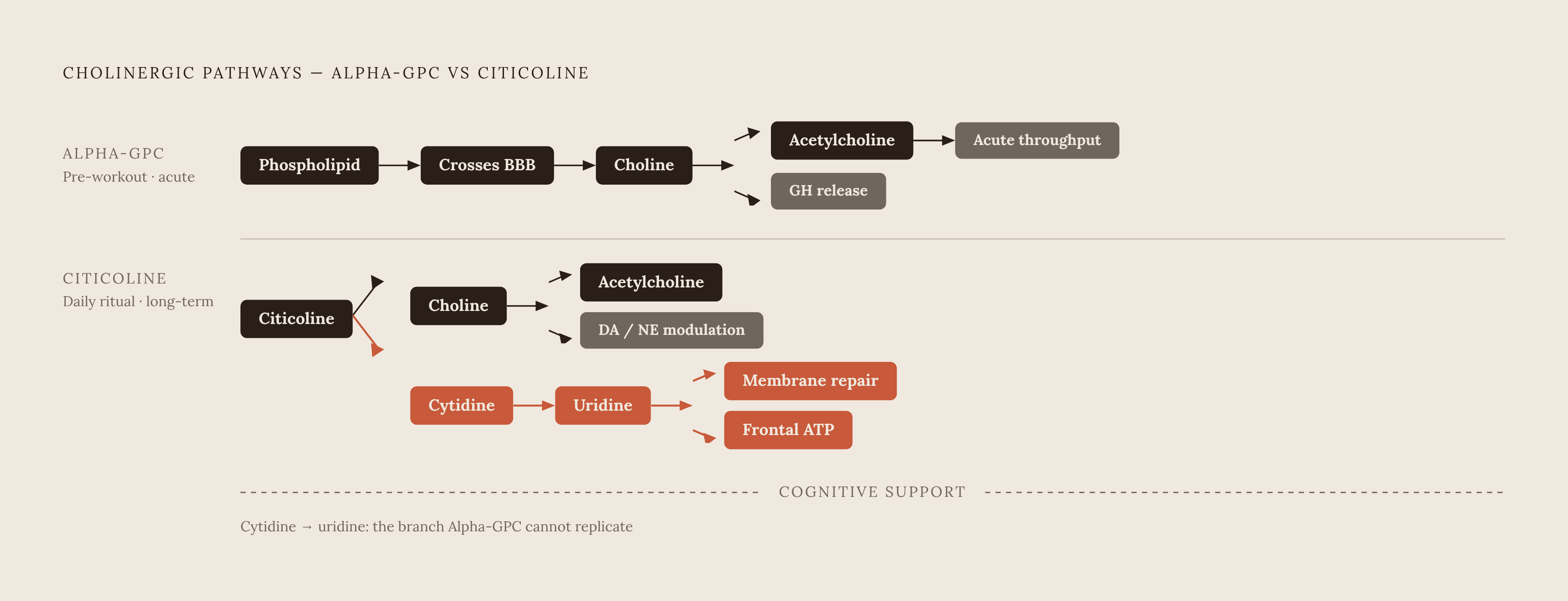
Standing in front of two supplement labels, you will often find both compounds described as choline sources for cognitive support. The shorthand suggests they are interchangeable. The chemistry says otherwise. Alpha-GPC is a phospholipid-derived compound whose structure mirrors natural choline intermediates already present in the brain. That structure enables rapid, concentrated choline delivery, which is why Ambition Pharma's formulation guide describes it as a rapid acetylcholine precursor chosen for fast cognitive performance.
Citicoline is a nucleotide derivative that breaks into two distinct components, choline and cytidine, each following its own metabolic route. The cytidine half converts to uridine and feeds phospholipid synthesis. This gives citicoline a broader neurological role than choline delivery alone. The practical consequence appears in the numbers: Alpha-GPC carries roughly twice as much choline per milligram as citicoline. But more choline per capsule is not the same as more benefit. One compound is tuned for acute cholinergic throughput, the other for sustained neurological infrastructure. Choosing between them without knowing that distinction is choosing blind.
How Alpha-GPC delivers choline to the brain and what that produces
Alpha-GPC is approximately 40% choline by weight, the highest of any widely used choline form. Its phospholipid structure moves across the blood-brain barrier more efficiently than water-soluble choline salts. Once inside the brain, the choline converts to acetylcholine via the enzyme choline acetyltransferase. Acetylcholine is the neurotransmitter most directly tied to memory encoding, attention, and cortical arousal. That is the primary mechanism, and it is a fast one.
A secondary mechanism separates Alpha-GPC from simpler choline sources. It stimulates growth hormone release from the pituitary gland through cholinergic signaling. Growth hormone and its downstream mediator IGF-1 support synaptic plasticity and are neuroprotective. Alpha-GPC also provides glycerophosphocholine as a direct precursor to phosphatidylcholine for membrane synthesis, though this membrane-repair function is weaker than citicoline's cytidine-to-uridine route. The formulation guides are consistent on what this adds up to: strong bioavailability, rapid brain uptake, and a profile suited to short-term cognitive performance.
How citicoline's two-component breakdown creates a broader neurological footprint
Citicoline's distinctive value is not its choline content. It is what the cytidine half of its breakdown does. Cytidine converts to uridine, and uridine feeds phospholipid synthesis, the raw material for neuronal membrane repair. Phosphatidylcholine is a major structural component of neuronal cell membranes. Supplying its precursors directly supports membrane integrity and repair, not just neurotransmitter output. That is a fundamentally different job from what Alpha-GPC does.
Citicoline also modulates dopamine and norepinephrine in the central nervous system, a dimension of cognitive support Alpha-GPC does not meaningfully replicate. MRI evidence shows citicoline increases ATP production in the frontal lobe, meaning it supports the brain's energy substrate alongside its neurotransmitter and structural functions. Think of it as working on two fronts at once: neurotransmitter production, what the brain signals with, and neuronal infrastructure, what the brain is built from. Alpha-GPC addresses the first front primarily. Citicoline addresses both.
What the clinical trials actually show for each compound in healthy adults
The evidence base for both compounds is heavily weighted toward diseased or aging populations. For healthy adults specifically, citicoline has the more substantial recent trial record. A randomized, double-blind, placebo-controlled trial with 148 healthy men and women aged 35 to 75 with poor sustained attention tested 500 mg of Cognizin daily against placebo for 12 weeks. Outcomes included improved sustained attention reaction time, faster rapid visual information processing reaction time, and improved mental energy composite scores. The results were presented at the 5th Symposium on Nutrition for the Ageing Brain in June 2025. A separate trial with 90 healthy young adults aged 18 to 35, sponsored by Kirin Holdings, was completed in 2025 to assess Cognizin's effects on cognitive performance. Another registered trial is evaluating citicoline's effects on mood.
Alpha-GPC's most compelling cognitive data comes from dementia and aging populations. A multicenter trial of patients with mild-to-moderate Alzheimer's found that 1,200 mg daily improved scores on the MMSE, ADAS-Cog, and Clinical Global Impression over six months. A 6-month RCT in elderly patients with age-associated memory impairment found similar improvements in memory and attention. The three head-to-head trials comparing the two compounds all used injections, all studied dementia populations, and all date from the early 1990s at high risk of bias. Neither compound has a deep RCT base in healthy working-age adults, but citicoline's recent trials in that specific population are more numerous and more recent.
Alpha-GPC's two distinct use cases: pre-workout performance and sleep-phase recovery
Alpha-GPC has one biological capability citicoline does not match: growth hormone release. A study in trained men showed that a 600 mg dose taken 90 minutes before resistance training increased growth hormone secretion, peaking 30 minutes post-exercise. That mechanism matters for muscle building, recovery, and strength. Alpha-GPC also prevents exercise-induced reductions in choline levels and increases endurance performance alongside growth hormone secretion. The evidence on athletic performance is not uniformly consistent, though. Some studies with similar dosages found no effect on power, average force, or work capacity. The pre-workout use case is supported but not settled.
The same growth hormone mechanism gives Alpha-GPC a role in sleep-phase recovery. Sleep is part of mental performance, not separate from it, and the cholinergic system is involved in sleep architecture and next-day cognitive output. Magic Mind's Sleep variant reflects this logic by treating sleep as a performance input rather than a separate problem. Citicoline has essentially no athletic performance data in this context. For a pre-workout or sleep-recovery supplement, Alpha-GPC is the clear choice. For a daily cognitive ritual, the calculation shifts.
The cardiovascular safety question that separates the two compounds for long-term daily use
Alpha-GPC carries a cardiovascular consideration citicoline does not share. Gut bacteria convert choline from Alpha-GPC into trimethylamine, or TMA, which the liver oxidizes to TMAO. TMAO is associated with adverse cardiovascular outcomes. That is the metabolic basis of the concern. A large cohort study of individuals aged 50 and older in South Korea found that Alpha-GPC use was associated with a higher risk of total stroke, ischemic stroke, and hemorrhagic stroke over a 10-year follow-up. The association was dose-responsive.
The evidence is not clean. A later Korean study in people with mild cognitive impairment found lower stroke risk in Alpha-GPC users. Both studies are observational, and they arrive at opposite conclusions. The evidence base is genuinely unsettled. This does not make Alpha-GPC dangerous for healthy adults at normal doses. But for a daily cognitive ritual measured in months or years, citicoline's cleaner cardiovascular profile is a meaningful input to the decision. The risk does not need to be proven to be weighed.
The objection that "more choline per milligram" is the wrong metric to optimize
The argument that Alpha-GPC is simply the stronger choline source treats choline delivery as the goal. It is not the goal. It is one input into a broader neurological outcome. Citicoline's choline content per milligram is lower, but its combination of choline and cytidine is a more complex intervention. The uridine pathway's role in synaptic plasticity and membrane synthesis means the lower choline figure understates total neurological impact. A systematic review of 13 studies found choline supplements did not clearly improve cognition in healthy adults. Raw choline delivery may not be the mechanism that matters most.
The EFSA 2024 assessment of citicoline adds a necessary limit. It judged the evidence for a biological mechanism behind a memory benefit to be insufficient. That finding cuts both ways. It is an honest limit on citicoline's evidence, but it also suggests that neither compound's mechanism-to-outcome story is as clean as the marketing implies. The right metric is fit to goal. Alpha-GPC fits acute cholinergic loading, athletic performance, and short-duration use. Citicoline fits sustained daily use, membrane support, dopaminergic modulation, and lower cardiovascular exposure over time.
A practical decision framework: matching each compound to the cognitive goal
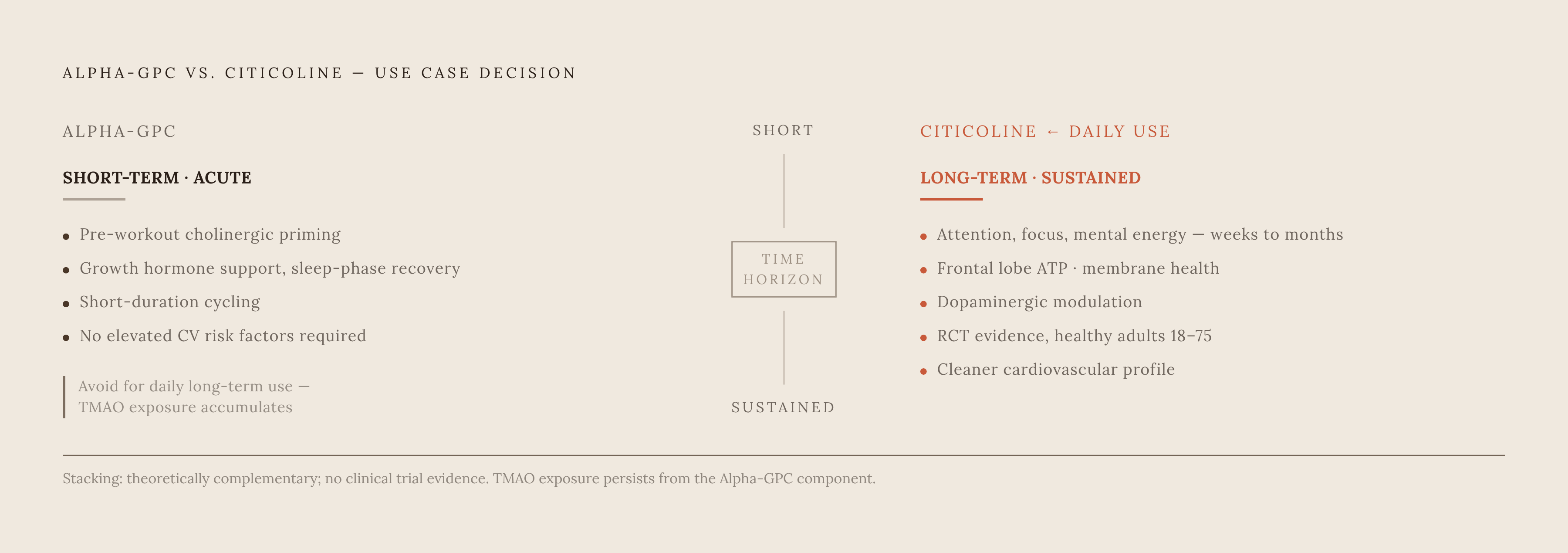
Once the goal is named, the choice becomes clear. Select Alpha-GPC when the objective is pre-workout cholinergic priming, a rapid acetylcholine elevation before a training session or a high-demand cognitive event. Growth hormone support during sleep-phase recovery is another reason to choose it. Short-duration supplementation rather than a daily open-ended routine tilts toward Alpha-GPC, as does the absence of elevated cardiovascular risk factors and an awareness of the unsettled TMAO evidence.
Select citicoline when the objective is sustained daily cognitive support, attention, mental energy, and focus over weeks and months rather than hours. Long-term brain membrane health and neuroprotection favor citicoline. So does the desire for dopaminergic modulation and frontal lobe ATP support alongside acetylcholine effects. Citicoline also brings the more recent RCT evidence in healthy working-age adults and the cleaner long-term cardiovascular profile. Combining the two is theoretically complementary, one for acute cholinergic throughput and the other for membrane support, but the combination has never been tested in a clinical trial. Anyone stacking should be alert to additive TMAO exposure from the Alpha-GPC component. Manufacturers treat these as distinct ingredients for distinct product positioning, which is exactly what the formulation guides confirm.
How citicoline fits into a complete daily cognitive stack — and what surrounds it
Citicoline produces its strongest outcomes alongside ingredients that address the other rate-limiting factors in cognitive performance. Lion's Mane is one of them. In a double-blind Japanese study, older adults with mild cognitive impairment who took Lion's Mane daily for 16 weeks showed significant improvements on the Revised Hasegawa Dementia Scale compared to placebo. When supplementation stopped, the benefits faded, suggesting the mushroom was actively driving improvement. The mechanism is complementary to citicoline's. Citicoline supplies the membrane precursors neurons need to form new connections. Lion's Mane supports the growth factor signaling that initiates connection formation.
Ashwagandha works through an entirely distinct route. Chronically elevated cortisol impairs memory encoding and recall. Ashwagandha helps reduce cortisol levels and supports calm mood without sedation. It functions as an indirect cognitive enhancer by removing a hormonal barrier to effectiveness. Citicoline raises acetylcholine. Ashwagandha removes what blocks that acetylcholine from doing its job. Bacopa Monnieri adds another layer. Its bacosides promote dendrite branching, increase acetylcholine activity, and provide antioxidant protection for neurons. A meta-analysis of nine RCTs found significant improvements in attention, cognitive processing speed, and working memory over 8 to 12 weeks of daily use. Because Bacopa increases acetylcholine activity, it operates with citicoline's cholinergic support rather than against it.
This is why formulation philosophy matters. Magic Mind uses Cognizin, a clinically backed form of citicoline, rather than Alpha-GPC, because its mission centers on long-term brain health and sustained cognitive support for knowledge workers rather than short-term acetylcholine spikes. Citicoline's dual-action model, supporting both neurotransmitter production and neuronal membrane repair through the uridine pathway, fits naturally into a multi-ingredient stack where real cognitive gain comes from several mechanisms working at once. Magic Mind's Original and MAXX mental performance shots include Cognizin citicoline alongside Lion's Mane, Ashwagandha, Bacopa Monnieri, Ceremonial-Grade Matcha, and vitamins. They are formulated as a daily 2 oz ritual for knowledge workers who want sustained cognitive support, not a situational dose. All ingredients are transparently dosed, third-party tested for over 56 contaminants including PFAS, heavy metals, and mycotoxins, and Certified Safe from Plastic Chemicals by LabProof.