GABA Supplementation and the Blood-Brain Barrier Problem
Oral GABA struggles to reach the brain due to the blood-brain barrier.
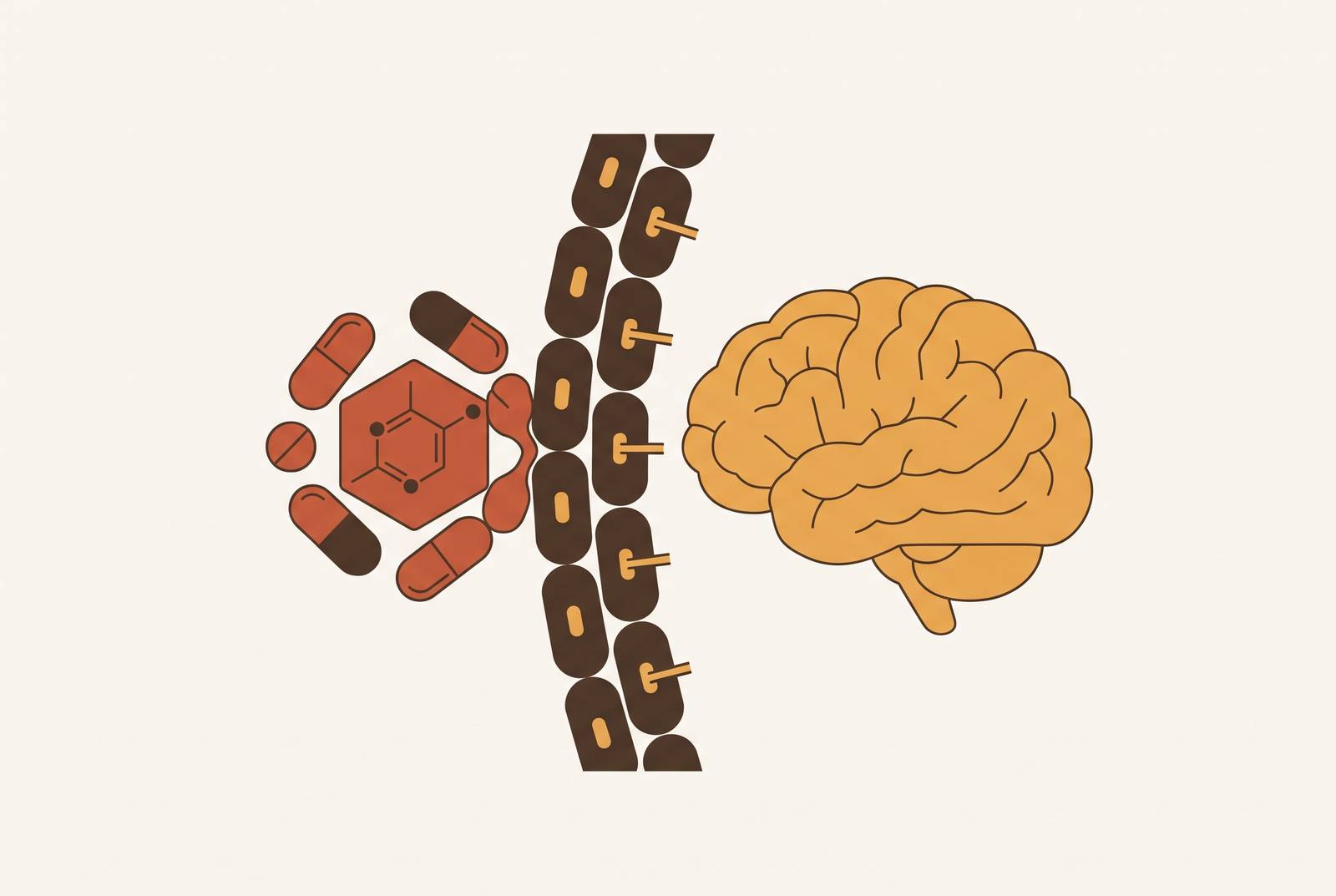
Oral GABA supplementation has a delivery problem. GABA helps quiet brain activity, but swallowing it does not reliably raise GABA levels in the brain. The blood-brain barrier makes that distinction unavoidable. The evidence points to a more useful way to judge brain-support supplements, which is to ask how they act, how they are absorbed, and whether their active compounds reach the place they are meant to work.
Why the blood-brain barrier blocks most molecules, including oral GABA
The blood-brain barrier is an actively selective interface between the bloodstream and the brain. Tight junctions between endothelial cells restrict passage, while selective transporters and astrocytic endfeet help govern what reaches brain tissue. This protects the brain by keeping tight control over the chemicals around it. A substance circulating in the blood therefore has no automatic right of entry. Reaching the bloodstream and reaching the brain are separate hurdles.
The barrier controls passage through several mechanisms, including passive diffusion, carrier-mediated uptake, and energy-dependent efflux. Passive diffusion lets molecules that have the right properties pass through without a dedicated carrier. Carrier-mediated uptake provides a route for molecules that fit particular transport systems. Efflux works in the other direction, actively moving substances out. These layers make the barrier more demanding than a filter that sorts molecules only by size.
Chemistry matters at every layer. Mahmoudi's explainable ML framework identifies topological polar surface area, hydrogen bond donors, lipophilicity, and the number of heteroatoms as influential predictors of crossing. Molecules that cross by passive diffusion tend to be lipid-soluble and below roughly 400–500 Da in molecular weight. GABA is charged and hydrophilic.
Why GABA's molecular profile makes it a poor candidate for direct BBB crossing
GABA, or gamma-aminobutyric acid, is the primary inhibitory neurotransmitter in the central nervous system. Its signal quiets overactive circuits involved in stress response and wakefulness. That role makes it an intuitive supplement ingredient for someone seeking calm or better sleep. The apparent logic is simple enough, since more of a calming signal sounds like a way to produce more calm. The missing step is getting the swallowed compound to those circuits.
GABA's charged, hydrophilic structure makes direct passage through the barrier difficult. It lacks the lipophilicity that favors passive diffusion, so its delivery problem follows from its chemistry rather than from an unusual failure of a particular supplement. The body also regulates neurotransmitter levels precisely. GABA introduced outside the brain may be metabolized and cleared before central access is possible. Even absorption into the bloodstream does not establish delivery to the brain.
The conclusion needs a clear limit. Oral GABA crosses poorly and does not reliably increase brain GABA concentrations, with some degree of crossing still possible. Transport pathways and indirect signaling remain subjects of research. Nor does the barrier establish that every reported benefit is unreal. It establishes that taking more GABA cannot simply be assumed to solve a structural delivery problem.
The three proposed mechanisms by which oral GABA might still influence the brain
The first proposed route is the gut-brain axis. GABA-sensitive sensory neurons in the gut seem able to affect the brain's stress and sleep pathways through the vagus nerve. Neuroendocrine and immune pathways may also carry signals between the gut and the brain. If this is how oral GABA works, it would affect brain activity without having to enter the brain itself.
The second proposed route is transporter-mediated active transport. The barrier's permeability can change, and transport pathways may let some GABA through at specific doses. That possibility differs fundamentally from free diffusion through the barrier. It would depend on a transport mechanism rather than on GABA becoming a more lipid-soluble molecule. This route is less well characterized than the gut-brain explanation and does not establish reliable central delivery in humans.
The third proposed route is metabolic conversion. GABA may be turned into active substances that affect sleep architecture through receptor systems and energy metabolism. In that case, the downstream substances would help explain an effect that the original molecule's poor permeability cannot explain on its own.
A 2025 animal study found increased GABA levels in the prefrontal cortex of rodents after extended oral administration. That finding leaves room for some degree of central access, but it does not settle whether the same occurs in humans. Investigators at the Université de Sherbrooke registered a clinical trial in 2024 to investigate whether oral GABA crosses the barrier in otherwise healthy humans. None of the three proposed routes has been proven to fully account for observed effects.
What the clinical evidence actually shows — and where the gaps remain
Small randomized controlled trials suggest that oral GABA may reduce sleep latency, which is the time it takes to fall asleep, and help people sleep better. Evidence for sleep and stress support nevertheless remains limited and inconsistent. A benefit on either measure would matter, but it would not identify the route responsible. Better sleep cannot, by itself, prove that supplemental GABA entered the brain.
Cognitive performance raises a different concern. A 2021 study found that people taking GABA did less well at cognitive task-switching than those taking placebo. That result is a reason for caution, with evidence limited to one aspect of thinking. It does, however, challenge the assumption that a supplement aimed at calm is necessarily neutral for executive function. A calming goal and a cognitive-performance goal are not interchangeable.
GABA is involved in the HPA axis, the stress-response system connected to cortisol. Elevated cortisol can activate the amygdala and reduce slow-wave sleep, making the relationship between stress and rest consequential for sustained mental work. But GABA's role in that system does not show that oral GABA reliably reaches the brain circuits a consumer wants it to affect.
PharmaGABA illustrates another gap between a plausible story and delivery evidence. It is produced by fermenting glutamic acid from sugar cane using Lactobacillus hilgardii. Abdou et al.'s 2006 Japanese study in BioFactors found significant EEG alpha-wave increases compared with water and L-theanine. A separate unpublished industry trial compared it with synthetic GABA, but that trial was small and industry-funded. No robust head-to-head pharmacokinetic data establishes a meaningful absorption advantage, so fermentation pedigree should not be mistaken for proven superiority in brain delivery.
Shanghai Jiao Tong University School of Medicine launched a 2024 trial examining GABA supplementation for childhood insomnia. That is evidence that the category remains worth investigating in controlled settings. It is not a substitute for results or a reason to extend findings from one population to another.
Why the BBB problem reframes the supplement question: peripheral action vs. direct nootropic
If oral GABA acts mainly through gut and peripheral receptors, it belongs in a different category from a compound that enters the brain and acts there directly. This interpretation reconciles possible benefits with poor barrier permeability. Instead, it changes the claim from direct neurotransmitter replenishment to indirect signaling.
That change has practical consequences. A compound acting through the vagus nerve and neuroendocrine pathways can have different onset timing, dose-response patterns, and appropriate uses from one that crosses the barrier and binds centrally. Oral GABA may offer some people sleep or stress support, but reliable brain GABA increases are not established.
For a professional seeking calm, focused mental output, oral GABA alone is unlikely to be the most efficient route. When the goal includes reaching the brain directly, it makes sense to compare compounds whose effects within the brain are better understood.
Ingredients with documented BBB crossing and what they do differently
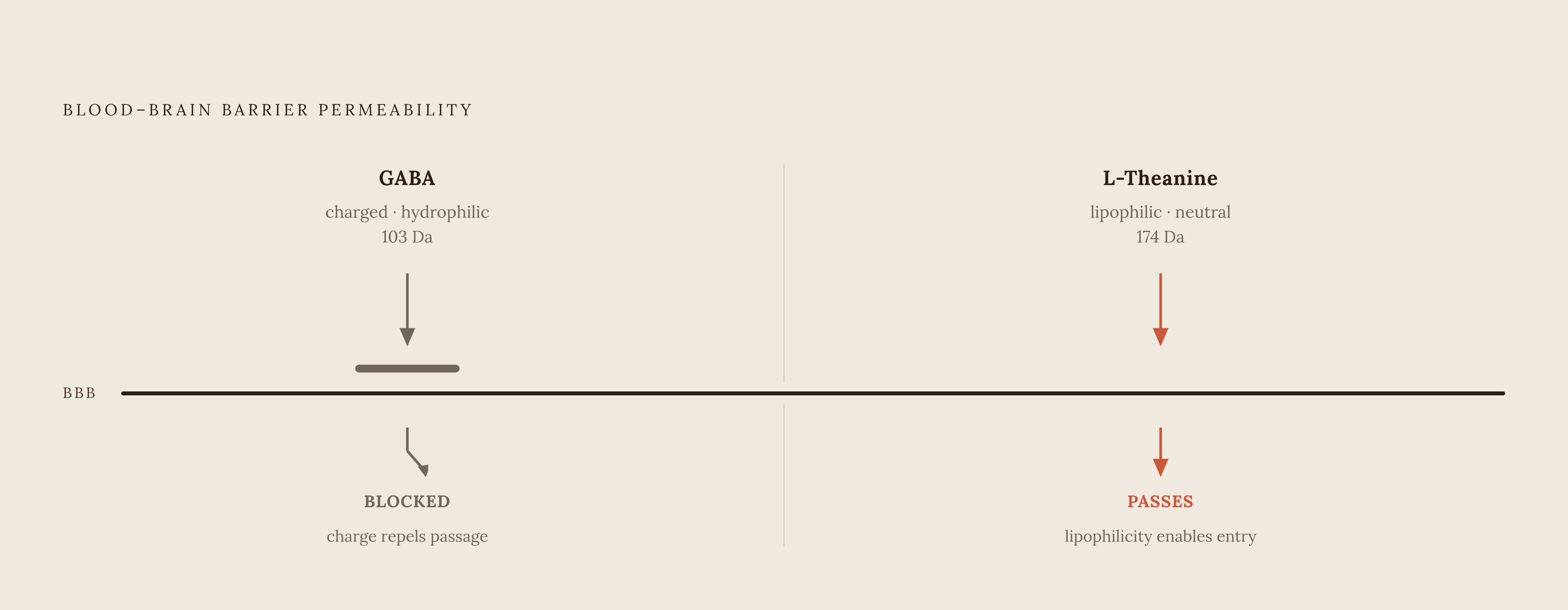
L-Theanine offers the clearest contrast with GABA's delivery problem. Found almost exclusively in tea leaves and certain mushrooms, it crosses the blood-brain barrier rapidly and modulates GABA, dopamine, and serotonin levels centrally. Its known action in the brain is linked to more alpha brain waves and relaxed alertness. Rather than attempting to supply GABA directly, it influences brain chemistry through a compound that can reach the brain.
The pairing of L-theanine with caffeine also has evidence relevant to focus. It can reduce jitteriness while preserving, and in some cases extending, alertness. A 2025 double-blind, placebo-controlled crossover study at the University of Peradeniya found that 200 mg L-theanine + 160 mg caffeine improved neurobehavioural and neurophysiological measures of selective attention in acutely sleep-deprived young adults. That finding supports a specific combination under specific conditions. It does not turn every theanine-containing format into an equivalent formulation.
Ashwagandha works upstream of the GABA pathway by modulating the HPA axis and supporting healthy cortisol levels. Its human stress-management evidence comes from multiple randomized controlled trials and is larger than the evidence base for oral GABA's stress applications. Bacopa Monnieri instead supports memory consolidation and attention through cumulative use, with synaptic signaling effects that build over weeks.
Lion's Mane shows why even an ingredient name can hide an important delivery distinction. Its active compounds, erinacines and hericenones, act on nerve growth factor, while erinacines also act on brain-derived neurotrophic factor. These proteins support neuron growth and synaptic plasticity. Erinacines appear to be the main driver of central nerve growth factor stimulation because hericenones cross the barrier less efficiently and appear to act mainly peripherally.
Citicoline supports phospholipid synthesis in brain cell membranes and acetylcholine production, providing structural and chemical support for neural communication. Rhodiola Rosea has a different profile, with rosavins and salidroside that appear to inhibit monoamine oxidase and support mitochondrial energy metabolism. It may also modulate the cortisol stress response, though human evidence is limited and mixed. These mechanisms provide a framework for comparison, with the relative strength of each compound's delivery evidence still to be assessed. Even a suitable ingredient depends on a formulation that gets its active compounds into circulation.
Why delivery format matters as much as ingredient selection for brain-targeted compounds
Brain delivery is a chain of requirements rather than a yes-or-no property printed beside an ingredient. Molecular structure, transport mechanism, and the route through the barrier all matter. Lipophilicity, polar surface area, molecular weight, and hydrogen bonding influence a molecule's passage through the barrier. Formulation can influence delivery, but it cannot be treated as proof that the final product reaches a brain target. The barrier's permeability can change with the body's physiological state, which makes passage harder to predict.
Absorption into the bloodstream is a necessary starting point for subsequent direct brain delivery. Nanoencapsulation addresses this earlier hurdle by enclosing active ingredients in lipid-based nanocarriers, including nanostructured lipid carriers or nanoemulsions. These systems can protect compounds during digestion and improve bioavailability at the gut wall, with faster onset than conventional pills or powders. That can matter especially for lipophilic compounds whose delivery format affects how much reaches circulation. Higher circulating availability, however, is not the same endpoint as demonstrated passage into the brain.
The Lion's Mane distinction makes the practical question concrete. A mushroom species on a label says less about central delivery than the specific compounds and the vehicle carrying them. So when judging a supplement, it helps to look at its active fraction, the evidence for its absorption, how it might work, and the results in humans for the use it is meant for. Third-party testing for contaminants, including heavy metals, mycotoxins, PFAS, and plastic chemicals, is a separate quality requirement.
The answer to whether GABA supplements work is narrower than either a blanket endorsement or a dismissal. A brain-support supplement needs evidence that how it works and where it goes match what it promises to do. An ingredient's role in brain chemistry is the beginning of that case.
Sources
- An Explainable Machine Learning Framework for Predicting Blood-Brain Barrier Permeability Using Molecular Descriptors
- Association Between Serum and Neuroimaging Measurements of the GABAergic System
- Understanding the blood brain barrier: current state and therapeutic implications
- Long-term GABA supplementation mitigates anxiety by modulating complement and neuroinflammatory pathways - PMC
- Long-term GABA supplementation mitigates anxiety by modulating complement and neuroinflammatory pathways - PMC