L-Theanine and Caffeine Synergy in Alpha Wave Production
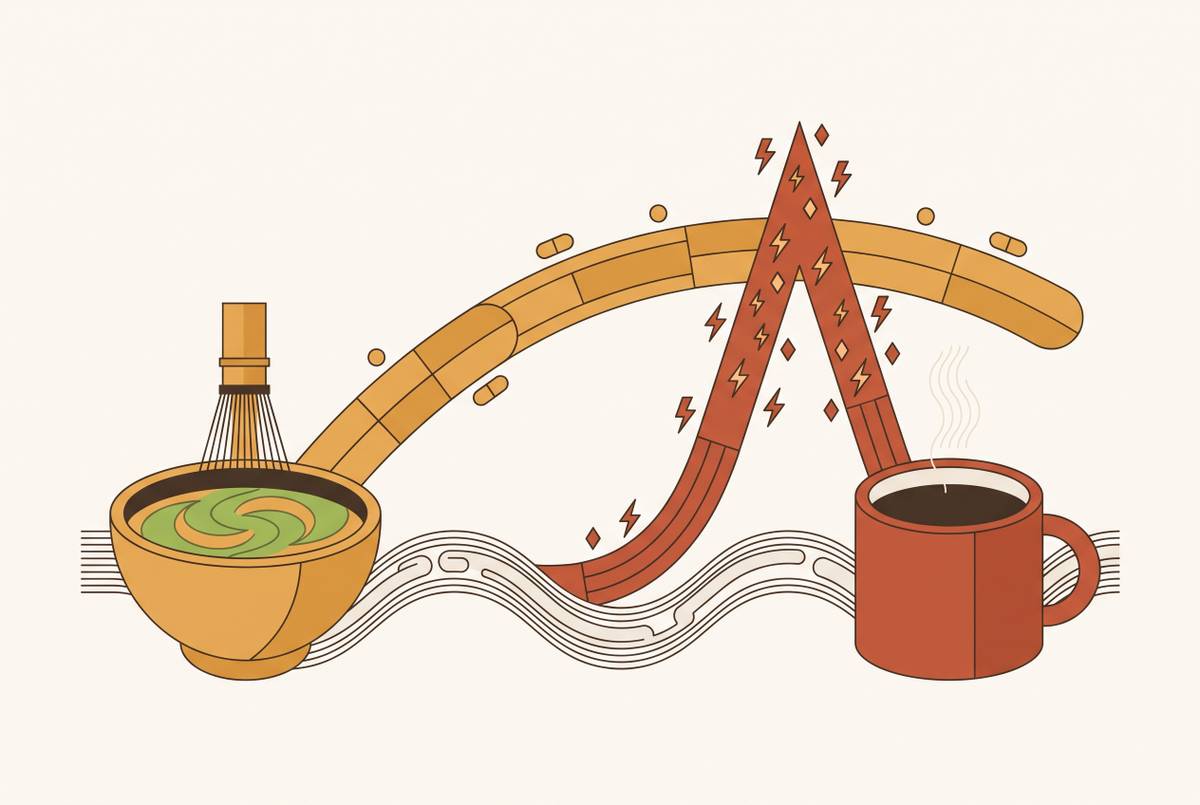
The amino acid L-theanine smooths caffeine's jitters while preserving its alertness boost.
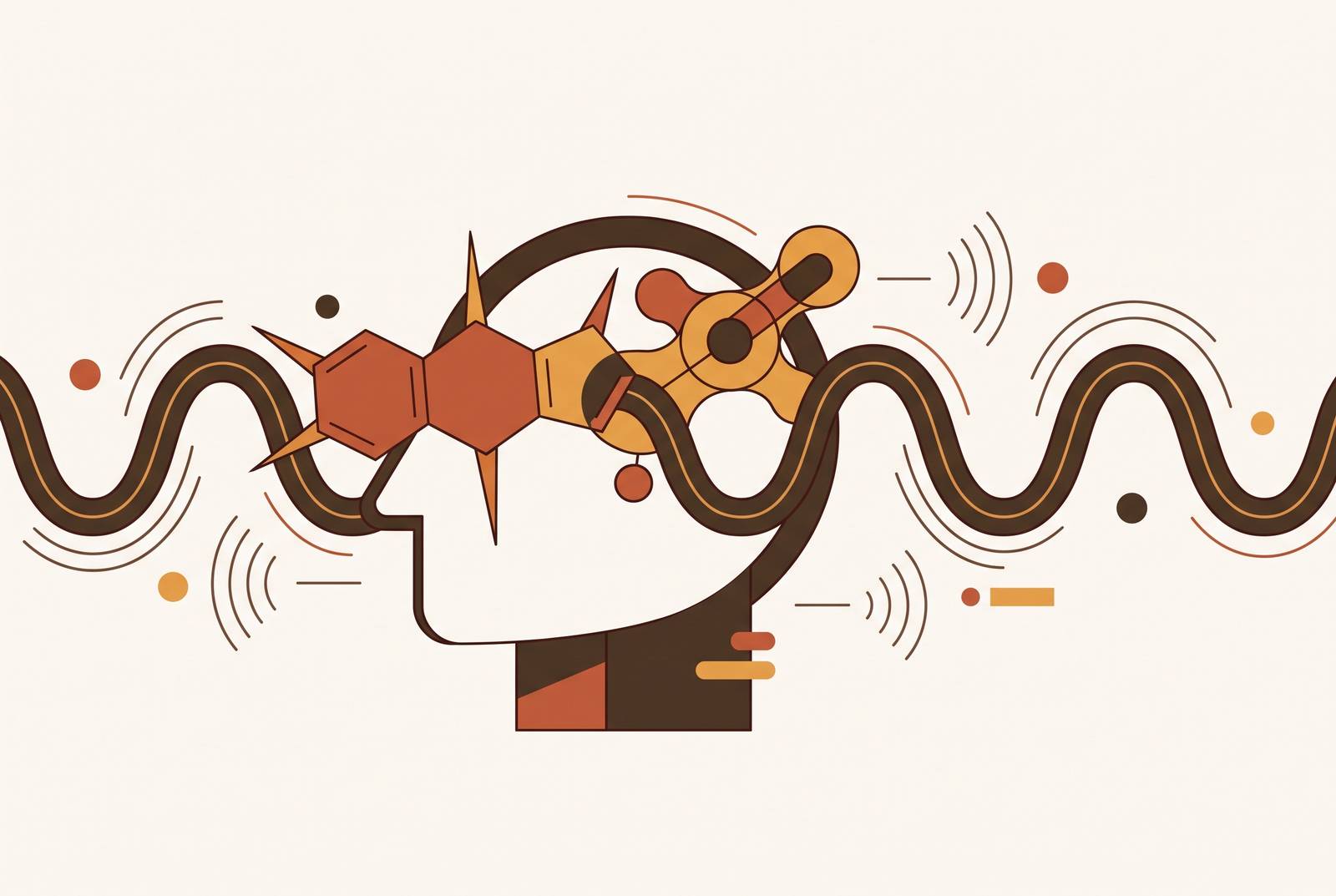
Alpha waves are electrical oscillations in the brain cycling at 8 to 12 hertz, and their presence on an EEG readout marks something specific: a state of relaxed attentiveness. This is the state measurable during meditation, during creative flow, during the quiet moment before a skilled task begins. Alpha activity is a sign that the brain has organized itself into a particular kind of readiness, calm but not disengaged.
Researchers draw a distinction between two kinds of alpha activity that matters for understanding the rest of this subject. Tonic alpha is the background level, the steady hum you get during rest. Phasic alpha is the anticipatory kind, and it rises and falls around specific moments of attention. Both measures show up later in the EEG evidence on caffeine and L-theanine combined.
L-theanine is the amino acid most responsible for promoting this state pharmacologically. Found almost exclusively in Camellia sinensis, the tea plant, and in certain mushroom species, L-theanine crosses the blood-brain barrier and selectively raises alpha wave amplitude. That single fact explains a puzzle tea drinkers have noticed for centuries: tea produces a different, steadier kind of alertness than coffee, even though tea contains caffeine too. The Alzheimer's Drug Discovery Foundation's Cognitive Vitality report on L-theanine lists the compound as blood-brain-barrier penetrant and confirms it has short-term effects on attention and relaxation, working in part by increasing GABA concentrations, dopamine release, and serotonin levels. None of this amounts to sedation. It amounts to a brain that is calm and paying attention at the same time, which is precisely the state that caffeine, used alone, tends to undo.
How caffeine drives vigilance and anxiety
Caffeine's mechanism is adenosine receptor blockade. Adenosine is the molecule that builds up in the brain over the course of a day and signals tiredness; caffeine, chemically known as 1,3,7-trimethylxanthine, occupies the receptors that would otherwise receive that signal. A 2026 randomized crossover study in Frontiers in Nutrition describes caffeine as an adenosine receptor antagonist with a stimulatory effect on the central nervous system, which is why acute intake is so widely used to cope with physical demands and sustain alertness. The effect is real and well documented.
Blocking adenosine receptors raises vigilance, but it does nothing to preserve the relaxed, attentive state that alpha waves represent, and in many people it actively suppresses that state. Jitteriness, anxiety, and a kind of attentional scatter accompany the high sympathetic arousal that caffeine alone produces, the brain stimulated without being focused. This is the gap the rest of this article is built around: caffeine raises the floor of arousal, but on its own it does nothing to stop the ceiling of relaxed attention from collapsing. That is the opening L-theanine fills.
What happens neurologically when both compounds are taken together
Combined, L-theanine and caffeine produce a cognitive state that is alert without being anxious, for a mechanistic reason. The two compounds act on separate neural pathways at the same time. Caffeine blocks adenosine receptors and drives vigilance. L-theanine raises alpha amplitude and preserves relaxed attentiveness. Taken together, neither cancels the other out; each compensates for what the other leaves unaddressed.
The clearest direct evidence for this comes from Kelly et al., published in The Journal of Nutrition, who tested four conditions, a placebo, L-theanine alone at 100 mg, caffeine alone at 50 mg, and the combination, using a visuospatial attention task with concurrent EEG recording. The combined treatment increased both hit rate and target discriminability (d′) relative to placebo. Caffeine alone increased d′ but not hit rate. L-theanine alone produced no measurable behavioral effect by itself. The result that matters most appeared at the level of brain activity rather than behavior: a significant drop in tonic, background alpha power occurred only in the combined condition, not in either compound given alone.
That finding deserves unpacking because it runs against intuition. A drop in background alpha sounds like it should mean less calm, not more focus. What it actually indicates is broader attentional engagement: the brain's baseline settles down so that the signal tied to the task at hand stands out more clearly. Neither compound produces that shift by itself. Only the pairing does.
There is a timing component to the synergy as well. Caffeine absorbs quickly and peaks first, producing the early lift in vigilance. L-theanine sets in more gradually and lasts longer, so it moderates the tail end of caffeine's action. This staggered absorption profile is the biological basis for what users commonly describe as the absence of a crash, since the compound that would otherwise leave arousal unsupported once caffeine fades is already active by the time caffeine's effect wanes.
What the combination consistently outperforms in controlled trials
Across a range of randomized controlled trials in healthy adults, the combination of L-theanine and caffeine reliably beats either compound alone on tasks involving attention and accuracy. The gains vary across different kinds of cognitive tasks and populations tested, and the honest shape of the evidence reflects that unevenness.
Giesbrecht and colleagues, publishing in Nutritional Neuroscience in 2010, tested 97 mg of L-theanine combined with 40 mg of caffeine against placebo in young adults. The combination significantly improved accuracy during task switching, and it raised self-reported alertness while it reduced self-reported tiredness. At the same time, the study found no significant effect on visual search, choice reaction times, or mental rotation. The benefit, in other words, is specific to certain kinds of tasks rather than a general-purpose boost to every form of cognition.
A 2025 study in the Journal of the International Society of Sports Nutrition carried the question into a demanding, real-world population: elite Iranian male wrestlers, tested for acute effects on attention, reaction time, and wrestling-specific measures of fitness, muscular endurance, and explosive power. The rationale behind testing athletes under physical load was straightforward. L-theanine's calming, nootropic qualities were expected to work alongside caffeine's stimulatory benefits, raising cognitive performance while blunting the jitters and anxiety that caffeine alone can produce in competitive settings. That design reflects a genuine trade-off: L-theanine's calming influence can improve accuracy, but accuracy and raw speed do not always move together, and a stack optimized for one may not maximize the other.
Where the evidence is more complicated than the consensus suggests
The idea that L-theanine and caffeine form a clean, settled cognitive pairing is well supported, but it runs into two problems the evidence has not resolved.
The first is a question of attribution. In most combination trials, caffeine accounts for the majority of the measured gain in attention. How much L-theanine contributes to cognitive performance on its own, apart from softening caffeine's anxiety-producing side effects, remains a live debate among researchers.
The second problem concerns the 2026 Frontiers in Nutrition crossover study, which tested the pairing directly against the assumption of synergy, and found it wanting in several respects. In the combined condition, the study found no additional or synergistic effect on maximal strength. L-theanine alone was associated with reduced maximal isometric leg and back strength compared with both caffeine and placebo, an unexpected result given the compound's reputation as purely calming. No significant differences appeared between any of the conditions for aerobic endurance, handgrip strength, or hand-eye coordination. The study's authors concluded that these findings challenge the assumption of caffeine plus L-theanine synergy, and they call for task-specific interpretation of co-supplementation strategies instead of treating the pairing as a universal performance enhancer.
The fairest reading of this body of evidence treats it as a finding about domain specificity. The combination holds up well for attention and accuracy-based tasks, the kind measured by Kelly et al. and Giesbrecht et al. It holds up less well, or not at all, for physical strength and endurance measures, where caffeine's known ergogenic effects do not appear to gain anything from L-theanine's addition and may, in the case of maximal strength, lose something. There is also a dose-context gap: most of the positive trials are acute, single-dose designs, and long-duration studies of sustained supplementation are limited. The ADDF Cognitive Vitality report notes that studies of chronic L-theanine dosing have not shown improved cognitive function, and that in multiple double-blind randomized controlled trials, chronic treatment produced no significant difference from placebo on cognitive outcomes.
Matcha's distinct position as a delivery vehicle for both compounds
Matcha is a whole-leaf preparation, meaning both compounds arrive embedded in a biological matrix, the full material of the ground tea leaf itself, and that matrix shapes how the two compounds are absorbed and how they act once absorbed, so matcha is not reducible to a convenient list of L-theanine and caffeine milligrams.
Because matcha is produced from shade-grown Camellia sinensis leaves that are consumed in their entirety rather than steeped and discarded, it stands among the richest natural sources of L-theanine available. High-quality ceremonial grade matcha carries a ratio of roughly one part caffeine to one part L-theanine. Lower grades can run as high as four parts caffeine to one part L-theanine. The ceremonial-grade ratio closely mirrors the proportions used in the controlled trials already described, and that is part of why matcha draws attention as a naturally occurring version of a pairing otherwise built in a lab.
Format affects outcome too. Liquid delivery of these compounds has been shown to outperform food-format delivery of the same compounds on cognitive measures, consistent with the faster absorption kinetics that liquids generally provide. That matters for matcha specifically because brewed tea carries real variability in dosing. The ADDF Cognitive Vitality report notes that a single cup of liquid tea can contain anywhere from 5 to 85 mg of L-theanine depending on the type of tea, its quality, and how it was prepared. So two cups of tea, made from different leaves or steeped differently, can give you wildly different doses of the compound responsible for alpha wave promotion. That variability is the practical argument for concentrated, standardized formats: predictable dosing matters when the effect being sought depends on a specific ratio between two compounds, not just their presence.
How complementary ingredients extend the focused-calm effect
L-theanine and caffeine, together, optimize the brain's attentional state over the span of a few hours. Sustained cognitive performance is a longer problem than that, one that also depends on managing cortisol, supporting memory consolidation, and protecting the physical architecture of neurons over time. None of that falls within what an adenosine blocker and an alpha-wave promoter can do by themselves, which is why a fuller cognitive stack typically reaches for slower-acting ingredients aimed at different bottlenecks.
Ashwagandha, the herb Withania somnifera, targets the cortisol side of that equation. Chronic stress raises cortisol levels, and elevated cortisol works against cognitive ability, sleep quality, and general psychological well-being, undercutting exactly the kind of sustained focus the rest of the stack is built to produce. A 2026 three-arm randomized controlled trial in the journal Medicine found that Perceived Stress Scale scores dropped significantly from baseline to day 60 of ashwagandha supplementation, and sleep quality, psychological well-being, and eating behavior all improved significantly too. Serum cortisol levels fell significantly in the higher-dose group. Ashwagandha closes a gap that caffeine cannot touch: it lowers the physiological stress load that would otherwise put a ceiling on whatever cognitive benefit a stimulant might offer.
Bacopa monnieri addresses a different bottleneck entirely, memory consolidation, through a mechanism unrelated to attentional activation. It works by enhancing neuronal communication and reducing oxidative damage to neural tissue, at the level of long-term neural architecture. Unlike caffeine and L-theanine, which act within the hour, this memory-focused ingredient requires weeks of consistent daily use before its benefits reliably appear, a reminder that cognitive performance stacks operate on at least two separate timescales at once: the immediate state that caffeine and L-theanine shape, and the slower structural variables that ingredients like ashwagandha and this one are built to address.
Sleep as a cognitive performance variable the same ingredient stack must account for
Cognitive performance is a cycle, not a single event, and the recovery half of that cycle depends on sleep in ways that the same ingredients used for daytime focus cannot be separated from. The ADDF Cognitive Vitality report notes that L-theanine itself improves some measures of sleep, which places it on both sides of the ledger: a compound used for daytime alpha-wave promotion that also has a documented effect on the recovery period that follows. Ashwagandha's effect on sleep quality, which the 2026 Medicine trial showed alongside its reduction in cortisol, points the same way. A stack built to produce calm, focused attention during the day loses much of its value if the same hours of elevated cortisol and disrupted sleep architecture it is meant to counteract are left unaddressed at night. Any ingredient combination built around L-theanine and caffeine has to be judged not only on what it does to an EEG readout during a task, but on what it leaves behind once the task is over and the brain has to recover for the next one.
Sources
- Full article: Performance-enhancing effects of caffeine and L-Theanine among Iranian elite wrestlers: a focus on cognitive and specific physical performance
- (PDF) The combination of L-theanine and caffeine improves cognitive performance and increases subjective alertness
- L-Theanine Cognitive Vitality For Researchers
- Frontiers
- L-Theanine and Caffeine in Combination Affect Human Cognition as Evidenced by Oscillatory alpha-Band Activity and Attention Task Performance - ScienceDirect
- L-theanine and caffeine in combination affect human cognition as evidenced by oscillatory alpha-band activity and attention task performance - PubMed
- The Cognitive-Enhancing Outcomes of Caffeine and L-theanine: A Systematic Review - PMC
- The combination of L-theanine and caffeine improves cognitive performance and increases subjective alertness: Nutritional Neuroscience: Vol 13, No 6