Energy Drink Ingredient Stacks vs Whole-Food Caffeine Sources Compared
The delivery matrix—not the source—determines whether caffeine sharpens focus or crashes.

A caffeine molecule pulled from a coffee bean and one synthesized in a lab are chemically indistinguishable. What actually separates a whole-food caffeine source from a commercial energy drink stack is the matrix of compounds surrounding that molecule, the timing of its release, and whether the formulation addresses more than one layer of cognitive demand at once. This article works through that distinction mechanism by mechanism, from matcha's plant chemistry to the adaptogen and neuroplasticity layers that extend past caffeine entirely, so the comparison can rest on something more durable than "natural versus synthetic."
The wrong focus for the comparison
Caffeine extracted from a coffee bean and caffeine synthesized from urea in a lab are the same molecule once they reach the bloodstream. They bind the same adenosine receptors, break down in the same liver enzymes, and clear the body on the same half-life. The label "caffeine anhydrous" sounds like a chemistry-set warning, but it just means the caffeine has been dried, not that it comes from a different or lesser source. Concentrated caffeine can cause real harm at high doses, and that risk comes from how much is taken at once, not from whether the caffeine started as a plant or a powder. The comparison that actually matters is not where the caffeine came from but what dose it arrives in, what else arrives with it, and how quickly it gets released into the system. Source is a distraction from the three variables that decide the outcome: dose, co-delivered compounds, and release timing.
What the delivery matrix is
Call it the delivery matrix: the set of plant compounds, co-factors, and absorption dynamics that travel alongside caffeine and shape how the body takes it in. In whole-plant sources, polyphenols, flavonoids, and amino acids slow the rate at which caffeine enters the bloodstream, spreading the stimulant effect out evenly over time. That slower, buffered release is why natural caffeine sources tend to produce fewer crashes, less jitteriness, and more sustained focus than the same milligram amount taken in isolated form. Most commercial energy drinks skip this buffer entirely: the caffeine is synthetic and delivered without the companion compounds that would slow it down, so the rise is fast and the fall, once the caffeine clears, is just as fast. That fall gets worse when a drink is also loaded with sugar, because adenosine keeps building in the background while caffeine is active, and when the caffeine wears off, that backlog of adenosine hits the brain's receptors all at once, right as blood sugar drops from the earlier sugar load. The two crashes land together and compound each other. A study out of Clarkson University compared natural and synthetic caffeine sources directly and found that the natural-source group reported improvements in cognition and mood that lasted longer. The most plausible reading of that result is not that natural caffeine works better as a molecule, but that everything riding along with it changes how the body handles it.
What caffeine alone can and cannot do for cognition
Caffeine earns its reputation honestly within a narrow band: it sharpens alertness and attention, and it does that reliably. What it does not reliably do is improve memory consolidation, speed up learning, or help the brain handle sustained stress, because those are different systems than the one adenosine-receptor blocking touches. A 2026 randomized controlled trial published in the European Journal of Nutrition, led by Hearris and colleagues, tested a multi-ingredient nootropic formulation against caffeine alone: the two produced comparable gains in selective attention, but caffeine alone did not match the broader formulation on sustained attention. So caffeine still holds its own for short, focused bursts of work. The same trial also found higher systolic and diastolic blood pressure in the caffeine-only group than in both the multi-ingredient formulation and placebo, along with higher negative mood scores. The strongest case against treating caffeine's limits as a verdict on commercial energy drinks is that caffeine is rarely sold alone. Many commercial drinks pair it with taurine, and both compounds have shown ergogenic effects on their own across physical and cognitive measures, so a critique of caffeine in isolation doesn't automatically extend to a full caffeine-taurine stack. Taurine closes some of the gap, but it does not reach into memory consolidation, neuroplasticity, or cortisol regulation, the territory that whole-plant compound stacks are built to address.
How matcha's matrix demonstrates the synergy principle in practice
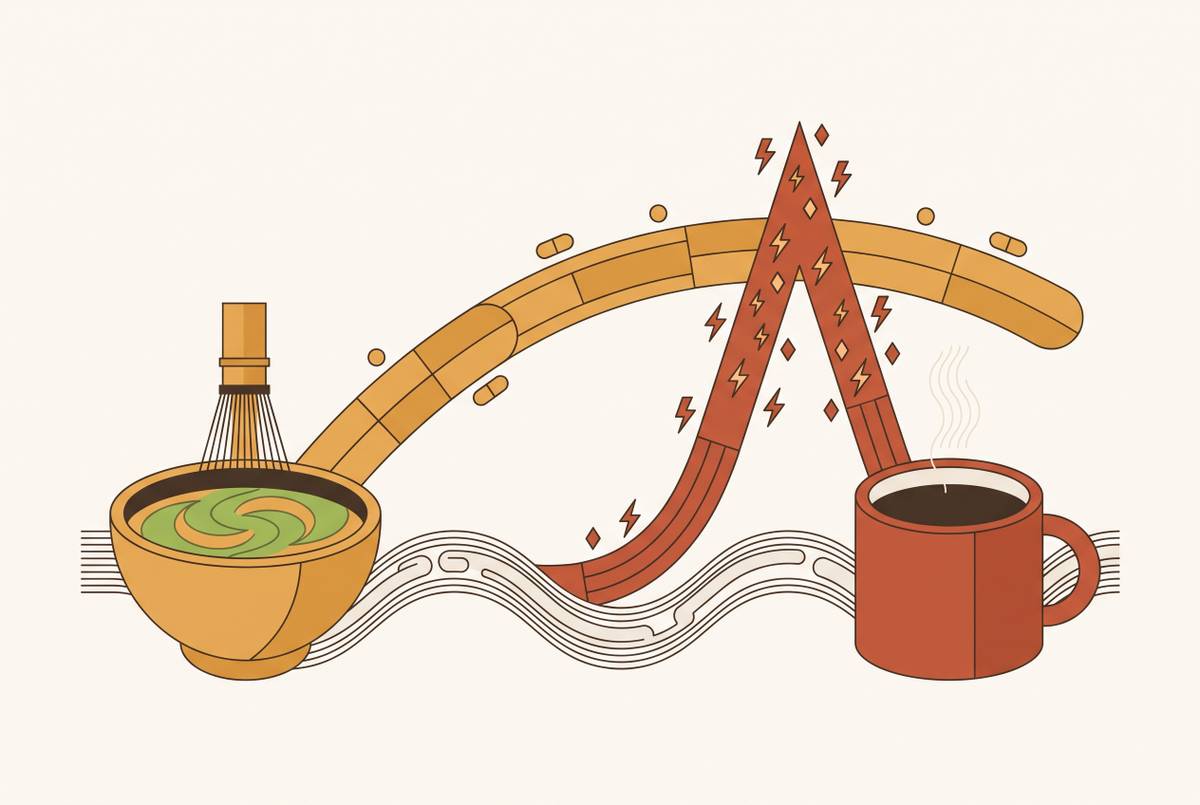
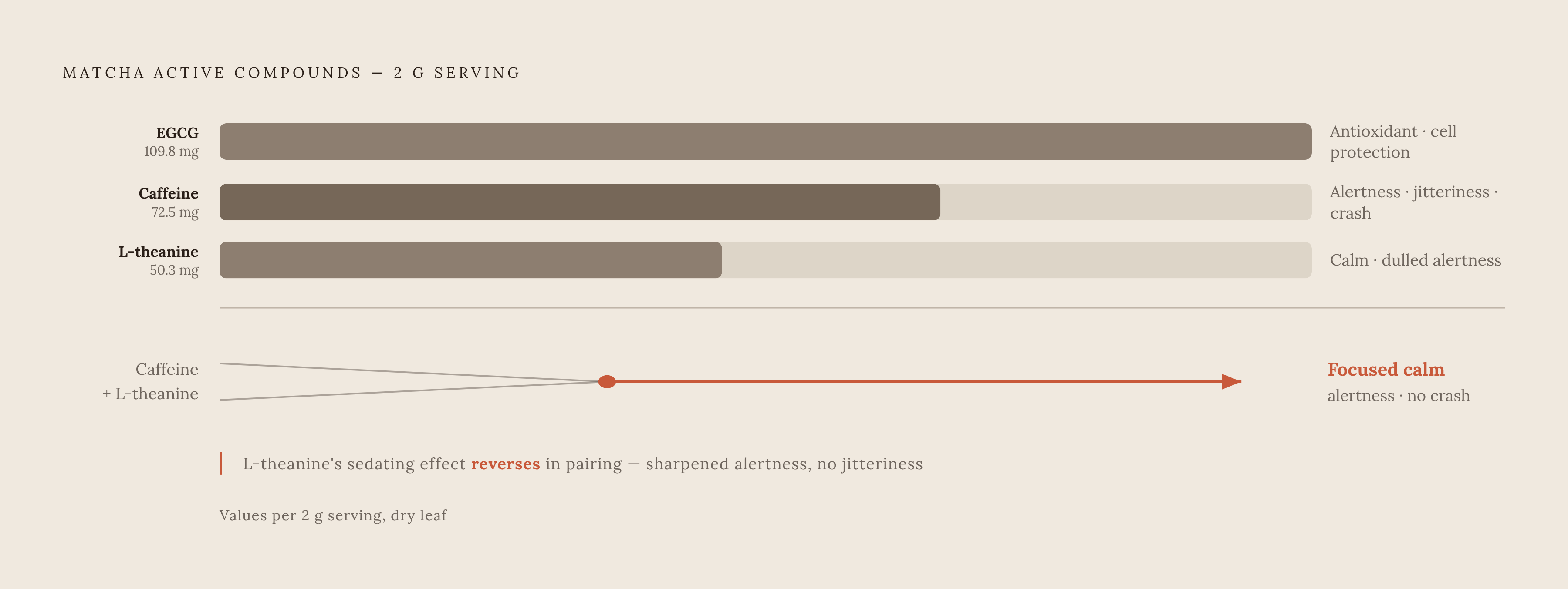
Matcha gives the clearest working example of a whole-food caffeine matrix because it delivers three active compounds together, caffeine, L-theanine, and EGCG, and the combination produces effects that none of the three produce on their own. A standard 2-gram serving of matcha carries roughly 72.5 mg of caffeine, 50.3 mg of L-theanine, and 109.8 mg of EGCG. Because matcha is made from whole tea leaves ground into powder rather than steeped and discarded, the full dose of all three compounds ends up in the cup instead of just the fraction that would leach out during an infusion. L-theanine works through GABA, dopamine, and serotonin to produce a calm that doesn't tip into drowsiness, while caffeine works through adenosine receptor blocking to produce alertness. Combined, they create a state that neither one builds alone. Across several randomized controlled trials, the caffeine-L-theanine pairing has improved attention-switching accuracy, reaction time, and how alert people report feeling, more consistently than caffeine on its own. L-theanine taken alone at higher doses tends to push toward sedation rather than sharpness, so the gain belongs to the pairing, not to either ingredient on its own. That is what makes this synergy rather than two effects running in parallel: L-theanine at calming doses, on its own, dulls alertness instead of sharpening it, and it takes caffeine's presence to flip that balance. A 12-month randomized controlled study of matcha found that regular consumption improved emotional perception and sleep quality in older adults dealing with cognitive decline, a result that stretches the benefit of this matrix well past the hour or two of acute alertness most people associate with a caffeine source. Matcha concentrates this matrix because it's the ground leaf itself. Brewed green tea carries the same three compounds but in far smaller amounts, because steeping only pulls out part of what the leaf holds.
This principle, that how an ingredient reaches the body matters as much as what the ingredient is, shapes how Magic Mind approaches formulation: it relies on patented nanoencapsulation alongside its clinically backed compounds, aiming for bioavailable absorption rather than leaving it to companion compounds to buffer things on their own.
What conventional energy drink stacks offer
Caffeine and taurine, the two bioactives behind most commercial energy drinks, each have real, demonstrated ergogenic effects on physical and cognitive performance, and that record is well established. The pairing has solid support for athletic output and for short-duration cognitive tasks, which is a genuine strength of the format, not an illusion. This gap shows up in the architecture of the formulation itself. Synthetic caffeine in these drinks arrives without the buffering compounds that slow absorption in whole-plant sources, so the rise is quick and the drop afterward tends to be sharper. Nothing in the standard caffeine-taurine stack reaches into memory consolidation, neuroplasticity, or the cortisol response that drives stress-related brain fog. Heavy sugar content makes the drop worse: the blood-sugar swing that follows a large sugar load occurs at roughly the same moment as the adenosine rebound, and the two effects stack on top of each other. When a cross-sectional study looked at this, higher energy drink consumption correlated with worse performance on measures of monitoring, inhibition, and emotional control, a pattern that fits an overstimulation effect more than an enhancement one. Some "calm energy" formulations add supplemental GABA to soften the stimulant edge, but whether oral GABA crosses the blood-brain barrier in any meaningful amount remains a genuinely open scientific question, which limits how much confidence that ingredient deserves. U.S. labeling rules don't require a drink to say whether its caffeine is natural or synthetic, and some labels skip the actual caffeine quantity. Whole-plant sources make that arithmetic easier, because the dose is tied to a known quantity of leaf or bean, not a blend hidden behind a trademark name.
The adaptogen layer: how stress-modulating compounds extend what the matrix can do
Rhodiola Rosea and Ashwagandha go after a problem that neither plain caffeine nor a matcha-style matrix touches: cortisol that stays elevated under chronic stress and wears down memory, attention, and processing speed no matter how much stimulant is on board. Rhodiola works on the hypothalamic-pituitary-adrenal axis, the system that regulates cortisol output, and multiple human trials link it to less mental fatigue, better cognitive performance under stress, and steadier attention during demanding work. A double-blind crossover study of physicians working night shifts found that a standardized Rhodiola extract cut mental fatigue and improved cognitive test scores compared to placebo, with the effect showing up within a single shift rather than the one to two weeks most adaptogens need to take hold. Rhodiola seems to do its best work when the brain fog in question is driven by stress rather than by simple lack of sleep, which matters for anyone deciding which tool fits which problem. Ashwagandha, in standardized forms sold as KSM-66® and Sensoril®, has been shown to lower cortisol significantly in adults under chronic stress, and human studies have also found improvements in both immediate and general memory, a pairing that suggests the cortisol drop is translating into something a person can actually notice. Animal research shows Ashwagandha raises BDNF levels in the hippocampus, and though no one has measured the human BDNF pathway directly, the memory gains recorded in people fit that mechanism. Neither Rhodiola nor Ashwagandha is a stimulant, so neither adds to the body's arousal load the way caffeine does. Their job is to protect the cognitive ground that chronic stress would otherwise wear down, making them a complement to a caffeine source.
The neuroplasticity layer: ingredients that build cognitive capacity rather than borrow against it
Lion's Mane and Bacopa Monnieri work on something no caffeine source and no energy drink stack reaches: the physical density and resilience of the neural connections that make sustained high-level performance possible. Lion's Mane is the most widely studied brain herb for stimulating nerve growth factor, or NGF, a protein neurons need if they are to survive and keep their connections to each other intact. In a double-blind Japanese study, older adults with mild cognitive impairment who took Lion's Mane daily for 16 weeks showed significant gains on the Revised Hasegawa Dementia Scale compared to placebo, and when supplementation stopped, those gains faded, a pattern that points toward the herb actively driving the improvement. Bacopa's active compounds, called bacosides, may raise brain-derived neurotrophic factor, or BDNF, supporting the formation of new synapses and the resilience of existing ones, and research links Bacopa to better memory consolidation and faster information processing, with the strongest effects showing up in people who are stressed or older. The studied dose range for Bacopa runs from 300 to 450 mg a day, and it takes 8 to 12 weeks to show an effect, a timeline that fits a structural mechanism. The real contrast with a stimulant stack is that caffeine and taurine draw on arousal the brain already has stored up, while Lion's Mane and Bacopa put resources into building the underlying wiring itself. The two approaches solve different problems and don't substitute for each other.
Bioavailability and whether a stack works
An ingredient only does its job if enough of it reaches the bloodstream at a high enough concentration to matter, and that bioavailability problem touches whole-food extracts just as much as it touches synthetic stacks. Matcha's whole-leaf form gives EGCG and L-theanine strong bioavailability partly because the compounds show up together in the state the plant naturally delivers them in, an advantage that can get lost once a compound is pulled out and isolated. The GABA added to some "calm energy" drinks runs into the same open question raised earlier: whether oral GABA crosses the blood-brain barrier in any useful amount, which is a real bioavailability gap between what's printed on the label and what the body can actually use. Isolated compounds sold as pills or powders face a parallel problem, because first-pass digestion can break them down before they reach circulation. Nanoencapsulation is one answer to that gap. Magic Mind's patented nanoencapsulation process delivers active ingredients with five times the effective absorption of standard pills and powders, by bypassing first-pass digestion, speeding up onset, and making absorption more consistent from one person to the next, a result that has been clinically studied in humans. The practical consequence is that a stack can be well chosen on paper, combining a solid caffeine source, real adaptogens, and real neuroplasticity ingredients, and still underdeliver if the delivery technology doesn't match the chemistry of what's inside it. Absorption has to be designed for. It doesn't happen by default.
Reading an ingredient stack and choosing a source
The right choice depends on matching the delivery matrix to the actual cognitive task at hand, and the honest answer changes depending on whether the need is a short burst of alertness or something that has to hold up over weeks under stress. For a short task that just needs fast alertness, plain coffee or a clearly labeled caffeine-taurine product is a perfectly reasonable choice, and the acute alertness research backs that up without qualification. For sustained work done under real stress, a whole-food caffeine matrix built around matcha, with its L-theanine intact, outperforms synthetic caffeine alone on attention-switching and mood, and adding adaptogen support from Rhodiola or Ashwagandha covers the cortisol layer that no caffeine source by itself reaches. Building long-term cognitive capacity is a separate project altogether: Lion's Mane and Bacopa need consistent daily use over weeks to show an effect, so that layer should be judged on its own terms rather than folded into the question of same-day energy. Reading a label well means checking for disclosed doses at the levels actually used in the clinical studies, named standardized forms such as KSM-66® for Ashwagandha, no proprietary blend hiding the amount of any single ingredient, and some mention of delivery technology where it bears on how much of the dose the body can use. Magic Mind's Original shot brings ceremonial-grade matcha, L-theanine, Rhodiola Rosea, Ashwagandha, Lion's Mane, Bacopa Monnieri, Cognizin®, Cordyceps, Turmeric, and Vitamins B2, B3, and B12 together with 55 mg of natural caffeine, all nanoencapsulated for that fivefold absorption gain. The stimulant, adaptogen, and neuroplasticity layers all show up in a single daily shot backed by a 100-day money-back guarantee. The MAXX version carries 165 mg of natural caffeine for people who want more stimulant, while the Free version carries 0 mg caffeine and delivers the full adaptogen and neuroplasticity stack intact, built for anyone who already gets their caffeine from coffee separately or who wants to handle the caffeine decision on its own terms. Caffeine's narrow ceiling, limited mainly to alertness, is why many people now reach past caffeine-only products toward formulations built with ten or more clinically validated compounds, aiming not just at alertness but at focus that holds up, stress tolerance, and cognitive resilience over time. Evaluating any stack against a cognitive goal comes down to three questions: does it address acute alertness, does it protect cognitive function under stress, and does it build the structural capacity that makes sustained performance possible in the long run. A formulation that answers all three is doing something a single ingredient, however well studied, cannot do alone.
Sources
- Synergistic Actions of Natural Compounds for Enhancing Cognitive and Physical Performance: A Narrative Review - PubMed
- Comparable improvements in selective, but not sustained, attention in response to a multi-ingredient nootropic formulation when compared with caffeine - PubMed
- (PDF) Caffeine and Cognitive Performance in Healthy Adults: Domain-Specific Effects and Dosing Considerations
- Acute Effects of Naturally Occurring Tea and Coffee-based Ingredients on Cognitive Performance
- Effects of Caffeine and L-Theanine on Physical and Cognitive Performance in Trained Athletes
- Caffeine and taurine: a systematic review and network meta-analysis of their individual and combined effects on physical capacity, cognitive function, and physiological markers