Adenosine Receptor Antagonism and How Caffeine Blocks Fatigue
Caffeine masks fatigue by blocking the brain's tiredness signals, not by providing actual energy.
Caffeine does not supply energy to the brain. It blocks the signaling system that tells the brain how tired it already is. The fatigue is still there, just temporarily hidden from view.
Most people treat caffeine as a kind of fuel, something that gets burned for a jolt of output. That picture doesn't match the chemistry. Caffeine triggers no production of ATP, no release of glucose, no new supply of any neurochemical fuel source. What it does is occupy space on a receptor system that would otherwise be telling the brain to slow down. The tiredness a person felt five minutes before a cup of coffee is the same tiredness sitting in the brain five minutes after, just unheard.
That distinction carries weight because almost everything people find frustrating about caffeine, the tolerance that builds over months, the crash by mid-afternoon, the jitteriness, the nights of thin sleep, traces back to this single fact. None of it is a separate flaw bolted onto caffeine's chemistry. All of it follows directly from the masking mechanism itself. Understanding that mechanism, in detail, is the only way to understand why caffeine behaves the way it does once the day wears on, and what it would actually take to get more consistent mental performance out of a daily routine.
How adenosine accumulates during waking hours
Adenosine is the chemical that produces the feeling of tiredness. It's a natural byproduct of metabolic activity: the brain breaks down ATP for fuel as neurons fire throughout the day, and adenosine is released. The longer a person stays awake, the more adenosine builds up in the brain, and that buildup is the actual biochemical basis for what people call sleep pressure. It is a molecule accumulating in real time, not a metaphor.
Adenosine acts on receptors, and there are four known subtypes: A₁, A₂A, A₂B, and A₃, all part of the G-protein-coupled receptor family found throughout the body. For the purposes of fatigue and wakefulness, only two matter: A₁ and A₂A. The A₁ receptor quiets glutamate-driven signals headed toward cholinergic neurons that project up into the cortex, the circuitry that keeps attention sharp and sustained. As adenosine accumulates and binds more of these receptors, that circuitry gets dialed down, gradually, hour by hour. Focus and alertness erode as a day goes on without any single dramatic moment of fatigue arriving.
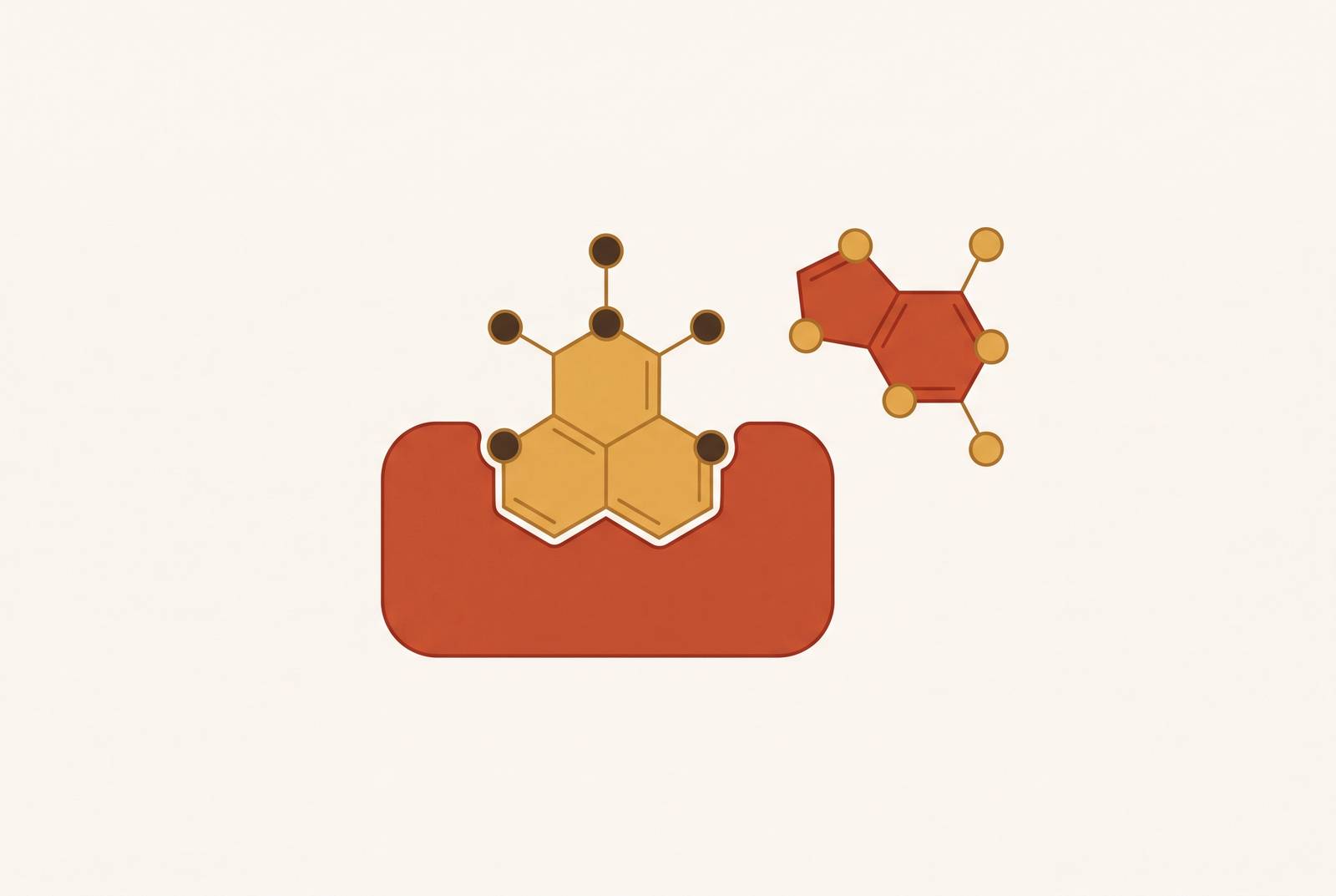
Caffeine interrupts this process because of a structural coincidence: its molecule is small, moderately lipophilic, and close enough in shape to adenosine that it fits into the same receptor sites. Once it crosses the blood-brain barrier, which it does easily given its size and solubility, caffeine competes with adenosine for A₁ and A₂A receptors and wins many of those slots without activating them. Picture a lock that still turns. Picture a lock: caffeine sits in the keyhole but doesn't turn, so adenosine can't turn it either. The warning signal adenosine would have sent gets physically blocked at the point of transmission.
This is caffeine's dominant action at the doses people actually drink. Caffeine can also inhibit an enzyme called phosphodiesterase, block GABA-A receptors, and mobilize calcium inside cells, but those effects require doses 20, 40, and 500 times higher respectively than what it takes to occupy adenosine receptors. At a normal cup of coffee's worth of caffeine, adenosine antagonism is effectively the whole story.
Why caffeine's anti-fatigue effect runs through dopamine
Receptor blockade alone doesn't fully explain how caffeine relieves fatigue. A downstream relay involving dopamine, routed through the striatum, does a substantial part of the work, which makes caffeine's action considerably more layered than simple occupancy of a binding site.
The evidence for this comes from genetic knockout studies. In mice bred without A₂A receptors in the forebrain, caffeine's ergogenic effects, the boosts to physical and mental output that make it useful before a workout or a long workday, disappear. That tells researchers forebrain A₂A antagonism is a necessary step in the chain, not an optional add-on. A 2024 study out of the Federal University of Santa Catarina pushed the finding further: when researchers gave subjects haloperidol, a drug that blocks D₂ dopamine receptors, caffeine's anti-fatigue benefits weakened substantially. So a dopaminergic relay sits downstream of adenosine blockade, and it does a meaningful share of the actual work.
The mechanism runs like this: A₂A and D₂ receptors interact directly in the striatum, so when caffeine blocks A₂A, dopamine signaling gets amplified as a secondary effect. That's the reason caffeine touches motivation and mood, not only raw alertness, and it's also the reason caffeine feels rewarding in a way that plain stimulant action wouldn't fully explain.
Tolerance Buildup and Rebound Fatigue
Caffeine blocks adenosine receptors, but it never removes adenosine from the brain, and that gap is what produces tolerance. The brain, sensing that its fatigue signal keeps getting intercepted, responds the way biological systems usually respond to a blocked channel: it builds more of it. Receptor density goes up. Over weeks and months of regular caffeine use, the brain grows a larger population of adenosine receptors than it would carry otherwise.
That growth is a structural change, not a psychological adjustment or a matter of willpower. When there are more receptors, the same amount of circulating adenosine has more places to bind, so the fatigue signal gets louder, but caffeine's capacity to silence it stays roughly fixed. The two curves move in opposite directions: fatigue signaling strengthens, caffeine's blocking power doesn't, and the net result is that a dose which worked a year ago does less now.
That mismatch produces withdrawal symptoms and the familiar afternoon crash. Skip a dose, or let blood caffeine levels drop as the morning wears into the afternoon: adenosine floods back into a receptor population that has expanded. The binding happens with more force than it would have before tolerance set in, and the result is the headache, the irritability, the trouble concentrating, and the heavy fatigue that habitual coffee drinkers recognize instantly. None of that is caffeine simply wearing off. It's the deferred fatigue signal, arriving through a channel the brain built to be more sensitive after months spent masking the same signal.
How caffeine disrupts sleep and reinforces fatigue-masking
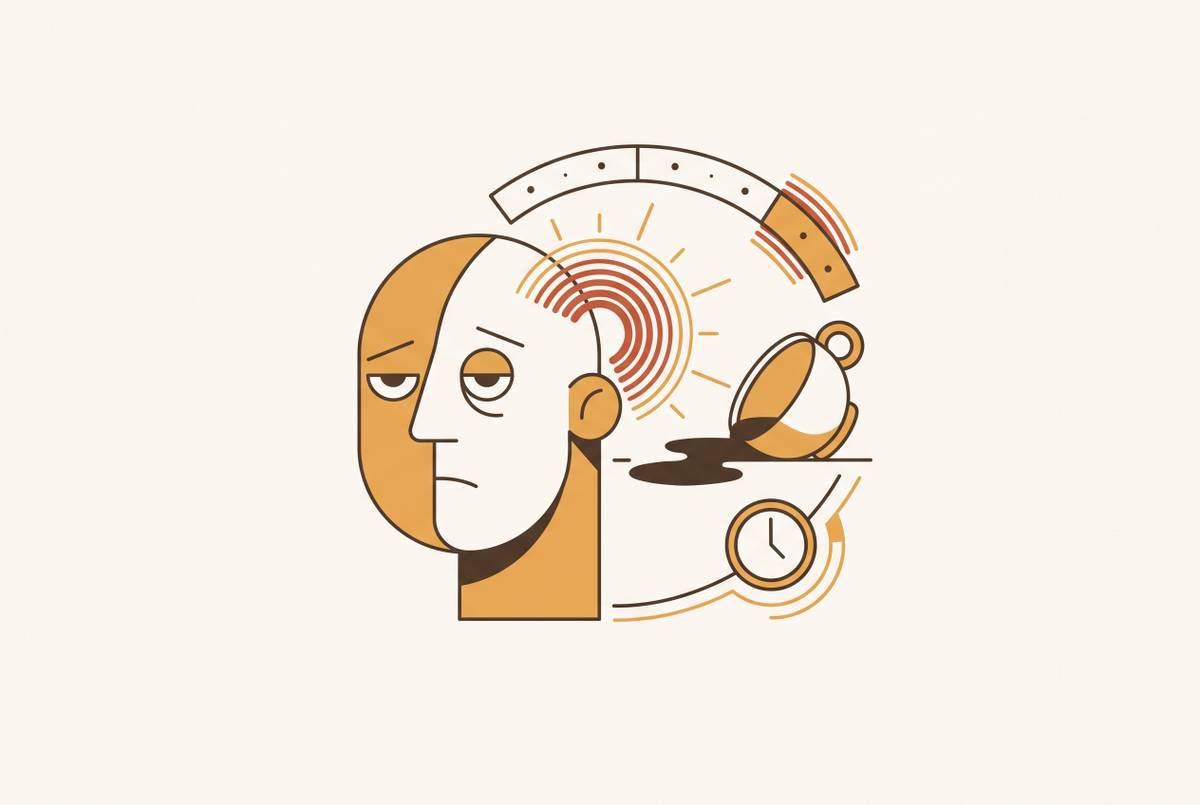
Adenosine that caffeine blocks during the day doesn't disappear. It gets deferred, and the sleep pressure that should have built up normally by evening arrives diminished or delayed, which degrades the sleep that follows and leaves more fatigue to deal with the next morning. The same antagonism of A₁ and A₂A receptors that keeps a person alert at 2 p.m. is the mechanism quietly cutting into the restorative sleep they'll need by 2 a.m.
Cortisol tracks this disruption closely. In people who drink caffeine daily, caffeine blunts the usual morning cortisol rise, and a second spike appears later in the afternoon instead. The body's stress hormone activity doesn't go away. It gets redistributed into a different part of the day, concentrated at an hour when it interferes with winding down rather than at the hour when it would help with waking up.
Poor sleep, caused by caffeine suppressing the sleep pressure that should have accumulated, elevates cortisol again the following morning, and that elevation produces anxiety and irritability. Both of those states are reliably treated with another dose of caffeine, which restarts the entire sequence. It's a closed loop built entirely out of legitimate biochemistry, and plenty of people who run on coffee from morning through evening live inside it and can never name what's happening. Chronically elevated cortisol is independently linked to impaired cognitive performance, so the loop doesn't just fail to deliver the mental sharpness caffeine is taken for. It actively works against it.
How genetics make caffeine's effects unpredictable
Two people can drink the identical cup of coffee and come away with opposite results. One gets measurably sharper executive function. The other gets foggier, more anxious, or both. How quickly each person metabolizes caffeine and the particular genetic makeup of their adenosine receptors shape the pharmacology far more than most people assume.
A study in the Journal of Psychopharmacology found clear gene by caffeine interactions across two separate cognitive domains. If you metabolize caffeine slowly, high caffeine intake was tied to stronger performance on measures of social cognition. If you're a fast metabolizer, moderate caffeine intake gave you the best executive function scores, a completely different dose-response curve for a completely different cognitive outcome. Certain genetic variants in the adenosine receptors themselves also raise your risk of caffeine-induced anxiety, so for a meaningful slice of the population, a standard dose of caffeine reliably brings on agitation.
None of this is a matter of weak willpower or low tolerance when someone says caffeine doesn't sit well with them. It reflects measurable differences in receptor genetics and metabolic speed, and it means no single caffeine dose, however carefully calibrated, can function as a universal solution. A fixed amount of a single compound cannot account for pharmacogenomic variation this wide.
What complementary compounds do that caffeine's mechanism cannot
Caffeine's shortcomings are not accidents to be engineered around with a bigger dose or a slower-release formula. They follow directly from what adenosine antagonism can and cannot do, so you need compounds that work through entirely different biological pathways to close those gaps, not more caffeine delivered more cleverly.
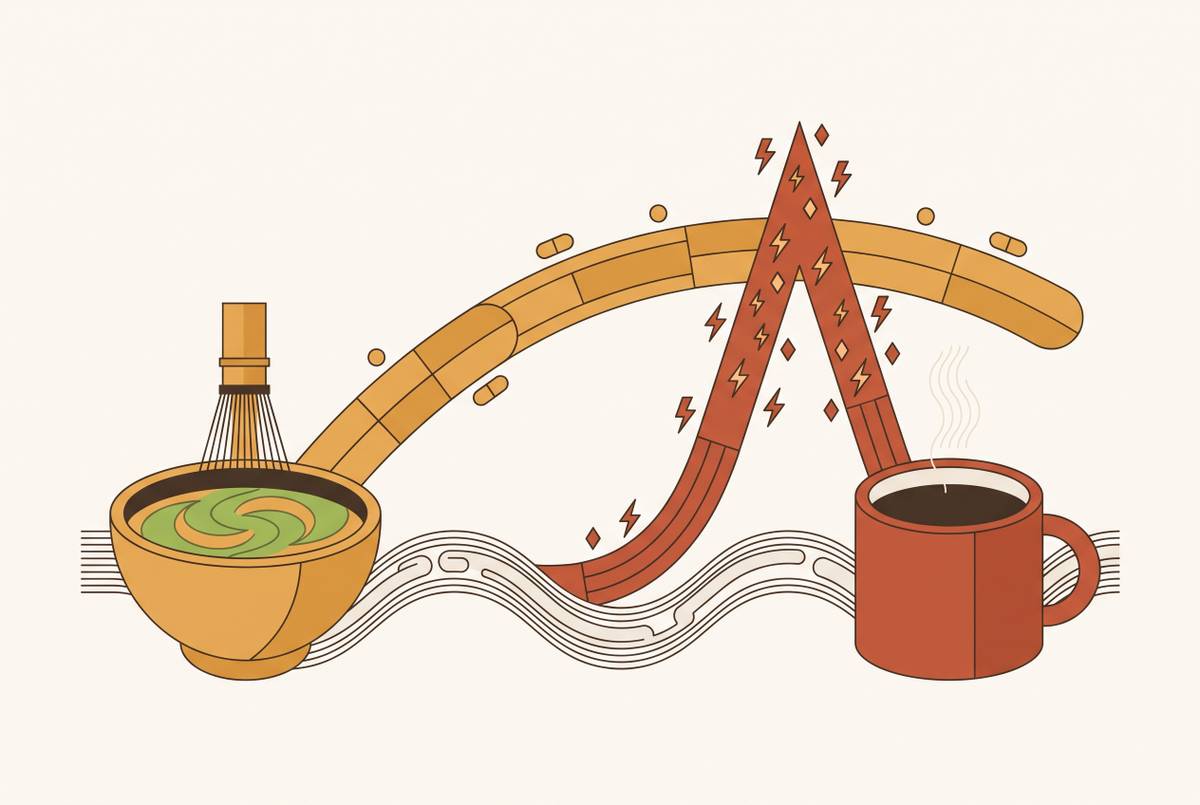
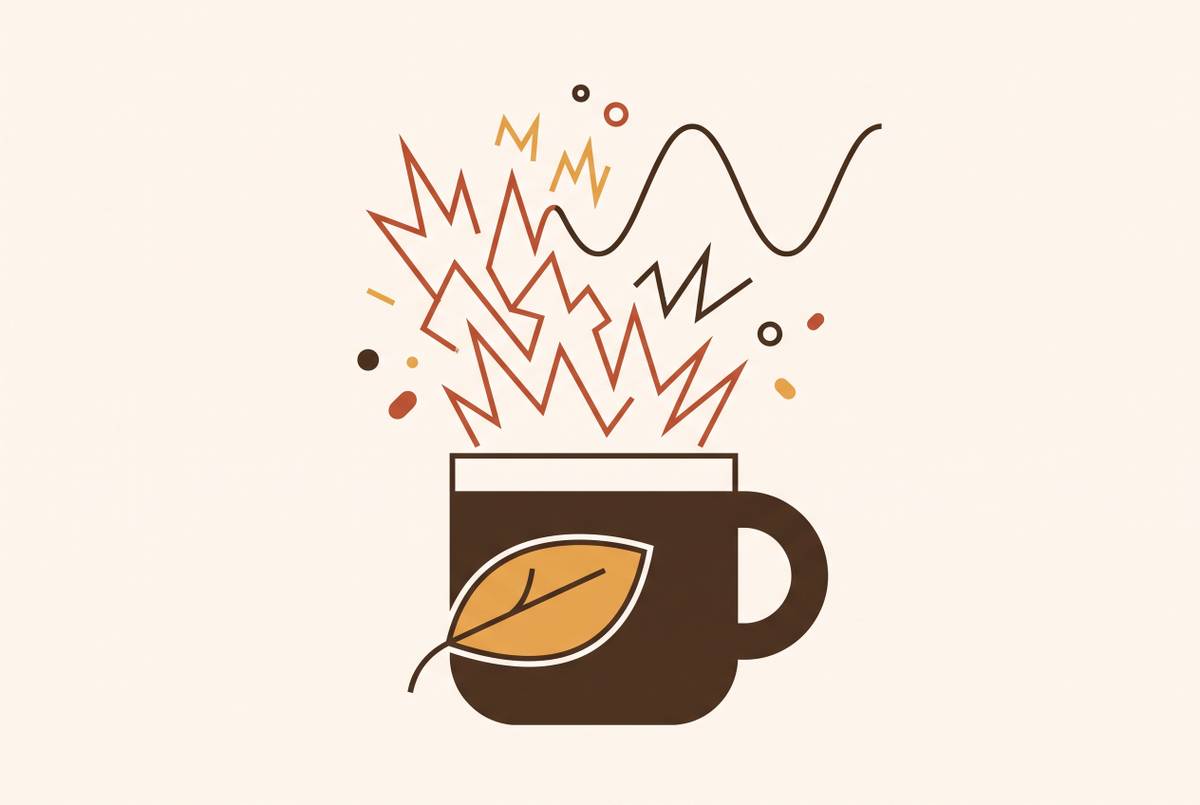
One pathway addresses the overstimulation caffeine's mechanism tends to produce. L-theanine, the compound that occurs naturally alongside caffeine in matcha, works on dopamine and serotonin activity rather than on adenosine receptors, and it tempers the sympathetic overdrive that comes from blocking adenosine alone. The pairing is built for calm focus rather than raw stimulation, which is a large part of why matcha has a different felt character than a straight espresso shot even at a comparable caffeine dose. Guayusa, a different caffeine-bearing plant, has been observed not to produce the jittery sensation commonly associated with coffee, a reminder that the surrounding plant matrix shapes the subjective experience as much as the caffeine molecule itself does.
A second pathway targets the cortisol increase described earlier. Ashwagandha works through GABAergic pathways and supports BDNF, and in doing so it reduces the stress load that caffeine's mechanism tends to amplify, addressing the cortisol-cognition link at its source.
A third pathway works on a much longer timescale. Bacopa monnieri acts through a cholinergic pathway tied to memory consolidation, a system that does not overlap with adenosine receptors. Its benefits build over weeks of steady use rather than appearing after a single dose, which makes it suited to closing a chronic performance gap that caffeine, built for acute effects, was never going to touch.
A fourth pathway targets the physiological root of fatigue. Rhodiola rosea stimulates dopamine, serotonin, and adrenaline activity and builds resilience to stress, working on the body's underlying capacity to handle strain rather than on how tired the brain feels in the moment.
A fifth pathway deals with long-term brain health, not moment-to-moment alertness. A 2025 review confirmed Lion's Mane, Hericium erinaceus, as a neuroprotective compound with antioxidant, anti-inflammatory, and antimicrobial activity. Its erinacines and hericenones promote synthesis of nerve growth factor, supporting neuron growth and repair through a pathway that shares nothing with adenosine antagonism. The evidence base here is earlier-stage than the ashwagandha bioavailability research described below, so you should read this as mechanistic promise, not settled clinical proof.
Why absorption technology determines whether these ingredients work
Picking the right ingredients only solves half of the actual problem. A compound can have strong mechanistic evidence behind it and still produce no measurable effect if the body never absorbs enough of it in a usable form.
Ashwagandha makes this concrete. A 2025 pharmacokinetics study found that the compound's key bioactive components, specifically polar withanolide glycosides, dissolve poorly, which limits how much of the ingredient reaches the bloodstream and caps its real-world effectiveness regardless of how much is listed on a label. A separate 2025 crossover bioavailability study tested four commercially standardized ashwagandha extracts and found that the version with the highest withanolide glycoside concentration, known as WS-35, delivered significantly better bioavailability than the other three. Same plant, same class of active compound, but when absorption was measured directly, the outcomes differed meaningfully.
That finding generalizes across an entire supplement stack. Two products can list identical ingredients at identical doses and still perform differently, because the determining factor is the physical form each compound takes and how well it survives the trip through the digestive system to cross into the bloodstream. Nanoencapsulation is one formulation method built specifically to address this: by shrinking particle size and shielding bioactive compounds during digestion, it targets the absorption step directly, rather than trying to solve the same problem by pushing the dose higher.
What caffeine's mechanism means for a cognitive routine
The pharmacology lays out a clear boundary around what caffeine can do. It blocks a fatigue signal at the receptor level, and through a dopaminergic relay it lifts motivation and mood along with alertness, but it does nothing to produce energy, nothing to clear accumulated adenosine, and nothing to protect the sleep architecture that fatigue recovery actually depends on. Every limitation that follows, tolerance, the afternoon crash, disrupted sleep, a cortisol rhythm pushed into the wrong hours, traces back to that same boundary rather than to some fixable flaw in how a given product is made.
Genetics widen that boundary further, because metabolism speed and receptor variants mean no fixed dose works identically across a population. Closing the gap calls for compounds that work on separate biological pathways entirely: dopamine and serotonin modulation to soften overstimulation, GABAergic support to manage cortisol, cholinergic support for long-term memory consolidation, stress-resilience pathways that address fatigue's physiological root, and neurotrophic support for the underlying health of neurons themselves. None of that matters if the compounds involved aren't formulated to reach the bloodstream in usable concentrations, so absorption technology matters as much as ingredient selection.
Caffeine remains a precise, well-understood tool for one specific job: temporarily blocking a fatigue signal the brain has already generated. Treating it as a complete solution to mental fatigue asks it to do work its own mechanism was never built to do.
Sources
- Received 08/18/2025 Review began 08/26/2025 Review ended 10/13/2025
- Central nervous system effects of caffeine and adenosine on fatigue
- Adenosine A2A and dopamine D2 receptor interaction controls fatigue resistance
- Habitual caffeine intake, genetics and cognitive performance - Angeliki Kapellou, Leta Pilic, Yiannis Mavrommatis, 2025
- Neuronal adenosine A2A receptors signal ergogenic effects of caffeine
- Adenosine, Adenosine Receptors and the Actions of Caffeine *
- Sleep-Wake Regulation and Its Impact on Working Memory Performance: The Role of Adenosine
- Pathways and Mechanism of Caffeine Binding to Human Adenosine A2A Receptor