Nanoencapsulation Technology in Supplement Delivery
Nanoencapsulation boosts how much supplement reaches your bloodstream.

A ready-to-drink nootropic shot can replace the routine of swallowing capsules, but liquid form alone does not establish that it works. Nanoencapsulation Technology in Supplement Delivery explains how to judge a formula by whether it gets evidence-backed ingredients into the bloodstream at concentrations high enough to be useful. Ingredients and delivery science need to be judged together, because a promising compound cannot help if too little survives the trip.
Why most cognitive supplements fail before they reach the bloodstream
A label full of good ingredients looks convincing. The common assumption is that swallowing a studied dose means receiving the benefit seen in research. A label describes what goes into a product at the start of its journey to the blood. Between those points, a compound must survive storage, dissolve in digestive fluids, cross the intestinal lining, and avoid being heavily reduced by metabolism.
Poor solubility is one of the first bottlenecks. A substantial proportion of supplement bioactives dissolve more readily in fat than in water. That creates a problem in the watery environment of the gastrointestinal tract, where poor dissolution restricts absorption. These compounds may also be sensitive to light, heat, oxygen, and changes in pH. Some of the active material can therefore degrade during processing and storage, before digestion even starts.
Surviving the gut is not the final hurdle. Hepatic first-pass metabolism means the liver processes an orally ingested substance before it reaches systemic circulation, reducing the amount available to other tissues. These losses help explain why an ingredient can perform well in a lab dish yet disappoint in the body. Poor aqueous solubility affects a substantial majority of potential nutraceutical compounds, so this is a structural problem across ingredient categories.
What nanoencapsulation actually does to a compound on its way to your cells
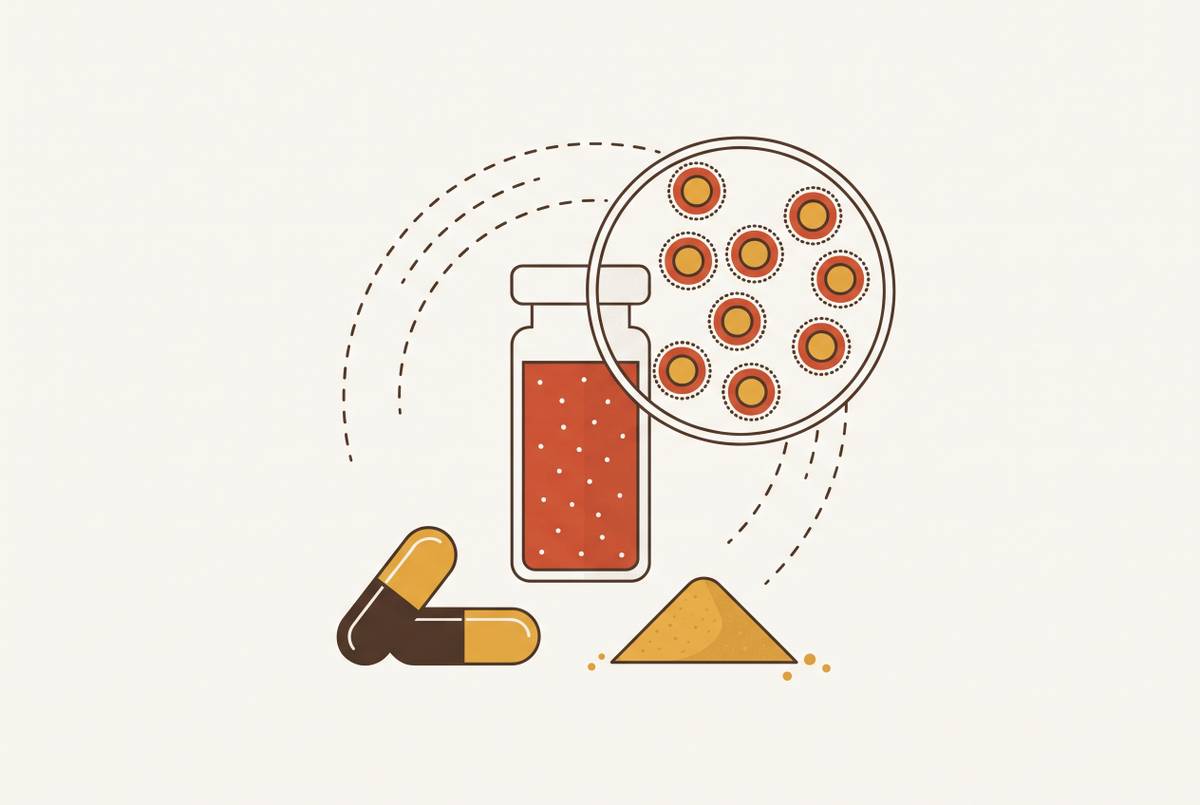
Nanoencapsulation changes the ingredient’s journey while leaving its intrinsic powers unchanged. It encloses active compounds in nanoscale carriers made from food-grade, biocompatible materials. In a lipid-based system, the surrounding fat-based structure helps accommodate a fat-soluble compound in the gastrointestinal environment. The carrier acts as a molecular escort, handling conditions the ingredient struggles with on its own. That can make more of the swallowed dose available for absorption.
Protection and absorption are separate jobs. The carrier can shield sensitive compounds from light, heat, oxidation, and pH extremes, helping preserve the payload before it reaches its absorption site. Once in the intestine, nanoparticles can adhere to the mucus lining, a process called mucoadhesion. Longer contact gives uptake more opportunity. Intestinal cells can also engulf nanoparticles through endocytosis, offering a route around the compound’s own difficulty crossing cell membranes.
Lipid-based carriers can use another route through intestinal lymphatic vessels. This pathway largely bypasses hepatic first-pass metabolism, so absorbed material can reach systemic circulation with less processing by the liver first. The route is especially relevant to fat-soluble compounds. Separately, carriers can be engineered to release their contents gradually, sustaining plasma concentrations. These mechanisms describe a delivery system’s potential, with performance dependent on the individual nanoencapsulated product.
How large the bioavailability gap is between nanoencapsulated and conventional forms
Bhogal et al.’s 2026 chapter in Nanotechnology and Phytopharmaceuticals describes bioavailability improvements between two- and tenfold over free forms across compound classes, though results may vary by formula. Bioavailability describes how much of a substance becomes available to the body, so a large increase can allow an otherwise promising dose to produce measurable exposure.
Curcumin makes the problem concrete because it is a well-studied lipophilic polyphenol with difficult delivery properties. Encapsulation in lipidic nanoconstructs has produced dramatically higher aqueous solubility and oral bioavailability than free curcumin. The ingredient has not become a different compound. Its physical packaging has changed how much can dissolve and reach circulation.
Vitamin D shows that the pattern extends beyond curcumin. Nano-delivery systems can substantially improve its bioaccessibility and increase cellular transport several-fold compared with conventional formulations. Those findings support the broader delivery argument, but they do not establish the size of a cognitive benefit from a different ingredient. The distinction is essential. A several-fold gain in absorption shows that more reaches the body, while a gain in memory or concentration still needs to be shown in its own right.
Why cognitive ingredients specifically have a delivery problem conventional supplements ignore
Cognitive supplements do not escape these physical constraints. Many of their studied active compounds are lipophilic, unstable, or dependent on sustained exposure. Lion’s Mane, or Hericium erinaceus, contains lipophilic erinacines, while hericenones are less so. For it to have the proposed nerve growth factor effects, its active compounds must reach tissue in high enough concentrations. The presence of the mushroom’s name on a label does not establish that this threshold will be reached.
Bacopa Monnieri’s bacosides require sustained plasma presence for memory consolidation effects, making release timing relevant as well as total absorption. Ashwagandha’s cortisol-cognition mechanism depends on bioavailable withanolides and other active constituents reaching tissue to influence the HPA axis, the body’s stress-response system. Cognizin® citicoline differs because it is water-soluble. A full cognitive stack therefore cannot be understood as a collection of compounds with identical delivery needs.
The blood-brain barrier adds another obstacle for neurologically targeted compounds. An oral ingredient must first achieve systemic availability and then still reach its relevant target beyond that barrier. Lymphatic transport can improve the starting concentration available for that second task by reducing earlier losses. Better access to the bloodstream and better access to brain tissue are connected but separate questions, a distinction that keeps the delivery argument grounded.
What the clinical evidence says about specific cognitive ingredients when delivery is accounted for
Bacopa has a comparatively strong human evidence signal. A 2024 meta-analysis found improvements in memory scores and processing speed, while a 2024 12-week placebo-controlled trial found gains across short-term, spatial, and working memory with standardized extract. Standardizing extract and dose reduces some uncertainty about what participants receive. It is a useful proxy for delivery consistency. Those trials support using the ingredient under the conditions in which it was tested.
Lion’s Mane presents a less settled picture. A randomized double-blind placebo-controlled trial in 41 healthy adults aged 18–45 found faster Stroop task performance shortly after a single 1.8g dose. A separate crossover trial in 18 healthy young adults found no significant global cognitive effect from a single dose of fruiting body extract. Extract type and dosing could explain the divergence, but the contrast does not resolve itself. Two larger trials, NCT06870136 and NCT07405632, completed in 2025–2026, are expected to clarify those questions.
With Ashwagandha, changes in stress biology and how people feel need to be judged separately. Double-blind trials show meaningful serum cortisol reductions over an extended period at doses of at least 250 mg/day. However, the pooled evidence is heterogeneous, which weakens confidence in a uniform response. Standardized delivery and dose make its HPA-axis mechanism more interpretable, but do not guarantee felt cognitive improvement.
Rhodiola Rosea fits a different use case. The 2026 evidence characterizes it as antioxidant but not ergogenic, with greater relevance to fatigue-related cognitive decline than sharpening cognition in rested, healthy people. Sleep also belongs within this discussion. BDNF is linked to slow-wave and REM sleep regulation, connecting sleep quality with neuroplasticity and giving sleep-supportive ingredients such as L-Theanine and Ashwagandha a place in the cognitive performance argument.
The strongest objection to delivery-first thinking, and where it actually holds
Better delivery cannot rescue an ineffective mechanism. If a compound has weak or inconsistent clinical evidence, increasing exposure does not establish that it will improve memory, focus, or daily functioning. Treating better delivery as proof of a benefit overstates what formulation science shows. This objection carries the most weight where researchers cannot yet explain why results differ.
Ashwagandha shows precisely where that objection holds. The pooled randomized trial data have high heterogeneity and low-certainty evidence, including a case where cortisol changed but Perceived Stress Scale scores did not significantly change. A biomarker can move without a person feeling different. Even a formulation that hypothetically increased the cortisol effect would still need to establish a subjective benefit.
The positive boundary is narrower and more useful. Where an ingredient has strong independent clinical evidence and absorption is demonstrably the limiting factor, delivery engineering addresses the right problem. Bacopa’s human evidence gives that reasoning a firmer starting point than a compound supported only by lab findings. Dose, extract, and intended outcome still need to match the evidence. Once those questions are settled and absorption remains the last unresolved variable, it becomes a tractable one to engineer.
How lipid-shell nanoencapsulation specifically addresses the absorption barriers cognitive ingredients face
Lipid-based carriers are a particularly good fit for the fat-soluble ingredients in a cognitive stack. Liposomes, solid lipid nanoparticles, and nanoemulsions are relevant because they address the same broad mismatch between lipophilic ingredients and watery digestive conditions. A lipid-shell claim has substance when the system supports dissolution, protects the active material, and enables uptake appropriate to the compound. A claim for olive-oil-derived delivery needs to pass the same test before it can count as proof.
The lymphatic route provides the clearest technical advantage. With less processing by the liver at first, this route can let more absorbed material reach systemic circulation at the same label dose. Timing is a separate design question. Lymphatic transport can reduce a source of processing delay and variability, while controlled release can spread exposure over time. A faster peak and a sustained concentration are different aims, so nanoencapsulation should not be treated as a universal promise of both.
Co-encapsulation extends the approach to multiple ingredients in one formulation. It offers a way to bring release and uptake into step for compounds whose physical properties would otherwise make their timing differ. This is an emerging precision nutrition approach. Contaminant testing addresses a separate quality layer, including PFAS, heavy metals, and mycotoxins. Better absorption says nothing about whether unwanted substances are absent, so delivery performance and third-party testing answer different questions.
What the 2026 state of nanoencapsulation research signals for how cognitive supplements will be evaluated
Bhogal’s chapter places nanoencapsulation within a living reference work in the Reference Series in Phytochemistry. That academic treatment signals a field becoming established delivery science. Parallel work on multifunctional nanoparticle systems and real-time imaging aims to visualize BDNF’s role in developing synaptic connectivity.
Nanocarrier toxicology, manufacturing scale-up, and consumer acceptance remain active challenges in the 2026 research. A plausible mechanism therefore cannot stand in for transparent manufacturing standards or evidence about the finished formulation. Third-party testing matters more as claims about delivery become more complex. The more a product promises about what reaches the body, the more clearly it needs to account for what is being delivered.
For buyers, the practical question is whether a product discloses its delivery mechanism and supports it with evidence appropriate to its ingredients. That applies equally to a ready-to-drink shot and a capsule formula. A label listing Lion’s Mane, Bacopa, Ashwagandha, Cognizin®, and L-Theanine offers an incomplete argument if it leaves absorption unexplained. Consistent daily use and a system designed for sustained exposure can support steadier concentrations than intermittent conventional use, but convenience and formulation remain distinct. The useful comparison is not liquid against capsule alone, but supported ingredients, studied doses, demonstrated delivery, and transparent quality controls.
Sources
- Frontiers
- Nanoencapsulation of Nutraceuticals and Dietary Supplements for Effective Delivery
- Frontiers
- Advances in Nanoparticle-Based Vitamin Delivery Systems for Precision Nutrition and Improved Bioavailability
- Nanoencapsulation and Nanocoating of Bioactives of Application Interest in Food, Nutraceuticals and Pharma
- Nanonutraceuticals Delivery
- The Impact of Supplementation With Hericium Erinaceus (Lion's Mane) Extract on Cognitive Functioning
- The Acute and Chronic Effects of Lion’s Mane Mushroom Supplementation on Cognitive Function, Stress and Mood in Young Adults: A Double-Blind, Parallel Groups, Pilot Study