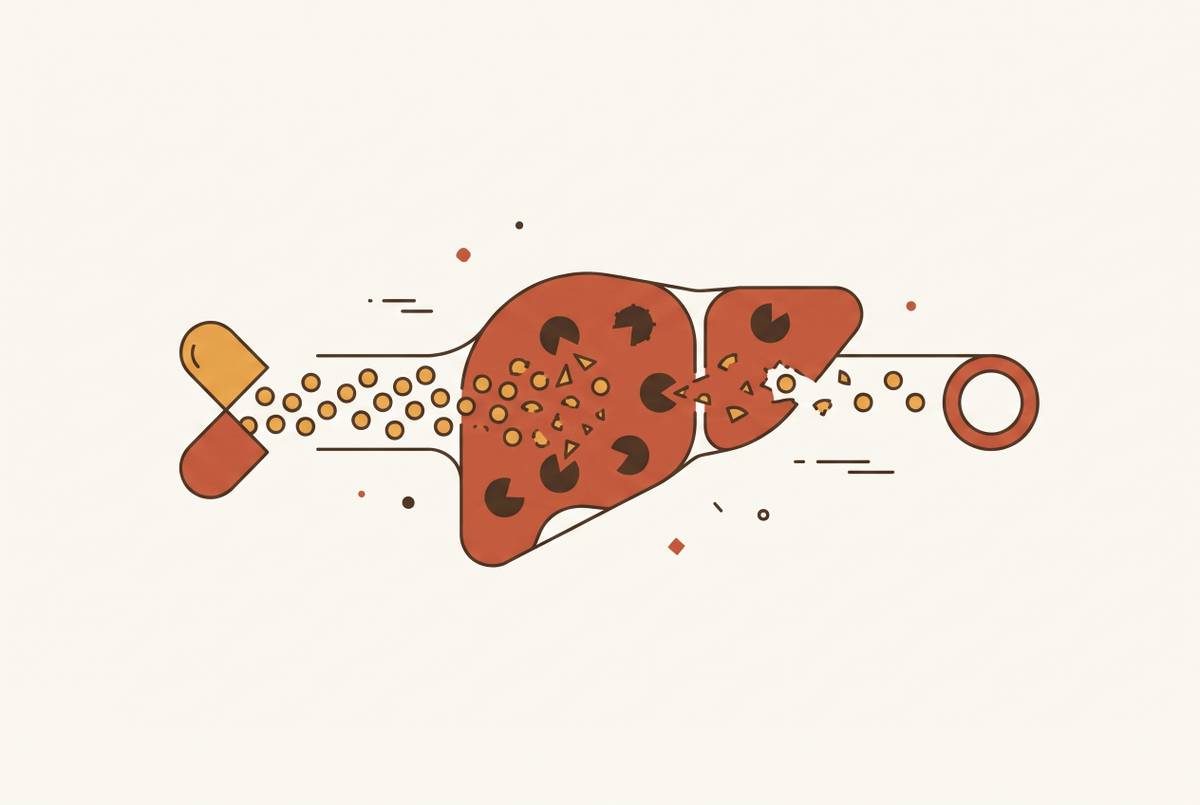
Liposomal Delivery vs Standard Capsules for Fat-Soluble Nutrients
Liposomal delivery helps some nutrients but not all—here's what the evidence actually shows.

A ready-to-drink nootropic shot can take the place of swallowing capsules, but being a liquid does not prove that it offers better absorption or better results. For fat-soluble nutrients, liposomal delivery can change how much reaches the bloodstream, yet properly formulated standard capsules often work well. The upgrade is justified when the specific ingredient has an absorption problem and the finished formula has evidence that it solves it.
Why the gap between dose and effect exists for hard-to-absorb nutrients
The dose on a label measures what goes into the supplement at the start of its path to circulation. Digestion puts several barriers between those two points. Stomach acid can degrade acid-sensitive molecules before they reach the intestine, while brush-border enzymes at the intestinal wall can modify or break down compounds during uptake. Absorbed compounds then usually enter portal circulation and pass through the liver, where first-pass metabolism removes a fraction before the rest reaches the body.
Absorption studies track this gap through two main measures. Cmax is the highest concentration measured in the blood, while AUC, or area under the curve, measures total exposure over time. A higher peak is not the whole story. A higher AUC means more of the compound reached circulation during the measurement window. Neither measure can be inferred from the label dose alone, because each compound survives digestion differently.
Why fat-soluble and water-soluble nutrients fail in different ways
Vitamins A, D, E and K can use the body’s normal lipid-digestion pathways, so properly formulated standard products generally work well. Some water-soluble compounds have high baseline absorption at normal doses, while the body has more trouble absorbing all of the vitamin C as doses rise and gut uptake becomes saturated.
Other compounds fail for different reasons. Glutathione is vulnerable to digestive breakdown, making standard oral delivery inefficient. Curcumin has poor water solubility and struggles to cross the intestinal membrane in unformulated form. Delivery choices therefore depend on which compounds need protection or help with solubility.
How a liposome physically protects a nutrient through digestion
A liposome is a microscopic sphere with a watery core enclosed by a phospholipid bilayer. That shell has the same double-layer structure as cell membranes. Water-soluble nutrients sit in the core, while fat-soluble compounds can sit within the bilayer itself. The architecture gives the active ingredient a protective enclosure, rather than simply mixing it into a drink or placing it inside a capsule.
That enclosure addresses the first two digestive barriers directly. The bilayer resists acidic conditions and shields its contents from digestive enzymes during intestinal transit. Protection is only part of the mechanism. At the intestinal lining, cells can take up the vesicle through endocytosis. In this process, the cell membrane engulfs it. Some may also enter through the lymphatic route, which lets part of it avoid first-pass metabolism in the liver right away.
This is a potential route by which swallowed liposomes may reach the bloodstream intact. Once in circulation, liposomes can interact with and fuse with cell membranes, releasing their contents at the cellular level. The mechanism explains why encapsulation can improve delivery. Whether it does so in a particular supplement still depends on the formulation. Human absorption measurements are therefore more persuasive than a diagram of a lipid shell.
What clinical trials actually show about liposomal absorption gains
Martin Purpura and colleagues’ 2024 double-blind, placebo-controlled, randomized crossover trial in European Journal of Nutrition looked at how vitamin C was delivered in 27 healthy adults. The trial found a moderately higher peak plasma concentration with liposomal vitamin C than with standard vitamin C at the same dose. It also measured an advantage in leukocytes, or immune cells. The gain was not confined to blood plasma. Even so, better uptake alone does not prove that it helps people think better or gives them a benefit they notice each day.
Vitamin C also illustrates a practical consideration beyond blood measurements. Liposomal delivery can allow higher doses with less of the bowel intolerance associated with standard high-dose ascorbic acid. Glutathione and curcumin present a stronger mechanistic case because their standard forms face substantial digestive or solubility barriers. Human evidence for liposomal delivery is most consistent for vitamin C and glutathione, while results for other ingredients depend more heavily on the specific formulation and study.
Dałek et al.’s 2022 comparison found that blood levels rose faster and were significantly higher with liposomal Vitamin D3 than with oil-based capsules. That finding prevents a simple rule that fat-soluble vitamins never benefit from encapsulation. The evidence supports ingredient-by-ingredient decisions about absorption gains for products labeled liposomal.
Why the liposomal advantage matters specifically for cognitive and stress-related ingredients
Curcumin shows why the delivery system belongs in any discussion of cognitive ingredients. Evidence links it to working memory, mood, attention and reduced perceived fatigue, but its poor bioavailability complicates comparisons between research formulations and ordinary capsules. The ingredient name alone is not enough. Without a lipid carrier or another solubility-enhancing approach, an unformulated product may deliver far less than the formulation used in a study.
Phosphatidylserine, or PS, raises a different question. It is a phospholipid found in neuronal cell membranes, and evidence supports its role in moderating the HPA axis, the system involved in the stress response. That is relevant because prolonged stress affects memory and decision-making. A phospholipid carrier is structurally compatible with PS, but chemical compatibility does not establish a clinical advantage over standard delivery. Bacopa Monnieri’s active compounds, bacosides, benefit from lipid co-ingestion, while its memory-related effects require sustained daily use over many weeks.
Lion’s Mane also requires attention to duration and population. Its hericenones and erinacines may promote nerve growth factor, a protein involved in maintaining and regenerating neurons. Trials have not produced uniform cognitive results. A single acute dose in healthy younger adults had no significant overall effect on composite cognitive function, while older people who took it for longer improved compared with those who took a placebo. Better absorption cannot erase those differences or turn evidence from sustained use into proof of an immediate effect.
Matcha and L-theanine address a more immediate goal of calm alertness. L-theanine can soften caffeine-related jitteriness without removing its alertness benefits, but that does not mean encapsulation is necessary for it to work. The 2026 systematic review and meta-analysis in Molecular Psychiatry examined 31 randomized controlled trials and found improved choice reaction time after a single dose of L-theanine. Effects on acute stress were modest and influenced by bias, while broader cognitive and mood findings were limited or mixed. For a liquid blend, onset and absorption claims therefore need evidence for the formula as a whole.
How fat-soluble nutrient absorption connects to sleep quality and overnight cognitive recovery
During sleep, glymphatic clearance removes metabolic waste, memory consolidation takes place and the brain forms and adjusts connections. Nutrients involved in neural membrane integrity and related processes, including PS and omega-3 DHA, must be absorbed to be available for those roles. Vitamin D and the mineral magnesium also belong in the discussion of nutrients relevant to sleep.
Dependable delivery over time is relevant to Ashwagandha’s stress-resilience effects, which typically emerge with consistent daily use and matter for sleep onset because chronically elevated stress can disrupt sleep. Consistent absorption of appropriate compounds at adequate doses supports sustained exposure in a way that irregular or poorly absorbed supplementation cannot.
Where liposomal encapsulation does not improve on standard delivery, and why that matters
For an ingredient already absorbed well, encapsulation may add cost without a meaningful benefit. The body often absorbs properly formulated vitamins A, D, E and K well, despite the finding for that specific Vitamin D3 formulation. Well-chelated minerals such as magnesium glycinate already have an approach that improves uptake. B vitamins and other water-soluble compounds with high baseline absorption at normal doses may also do well in standard form. There needs to be a clear reason to use a more complex carrier.
The label itself is not proof of that reason. Genuine liposomal production requires specialized equipment and verification that the intended particles have formed. A simple lecithin blend is not equivalent to demonstrated encapsulation. Shelf stability is another limit, because particles can change or clump together while stored, which makes them less able to improve delivery. An absorption result from a fresh research sample cannot, by itself, establish how a commercial product performs throughout its shelf life.
The clinical evidence has limits as well. Small samples, differences between formulations and variable outcomes make it difficult to transfer a result from one product to another. A positive trial supports the specific formulation tested.
How nanoencapsulation compares to liposomal delivery, and when it is worth the trade-offs
Nanoencapsulation uses very small particles to try to improve delivery, especially for compounds that do not mix well with water. It is not a cleanly separate size category. The ranges given for these technologies overlap, with liposomes at approximately 50–250 nm and nanoencapsulated particles typically below 100 nm. Smaller particles may help the body absorb more, but size alone does not prove that they work better. The shell, active ingredient and finished formulation still need to be tested.
Producing those particles also creates practical costs. Genuine nanoencapsulation requires pharma-grade equipment, and the resulting formulation can be less stable than a liposomal product. Particle aggregation during storage can erode the absorption advantage, while some formulations require refrigeration. Some markets may also require additional safety data for nano-formulations. A small gain in controlled conditions has less value if the product cannot preserve it through ordinary storage.
Lipid-shell approaches, including patented olive-oil-derived shells, aim to combine protection with improved uptake and partial avoidance of immediate first-pass metabolism. A patent, however, does not answer the absorption or stability questions. Finished products need to be compared by how well they have been shown to work, since technology names alone do not show that. Nanoencapsulation is worth its trade-offs when evidence supports an additional delivery benefit for the active and shows that the commercial formulation retains that benefit over its stated shelf life.
How can you tell whether an encapsulated nootropic shot actually delivers?
For a buyer choosing a drinkable alternative to capsules, the lesson is to separate convenience from demonstrated performance. Start with the active ingredient and ask whether it has a known problem in standard form. Curcumin, glutathione, higher-dose vitamin C and poorly soluble polyphenols give a carrier a clear job. Then look for human evidence at the delivered dose. Animal or laboratory results do not establish that the amount in a daily shot produces the claimed cognitive or stress-related effect.
The next step is to examine the delivery claim itself. Particle-size testing, such as dynamic light scattering or an equivalent method, helps distinguish measured particles from a vague liposomal label. Disclosure of the phospholipid source and encapsulation method adds useful detail. Storage evidence is just as important here. The stated shelf life should be supported under the stated conditions, including any refrigeration requirement, rather than resting only on measurements taken immediately after production.
Third-party testing for contaminants, including heavy metals, mycotoxins and PFAS, and certification from recognized bodies are baseline signals of manufacturing quality. Transparent ingredient doses allow comparison with clinical research, while proprietary blends obstruct it. Purity testing and delivery testing answer different questions. A convincing product needs evidence appropriate to both, rather than using one certificate to imply that every claim has been established.
Bacopa’s memory effects take many weeks of regular use to develop, and Ashwagandha’s stress-resilience effects also develop over weeks. Lion’s Mane findings depend on sustained use and the population studied. For these ingredients, a ready-to-drink format may simplify the routine, but it cannot compress the research timeline. The strongest reason to pay for encapsulation is a demonstrated solution to an actual absorption problem.
Sources
- Liposomal vs Nano-Encapsulation vs Standard Delivery: Which Wins for OEM Customers in 2026? - Bionutricia Holding Sdn Bhd
- Liposomal delivery enhances absorption of vitamin C into plasma and leukocytes: a double-blind, placebo-controlled, randomized trial
- Fat-Soluble Vitamins in Standard vs. Liposomal Form Enriched with Vitamin K2 in Cystic Fibrosis: A Randomized Multi-Center Trial