Acetylcholine Synthesis Pathway and Cognitive Performance
Boosting choline intake sharpens attention and memory formation.

Acetylcholine runs two separate jobs in the nervous system, and almost no other signaling molecule does both. When a motor neuron releases acetylcholine onto a muscle fiber, the result shows up almost instantly: nicotinic receptors are ion channels that open the moment the molecule lands, letting sodium and calcium flood into the cell and the muscle fire. That's the fast mode. The slow mode belongs to the basal forebrain, where cholinergic neurons release acetylcholine across the cortex and reset how entire circuits handle incoming information, sharpening attention and priming those circuits to learn. Two receptor families divide this labor: nicotinic receptors handle the fast, ionotropic signaling, while muscarinic receptors, slower and built on G-protein coupling, carry out the longer modulatory work; the M1 muscarinic receptor, concentrated in the hippocampus and prefrontal cortex, matters most for memory and executive function. Acetylcholine's split identity, capable of triggering a twitch in milliseconds and consolidating a memory over hours, is what makes the pathway that produces it worth understanding in detail.
The synthesis pathway step by step: choline uptake, ChAT activity, vesicular storage, and release
Acetylcholine gets built and delivered through four linked steps, and a slowdown at any one of them limits how much ends up at the synapse.
Step one is choline uptake, which forms the bottleneck for the whole chain. Neurons can't make their own choline; it has to come from outside the cell, and the sodium-dependent, high-affinity transporter called ChT1 controls how much gets in. Because neurons depend entirely on this external supply, getting choline from the diet and across the blood-brain barrier is a precondition for the entire pathway to run.
Step two is synthesis itself. Once inside the presynaptic neuron, choline meets acetyl-CoA, a product of mitochondrial metabolism, and the enzyme choline acetyltransferase (ChAT) joins them into acetylcholine. ChAT's activity level reflects the health of the cholinergic neuron producing it, so a decline in that activity signals a real breakdown in the system.
Step three is storage. The vesicular acetylcholine transporter, or VAChT, loads the newly made acetylcholine into synaptic vesicles, where it waits for a release signal. This step used to be something researchers could only infer. Now it can be measured directly in living people with the PET ligand [18F]FEOBV, turning vesicular storage capacity into an actual biomarker of cholinergic function.
Step four is release and recycling. An electrical impulse triggers calcium to flow into the neuron, the vesicles fuse with the membrane, and acetylcholine spills into the synaptic cleft. Acetylcholinesterase then breaks it back down into choline and acetate within milliseconds, and that choline gets pulled back into the presynaptic neuron to be used again. This entire cycle, synthesis through degradation, moves fast enough to support split-second attentional shifts, and it still sustains the slower modulation that underlies learning over time. The system isn't a one-way burn of raw material. It runs on a loop that can be kept well-stocked or allowed to run down, depending on what feeds back into step one.
Where these pathways project in the brain
The cognitive effects of acetylcholine depend on where the signal actually goes, not just on how much gets made. The basal forebrain projection system is the one that governs memory, attention, and learning, and it reaches specific, mappable targets.
The nucleus basalis of Meynert sends cholinergic fibers out to the neocortex, including the frontal lobes, and to the amygdala, covering the circuits behind higher cognitive function and fear regulation. The hippocampus gets its cholinergic input from a different source, the medial septum and the diagonal band of Broca, and this is the circuitry responsible for encoding new memories. A separate branch of the system starts in the brainstem, at the pedunculopontine and laterodorsal tegmental nuclei, and extends into the striatum, where it supports motor control. That pathway sits outside the memory and attention story this piece is tracing, but it still matters if you want the full scope of cholinergic function.
Acetylcholine also reaches the mesolimbic dopamine system, again through the laterodorsal tegmental nucleus and the pedunculopontine nucleus, linking the molecule to motivation and reward processing and extending its reach well past pure memory function. A small population of cholinergic interneurons inside the striatum, a minor fraction of the total neurons there, further shapes reward and reinforcement learning.
When acetylcholine availability drops at the synapse, the damage lands on specific functions, episodic memory encoding, sustained attention, behavioral flexibility, because each of those functions is tied to a distinct projection pathway, not as a uniform fog across cognition. A deficit in one circuit doesn't necessarily mean trouble in another. The geography of the system matters as much as the biochemistry.
Choline supply as the most controllable variable in the pathway
Since neurons can't make choline on their own and ChT1-mediated uptake is the rate-limiting step in the entire pathway, the amount of acetylcholine the brain can produce is ultimately capped by how much choline is on hand. So dietary choline is the single most controllable upstream lever in the whole system.
Phosphatidylcholine makes up the large majority of choline found in animal tissue. Eggs and liver stand out as the most concentrated dietary sources for supporting acetylcholine production. The stakes here aren't abstract: the Framingham Offspring Cohort found that past choline intake was significantly associated with changes in white-matter hyperintensity volume, and concurrent choline intake was tied to measurable differences in cognitive function. Choline also builds phosphatidylcholine for the cell membrane itself, so a chronic shortfall damages neurotransmission and membrane structure at the same time.
Eating more eggs sounds like the obvious fix, but not every form of dietary choline crosses the blood-brain barrier with the same efficiency. That gap in absorption and conversion is why the form a person takes matters as much as the amount, and it's the question the next section takes up directly.
Variation among choline precursors in reaching and feeding the pathway
Alpha-GPC and citicoline both raise acetylcholine synthesis, but they get there by different metabolic routes, and that routing shapes how fast each one acts and what secondary effects come along with it.
Alpha-GPC, also called choline alphoscerate, is a cholinergic compound already present in the brain. Its choline content is high and it crosses the blood-brain barrier efficiently, so it converts rapidly and directly into the active form of choline that feeds acetylcholine release, a more direct route than citicoline takes. Clinical studies show improvements in reaction time on psychomotor vigilance, Stroop, and serial-subtraction tasks at doses between 200 and 630 mg. A 2025 review in Frontiers in Aging Neuroscience adds that choline alphoscerate may also support healthy sleep architecture and protect against β-amyloid injury, extending its relevance well past short-term cholinergic support. Its efficacy for cognitive function is established in patients with mild cognitive impairment, Alzheimer's disease, and cognitive impairment of vascular origin.
Another precursor compound raises acetylcholine levels through a longer metabolic sequence, and clinical research backs its use for attention, mental energy, and working memory. The longer route isn't a drawback by default. Citicoline's additional metabolic byproducts may contribute benefits of their own beyond raw acetylcholine production. But if you want direct, fast precursor loading, Alpha-GPC's conversion pathway gets you there more efficiently.
Acetyl-L-Carnitine works on a different part of the chain. It is needed for the mitochondrial function that generates acetyl-CoA, the second raw material ChAT needs, working as a complementary tool alongside choline supply.
Choosing among these options comes down to more than dosage. It depends on where in the pathway a given compound acts and how well it clears the blood-brain barrier, the same bioavailability logic that governs supplement choices generally.
Compounds that modulate the pathway indirectly by protecting ChAT activity, slowing ACh breakdown, or improving the conditions under which synthesis occurs
Supplying choline is necessary, but it isn't the whole picture. The pathway's output also depends on ChAT staying active, on acetylcholine breakdown happening at a reasonable pace, and on the surrounding cellular environment supporting plasticity. Several bioactive compounds act on these conditions directly.
Lion's Mane (Hericium erinaceus) works through nerve growth factor. Hericenones, found in the fruiting body, and erinacines, found in the mycelia, stimulate NGF synthesis, which supports neuronal growth and repair. In a preclinical Alzheimer's model, a polysaccharide-enriched extract raised both acetylcholine levels and ChAT activity directly, and it acted on the enzyme at the center of the synthesis pathway. The human evidence comes with an important qualifier: an April 2025 randomized crossover study of 18 young adults found that a single dose had no effect on cognition or mood, which points to Lion's Mane as a slow-build intervention aimed at long-term structural support, delivering no acute cognitive lift.
Bacopa Monnieri works on the breakdown side. It gently inhibits acetylcholinesterase, slowing the rate at which acetylcholine gets broken down in the synaptic cleft and stretching out the signal without shutting the enzyme off. Bacosides also raise protein kinase activity in the CA1 and CA3 regions of the hippocampus, encouraging the growth of new synaptic terminals and dendritic branching, structural changes that help the brain make better use of the acetylcholine signal it already has. Bacopa's evidence base is one of the deepest in the nootropic herb category, with well over a thousand studies and numerous human trials behind it. Standardized extract requires 300 to 600 mg per day, and full cognitive benefits generally take 8 to 12 weeks of steady use to appear.
Ashwagandha (Withania somnifera) takes a different angle, working through cortisol. Chronic cortisol elevation suppresses cholinergic neuron function and interferes with memory encoding, which makes cortisol a real mechanistic link between stress and a weakened acetylcholine system. A 2025 systematic review and meta-analysis found a statistically significant reduction in cortisol with Ashwagandha use, but a mismatch between cortisol reduction and perceived stress scores shows dose, duration, and the populations studied still need more work. A 90-day randomized controlled trial found significantly improved recall memory, lower cortisol, and better sleep quality in the Ashwagandha group compared to placebo, tying the cortisol reduction directly to memory outcomes that depend on a functioning acetylcholine pathway. Withanolides, the compounds behind these effects, lower cortisol and improve sleep onset through adaptogenic mechanisms, making Ashwagandha a tool for reducing one of the pathway's most persistent environmental stressors.
How cortisol and sleep deprivation degrade the pathway
The acetylcholine synthesis pathway doesn't run in isolation from the rest of the body's physiology. Chronic cortisol elevation and sleep deprivation both create conditions where ChAT activity falls, acetylcholine availability drops, and the cognitive functions built on that pathway suffer, even when choline intake is perfectly adequate.
Chronic cortisol elevation suppresses the cholinergic neuron function that memory encoding and sustained attention depend on, and this is one of the clearest mechanistic links between chronic stress and acetylcholine deficits. Sleep deprivation works through a related but distinct route: it disrupts serotonin, dopamine, and GABA signaling, interfering with synaptic function and plasticity, and it reduces neuroplasticity markers like BDNF and NGF, which in turn weakens synaptic connectivity. The combined effect degrades motor performance, cognitive processing, and emotional regulation.
Acute interventions can partly offset the sleep-loss side of this equation. A double-blind, placebo-controlled crossover trial published in August 2025 in the British Journal of Nutrition (conducted at the University of Peradeniya) tested a combination of 200 mg L-theanine and 160 mg caffeine against neurobehavioral and neurophysiological measures of selective attention in 37 healthy adults aged 22 to 30 who had gone without sleep overnight. The trial was designed to test whether that combination could rescue the attention deficits caused by sleep loss. A separate review found that targeting cortisol dysregulation through bioactive compounds can serve as both a preventive and a restorative strategy for chronic stress or ongoing sleep problems.
Managing cortisol and protecting sleep aren't extras layered on top of a supplement regimen. They set the operating conditions the entire pathway runs under. Compound strategy on its own can't carry the full weight of cognitive support.
What cognitive training does to the cholinergic system
Vesicular storage, step three in the synthesis pathway, was long treated as a fixed ceiling on how much acetylcholine the system could hold and release. Direct neuroimaging evidence from a 2025 randomized controlled trial shows that ceiling can move.
The INHANCE trial, published October 13, 2025, in JMIR Serious Games, used PET imaging with the VAChT ligand [18F]FEOBV to measure cholinergic binding in 92 healthy adults aged 65 and older, before and after 35 hours of computerized cognitive training spread across 10 weeks. This marks the first evidence that speed-based training can measurably change cholinergic terminal density in living humans, as captured through VAChT binding on FEOBV-PET. That result speaks directly to the pathway's storage and release capacity, not just to self-reported cognitive improvement.
The cholinergic system weakens progressively with age, but cognitive training gives you a non-drug route to push back against that decline, because it strengthens the pathway's physical infrastructure, not just its raw material supply. A second trial, registered under NCT07243600 and not yet recruiting, is set up to test whether this same kind of neuroplasticity-based computerized exercise can improve neurological health through acetylcholine in people with mild cognitive impairment, extending the question from healthy aging into early disease. Choline precursors and cognitive training aren't competing approaches. One feeds the pathway's substrate supply, and the other builds up the transporter machinery that packages and delivers it.
Putting the pathway together: what each step implies for how someone can support their cognitive performance day to day
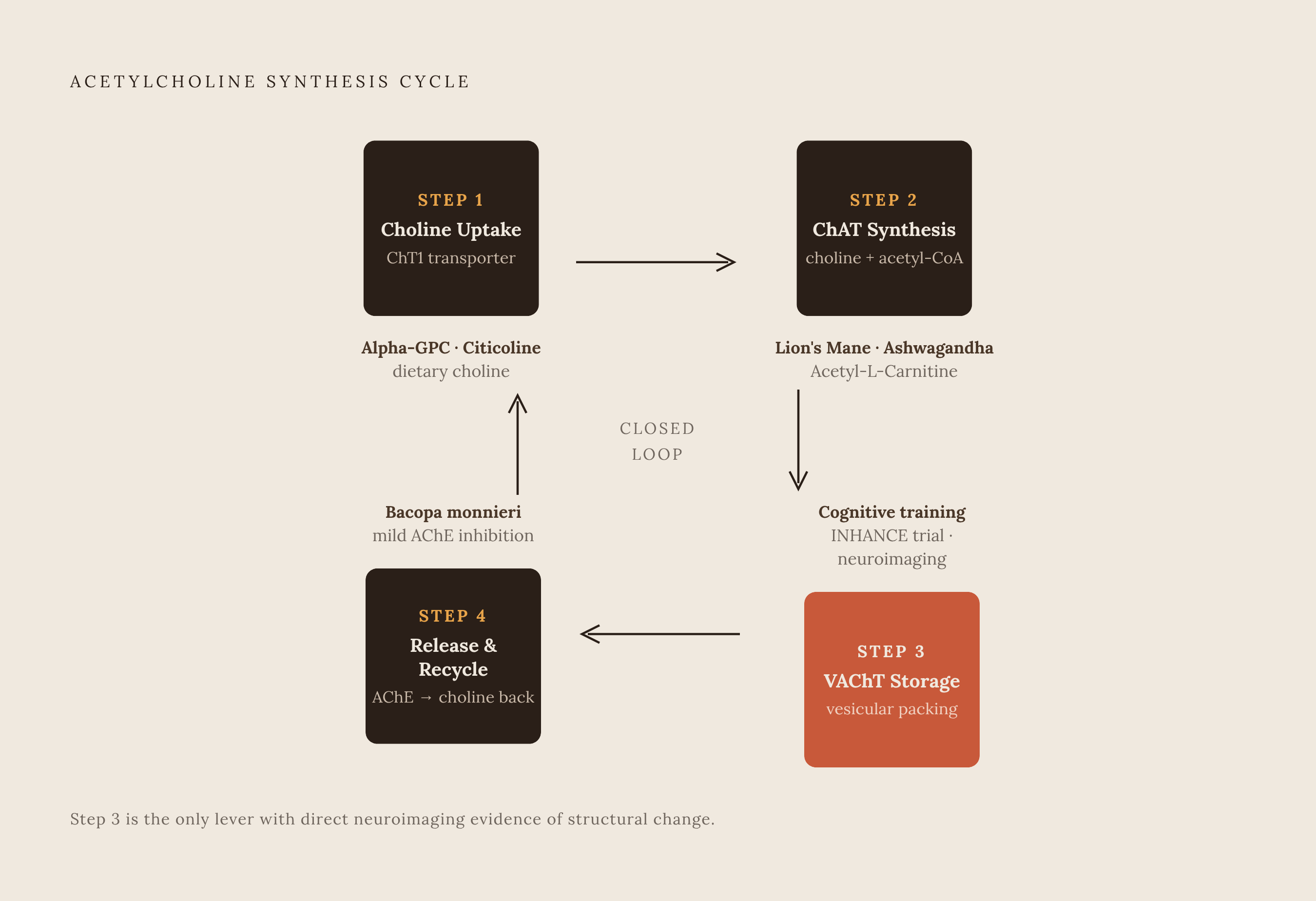
Each node in the acetylcholine synthesis pathway lines up with a distinct lever that can be worked on directly, and the strongest approach treats them as a set.
The first step, ChT1-mediated uptake, is shaped by choline from food and from high-bioavailability precursors such as Alpha-GPC and citicoline, making it the most accessible point of intervention for most people. Step two, ChAT activity, depends on three things at once: NGF availability, which sustained Lion's Mane use supports, freedom from chronic cortisol load, which Ashwagandha and general stress management address, and a steady supply of acetyl-CoA, supported by Acetyl-L-Carnitine and basic mitochondrial health. Step three, VAChT storage capacity, turns out to be directly modifiable through cognitive training, as the INHANCE trial demonstrated, and it remains the most overlooked lever in most conversations about acetylcholine support. Step four, release, termination, and recycling, can be gently extended through Bacopa's mild inhibition of acetylcholinesterase, and the choline recovered during recycling feeds straight back into step one, making the whole system more efficient when substrate supply is already solid.
None of these steps function independently of the environment they run in. Sleep quality and cortisol management aren't optional additions sitting outside the biochemistry. They set the ceiling on what the pathway can produce regardless of how well the nutritional side of steps one through four is handled. If you eat plenty of choline-rich food, take a well-chosen precursor, and still sleep five hours a night under constant stress, your cognitive output gets capped anyway, because the limiting factor has simply shifted from substrate to environment. The synthesis pathway behaves as a connected system, not a single adjustable dial, and addressing all five of these points together, choline supply, enzyme support, transporter capacity, breakdown pacing, and the environment surrounding all of it, is the approach the current science actually supports.
Sources
- Effects of Computerized Cognitive Training on Vesicular Acetylcholine Transporter Levels using [18F]Fluoroethoxybenzovesamicol Positron Emission Tomography in Healthy Older Adults: Results from the Improving Neurological Health in Aging via Neuroplasticity-based Computerized Exercise (INHANCE) Randomized Clinical Trial
- Frontiers
- Pathways of Acetylcholine Synthesis, Transport and Release as Targets for Treatment of Adult-Onset Cognitive Dysfunction
- Choline alphoscerate: insights between acquired ...
- Editorial: Mechanisms of cholinergic transmission in motivation and cognition
- Acetylcholine Pathway - an overview
- Improving Neurological Health With Acetylcholine Via Neuroplasticity-based Computerized Exercise in Mild Cognitive Impairment
- The relation of dietary choline to cognitive performance and white-matter hyperintensity in the Framingham Offspring Cohort - ScienceDirect