Dopamine Precursors and Motivation in High-Cognitive-Demand Work
Dopamine precursors work best when stress and fatigue deplete the system.

Dopamine precursors matter for work that takes hard thinking because dopamine helps shape both whether the work feels worth trying and whether finishing it feels rewarding. The practical message is to support dopamine production when demand drains the system, while addressing the stress, fatigue and nutritional gaps that can limit the benefit.
Why dopamine controls the willingness to attempt hard thinking, not just the reward that follows it
Sitting down to work and engaging with a difficult problem are different events. The task can matter, the deadline can be clear, and the pull toward something easier can still win. That gap is not automatically a failure of willpower. Before effort begins, the brain weighs the expected payoff against the cost of doing the work. Dopamine helps tip that calculation toward engagement by giving the benefit more weight.
Calling dopamine a “feel-good chemical” misses this upstream role. Its signal helps create the drive to try a hard task and stays active while the task is underway. Miederer et al.’s 2025 PET study linked a rise in cognitive demand during task-switching to dopamine release in the ventromedial prefrontal cortex, and those with more release did better at the task. That association points to a biological mechanism for motivation that a simple instruction to try harder leaves out, while leaving the cause of any particular stalled work session uncertain.
How cortico-striatal circuits weigh the cost of thinking hard against the expected payoff
The relevant negotiation happens in cortico-striatal circuits, which connect cortical regions with the striatum. One side of the negotiation weighs how much mental effort the work will take. Dopamine strengthens the other side by increasing the weight of the expected benefit. When that effort feels too costly, the easier task has more pull, even if the harder one matters more. The same broad system helps drive people to put in both physical and cognitive effort.
As part of this system, the prefrontal cortex helps with executive functions, which include working memory, cognitive flexibility and staying with a problem. How much dopamine is available affects how well those functions work, but the relationship follows an inverted-U curve. Too little can produce disengagement, while too much can impair flexibility. The mesolimbic pathway also contributes anticipatory “wanting,” which helps explain why consciously valuing a goal does not always create the drive to pursue it.
Why individual response to dopamine support varies — the genetic layer
That useful range does not start from the same baseline in everyone. Dopamine metabolism is partly shaped by genetics, so two people facing the same workload may have different dopamine availability in the prefrontal cortex. The COMT Val158Met polymorphism affects dopamine levels there and modulates executive functions. DRD2 and DRD4 variants are also linked to novelty seeking, reward dependence and how people cope with stress.
Genetics interacts with neural activity and environment, which makes individual responses harder to predict than a product promise suggests. A precursor that meaningfully changes availability for one person may produce no measurable benefit for another. Results from trials in groups of people are still useful, but an average cannot guarantee how any one person will respond. Select compounds carefully, use them consistently and observe your response honestly. Because people start from different baselines, a strategy needs to be judged by how well it helps under the conditions a person actually faces.
L-Tyrosine as a depletion reverser, not a universal dopamine booster
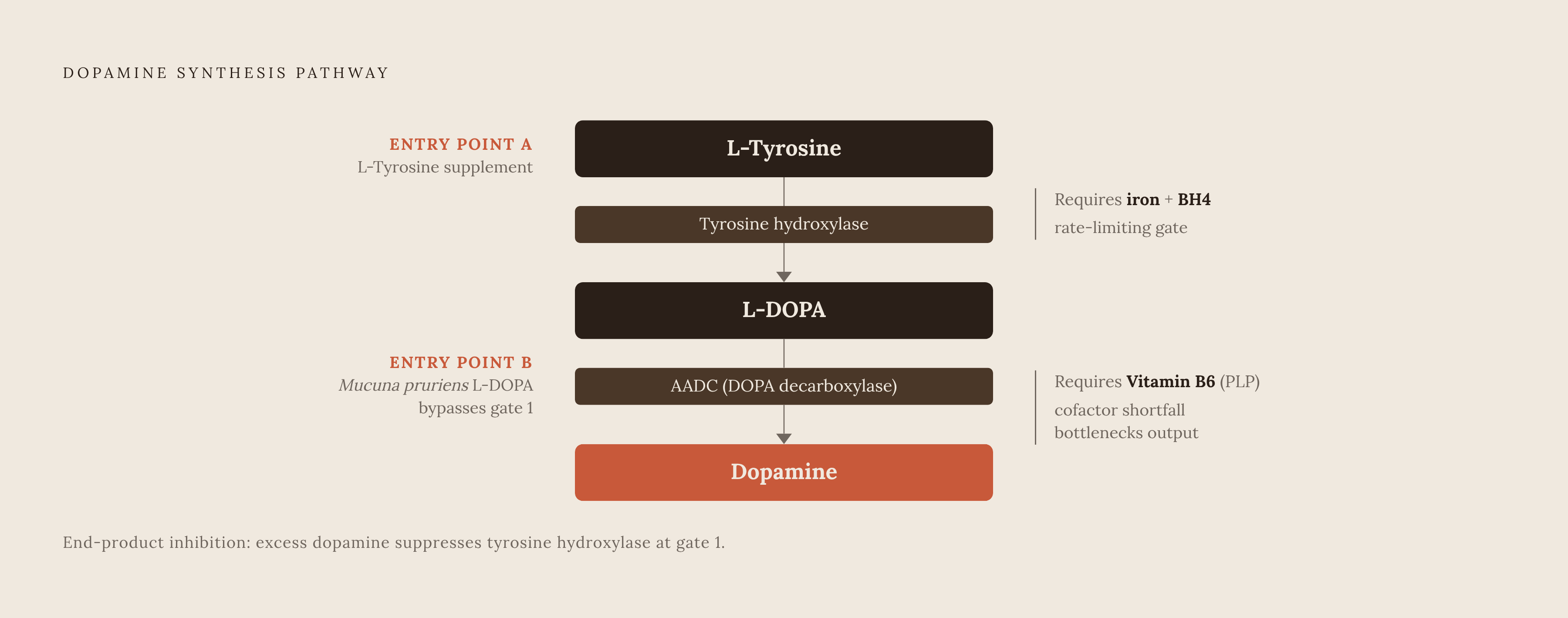
L-Tyrosine makes the most sense when those conditions include depletion. It is an amino acid used to make dopamine and norepinephrine, both of which can be depleted under stressful conditions. In the dopamine pathway, tyrosine hydroxylase converts tyrosine into L-DOPA, which is then converted into dopamine. The first enzyme is subject to end-product inhibition. In plain terms, when dopamine is adequate, the enzyme slows, and extra tyrosine cannot simply force more through the gate.
This brake separates precursor support from the idea of an unrestricted dopamine boost. L-Tyrosine’s evidence is strongest during acute stress, sleep restriction and sustained cognitive load, when replacing depleted raw material is more likely to help. Long strategy sessions and repeated high-stakes decisions fit those conditions for depletion, but they do not prove that every worker will benefit. Research in older adults found that they did worse on cognitive tasks as their oral tyrosine doses rose, which fits the inverted-U model. Once the shortfall is made up, more brings no added benefit, so L-Tyrosine is best treated as a tool for those conditions.
Mucuna pruriens and L-DOPA — skipping a conversion step and what that means
The University of Cologne’s 2025 study, published in the Journal of Neuroscience, found that people who took pharmaceutical L-DOPA were slightly more willing to wait for larger rewards later than those who took placebo. The effect was modest and did not credibly change how quickly they gathered information or how cautiously they decided.
Mucuna pruriens naturally contains L-DOPA, the direct precursor to dopamine. It therefore enters the pathway downstream of tyrosine and bypasses the tyrosine hydroxylase conversion step. That puts it less under the control of the gate that limits L-Tyrosine’s effect when there is already enough dopamine, but does not make it a better choice by default. The trial’s use of pharmaceutical L-DOPA makes the connection to Mucuna pruriens mechanistic and directional, with an equivalent supplement effect still unproven. Common proxies for baseline dopamine, including working memory capacity, spontaneous eye-blink rate and impulsivity, also failed to reliably predict individual response.
Why the synthesis pathway needs cofactors, and what happens without them
Getting raw material into the pathway is only part of the job. Vitamin B6, in its PLP form, is an essential cofactor for converting L-DOPA into dopamine. The earlier conversion from L-Tyrosine into L-DOPA depends on iron and tetrahydrobiopterin, or BH4. B9 and B12 support related methylation processes, but they are not direct cofactors for those two conversion steps.
A cofactor shortfall can therefore become a bottleneck even when precursor intake is adequate. Adding more substrate does not supply the missing machinery, so the expected benefit can be limited regardless of the precursor dose. A formula that includes L-Tyrosine but ignores the B-vitamin foundation leaves cofactor needs unmet.
How cortisol competes with dopamine for the brain's cognitive resources — and what Ashwagandha does about it
Even a well-supplied pathway has to operate under the conditions stress creates. Chronically high cortisol impairs prefrontal function in the same region that relies on dopamine for executive performance. Stress can therefore create a double burden by accelerating depletion while weakening the circuits that the replacement material is meant to support.
Ashwagandha, or Withania somnifera, addresses this burden through HPA-axis activity. Its KSM-66 extract contains withanolides that appear to influence cortisol secretion at the adrenal glands and the brain. Randomized trials included in a 2025 analysis found lower cortisol levels in laboratory tests, but some measures of how stressed people felt did not significantly improve. That gap matters because a lower biomarker does not guarantee that a person feels less stressed, especially when the stressor remains. The case for Ashwagandha is therefore narrower than a promise of calm, resting on reduced HPA-axis overactivation and better conditions for prefrontal function.
Rhodiola Rosea and the specific problem of mental fatigue under sustained cognitive load
A person may need to keep thinking accurately through an extended workload. Rhodiola Rosea is the more targeted fit for this endurance problem. A study of doctors working night shifts found less mental fatigue while they faced sustained cognitive demand with less sleep. That setting is relevant to extended work crunches without making the occupations identical.
Research on the standardized SHR-5 extract used 340–680 mg/day and measured its effects over a 6-week period. The distinction in compound selection is the important point. There is stronger evidence for Ashwagandha when stress raises cortisol and for Rhodiola when fatigue makes people do worse on cognitive tasks. A formula may have a reason to include both because they have different targets.
Lion's Mane and Cognizin — supporting the neural infrastructure that dopamine signals run on
Preclinical studies suggest Lion’s Mane, or Hericium erinaceus, may reduce neuroinflammation and increase nerve growth factor, known as NGF. This protein can increase the length of nerve cell processes and is relevant to neuronal maintenance and repair. The promising findings on NGF alone do not show that it improves motivation in healthy adults who already perform well.
Human evidence for Lion’s Mane remains limited, with larger and longer trials needed. A clinical study reported improvement after 16 weeks of 3 g/day, but the benefit was not maintained four weeks after treatment stopped, and it does not establish the same outcome in healthy knowledge workers. Cognizin® is a clinically studied branded form of citicoline with trial data supporting cognitive function in healthy adults. It supports synthesis of phosphatidylcholine, a key part of neuronal cell membranes, contributing to membrane integrity and metabolic efficiency. The distinction is between maintaining the hardware over time and supplying raw material for today’s signal.
Why ceremonial-grade matcha is a more complete alternative to isolated caffeine for cognitive work
A brief peak is not the same as steady focus across a multi-hour work session. Ceremonial-grade matcha provides caffeine with L-theanine in a catechin-rich whole-leaf matrix. The case for this combination is a more sustained energy curve with theanine modulation, rather than treating caffeine alone as the whole intervention. That may help make focus steadier, though some people may still get jitters.
Caffeine connects this energy layer to dopamine by blocking adenosine receptors. Adenosine signaling interacts with dopaminergic circuits, so changing that brake indirectly affects the motivational state the precursor strategy aims to support. Matcha’s broader polyphenol matrix may also help absorption compared with isolated extracts. Lower-grade matcha has different catechin and L-theanine profiles. The case therefore rests on the composition of high-quality leaf.
Why the compounds work better as a consistent daily stack than as on-demand interventions
These mechanisms operate on different clocks, which is the strongest rationale for a consistent daily approach. L-Tyrosine can replenish depleted substrate during acute load, while matcha supports alertness within the current work session. Stress and fatigue support have different targets and study timelines, and structural support takes longer still. Bacopa Monnieri, when included, requires 8–12 weeks before measurable cognitive changes appear. B-vitamin adequacy underpins precursor conversion.
For a knowledge worker, the practical approach is a well-composed daily formula used consistently over weeks to months, with expectations matched to each ingredient’s evidence. That does not mean every ingredient is necessary for everyone or that studies of individual compounds prove the combined stack works better. A single dose gives no fair test of mechanisms studied over weeks or months of use, and a more direct supply of dopamine does not always help more. Consistent use keeps the supply of nutrients steady while genetics and the environment vary.
Sources
- Driven by Dopamine: Genetic Insights into Motivation and Performance in Sports and Esports
- Neurochemical drivers of effort: The roles of dopamine and beyond in physical and cognitive exertion - ScienceDirect
- The Effects of Acute Dopamine Precursor Depletion on the Cognitive Control Functions of Performance Monitoring and Conflict Processing: An Event-Related Potential (ERP) Study
- Lion’s Mane & Your Brain