Decoding Supplement Facts Panels on Adaptogen Drinks for Clinical Dose Verification
How to spot adaptogens with research-backed doses on their labels.
For an adaptogen drink aimed at stress-related cognitive fatigue, look for separately disclosed ashwagandha and rhodiola doses matched to the extracts used in research. Benchmarks for individual ingredients include 300–600 mg of standard aglycone ashwagandha extract and 200–680 mg/day of standardized rhodiola. Reading the Supplement Facts panel can help tell a formula that matches the research from an expensive drink whose dose cannot be checked.
Why most adaptogen drinks cannot prove they work at the dose on the label
A shopper holds a can listing ashwagandha, rhodiola, and lion’s mane, but cannot tell whether any ingredient matches the research dose. The names look promising. The shopper still needs to know how much is in the can and in what form, because trials use concentrated, standardized extracts, often taken regularly over weeks or months. Many drinks on the market give only a blend name or total weight, which keeps those details hidden.
Dana Ellis Hunnes of UCLA puts the uncertainty plainly. “It's unknown whether the dose that most people can buy of adaptogens on the market are high enough to produce a medicinal effect”. A 500 mg blend split across three ingredients illustrates the problem when ashwagandha alone has a 300–600 mg benchmark for a standard extract.
Supplement Facts means the drink is classed as a dietary supplement, while Nutrition Facts has different rules for what the label must show. Neither means a regulator has verified potency. Most adaptogen drinks cannot demonstrate a clinically meaningful dose from their labels because the information needed to connect the formula to the research is missing.
What a Supplement Facts panel is actually required to show — and what it is not
A Supplement Facts panel must show the serving size and how many servings are in the container. It must also show how much of each ingredient is in it, except when ingredients are part of a proprietary blend. In that case, only the total blend weight is required, with ingredients listed in descending order of weight. Knowing which botanical weighs most does not tell you whether there is enough of it to match the dose used in research.
Optional panel disclosures include an extract’s standardization percentage, such as “5% withanolides”, and extract details such as glycoside versus aglycone ashwagandha or fruiting body versus mycelium on grain for mushrooms. Bioavailability data and third-party testing results are not required disclosures either.
That is the limit of the panel. It describes the formula within disclosure rules, but does not establish that the formula reproduces a clinical trial. A proprietary blend makes individual-dose verification mathematically impossible from the total alone. To move beyond that impasse, the useful benchmarks are ingredient-specific milligram ranges paired with the extract forms and treatment periods behind them.
How adaptogens work in the body, and why dose and duration are non-negotiable
The rationale for adaptogens centers on the HPA axis, the hormonal cascade that governs the cortisol response. Rather than suppressing stress symptoms like sedatives, these botanicals are studied for helping rebalance that response. This is not an instant off switch. Hormonal re-regulation helps explain why taking an effective amount regularly over weeks differs from having a small serving now and then.
A sub-clinical dose may produce no measurable effect at all. Expecting half a therapeutic dose of a vitamin to deliver half the benefit would make the same mistake. Dose-response relationships are not a sliding discount on results, so “contains ashwagandha” says little without an amount and extract identity.
Duration also separates different kinds of ingredients. Caffeine and L-theanine can produce measurable effects within a single session, while ashwagandha, bacopa, and rhodiola generally require sustained clinical-range dosing, though some rhodiola trials examine acute effects. The HPA axis also governs sleep quality, which affects memory, processing speed, and executive function. For someone seeking longer-term stress and cognitive support, an immediate lift is therefore not evidence that the botanical portion is adequately dosed.
Ashwagandha — what the label needs to show beyond milligrams
Ashwagandha has the deepest human randomized controlled trial evidence base among adaptogens. NIH summaries support stress and cortisol reduction particularly around 600 mg/day over 8+ weeks. Yet the milligram number is only part of the comparison, because different extracts have different concentrations and forms of withanolides. Extract identity changes the dose benchmark.
Standard withanolide aglycone extracts have a research range of 300–600 mg. Shoden, a glycoside-dominant extract standardized to 35% withanolide glycosides, has demonstrated clinical effects at 60 mg. Sensoril, a mixed extract, has demonstrated effects at 125 mg. A lower number can match research when it belongs to the specific extract studied.
A 2025 pharmacokinetic crossover study found that glycoside-dominant extracts produced dramatically higher systemic exposure per milligram than aglycone-dominant extracts at equivalent total withanolide doses.
For a buyer, the check starts with a separately disclosed dose, followed by the withanolide percentage and type or a named extract such as KSM-66, Sensoril, or Shoden. The dose then needs to match the research for that extract. A label that says only “ashwagandha root extract” and a milligram amount leaves the comparison unresolved.
Rhodiola, bacopa, and lion’s mane — different ingredients, different label traps
Rhodiola rosea has a research dose range of 200–680 mg/day, standardized to defined rosavin and salidroside percentages, for outcomes including stress-related fatigue and mood. Its distinctive label problem is rosavin variability. The milligram amount and both standardization percentages need to be stated and matched to the relevant research targets. Some trials show effects with an acute, single-dose approach, but a product low in rosavin may not have the same effects even if its total extract weight looks right.
Bacopa monnieri adds a different trap, which is time. Its research range is 300–450 mg/day of standardized extract, with 20% bacosides as the label benchmark here. A meta-analysis of nine randomized controlled trials supports benefits for attentional speed, but the assessments used timelines of 12 weeks or longer. Buying a drink now and then cannot match that treatment schedule.
Lion’s mane requires attention to both source and scale. Human trials in older adults with mild cognitive impairment found that cognition improved when they took 3–5 g/day of fruiting body powder over 12–16 weeks. Those findings do not show that every buyer who wants help with brain fog will benefit. Drinks delivering under 250 mg per serving are unlikely to match research-level effects, and an unspecified extract cannot be treated as equivalent to the studied powder.
The mushroom source is a separate disclosure check. Fruiting body and mycelium grown on grain differ significantly in polysaccharide content, so the label needs to identify which is present. The nerve growth factor effects cited in marketing are largely preclinical, demonstrated in lab and animal studies, and confirmation that taking lion’s mane raises nerve growth factor in people still awaits a human trial.
L-theanine and matcha — where tea falls short of supplement doses
The caffeine–L-theanine combination has evidence for acute attention and alertness effects. Several randomized controlled trials have found that roughly 50 mg caffeine plus 100 mg L-theanine improves attention-switching accuracy, reaction time, and how alert people feel more consistently than caffeine alone. Here, the dose comparison is especially concrete. The studied combination is not simply “tea plus calm”.
A serving of ceremonial-grade matcha has roughly 30–70 mg of L-theanine, while research aimed at calm focus often uses 100–200 mg or higher. For label checking, L-theanine milligrams need to be disclosed separately from matcha milligrams, because matcha weight is not L-theanine weight. The L-theanine-to-caffeine ratio should also approximate the studied 2:1 range.
A 2025 meta-analysis found a statistically significant reduction in jitteriness versus placebo at two hours for the combination, with a mean difference of −3.25. That comparison leaves L-theanine’s role in offsetting caffeine-induced jitteriness and the claim of crash-free energy unproven. Some manufacturers use nanoencapsulation to help the body absorb water-soluble compounds such as L-theanine, but how well that technology works needs to be checked along with the dose.
Why extract standardization and delivery format change what a correct dose actually means
Standardization describes the concentration of the plant compounds linked to an effect. A correct milligram disclosure is therefore necessary but insufficient. It tells the buyer how much extract is present, while standardization helps establish what that extract contains. Absorption then determines how much of the stated dose reaches the bloodstream.
Delivery format can alter that final step. In theory, the body can absorb water-soluble compounds more easily from liquids than from compressed tablets, but putting them in a liquid cannot make up for a dose below the effective range. Nanoencapsulation wraps active ingredients in a lipid shell and can improve absorption and onset speed for botanical actives. Piperine, or black pepper extract, is also included in some formulas to support bioavailability.
For buyers, useful disclosures include the extraction method, lipid-based delivery, and piperine inclusion. A delivery claim only becomes useful when the underlying dose and standardization are clear. If the label is silent on extract type, a manufacturer’s analytical report is the route to verifying compound-level standardization beyond the label.
How can a buyer check an adaptogen drink before purchasing?
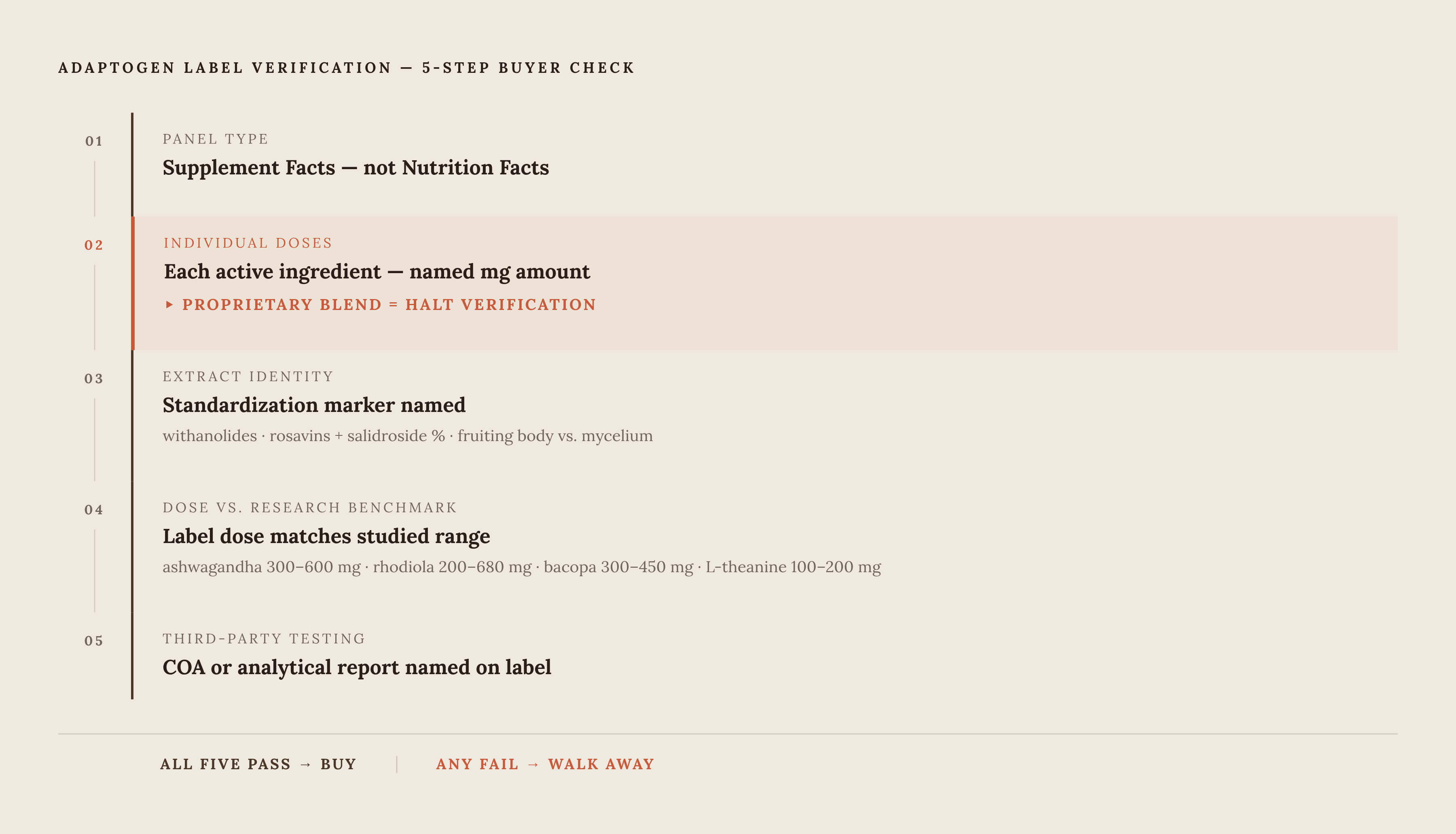
The five checks work in order. A missing detail leaves verification through this process incomplete and the product’s effectiveness unresolved. Most products will fail one or more checks. The purpose is to distinguish evidence a buyer can inspect from a promise that still requires trust.
Check 1 is the panel type. A Supplement Facts panel indicates dietary-supplement classification and provides the baseline for this audit. A Nutrition Facts panel has different rules for what it must show. Neither panel guarantees potency, so knowing how the drink is classed is only the start of the check.
Check 2 looks for the milligrams of each active ingredient listed on its own. If ashwagandha, rhodiola, bacopa, or lion’s mane appears only inside a proprietary blend, individual-dose verification stops there. This is the most important transparency check.
Check 3 is extract identity and standardization. Ashwagandha needs a withanolide percentage and type or a named research-linked extract, while rhodiola needs both rosavin and salidroside percentages. Bacopa needs its bacoside percentage checked against the research target. Lion’s mane needs explicit identification as fruiting body or mycelium on grain.
Check 4 compares the dose on the label with the range used in research on that specific extract. Standard aglycone ashwagandha uses the 300–600 mg benchmark, compared with 60 mg for Shoden at 35% glycosides and 125 mg for Sensoril. Standardized rhodiola has a 200–680 mg range, and standardized bacopa has a 300–450 mg range. Lion’s mane needs comparison with the human fruiting body research, while targeted L-theanine effects commonly use 100–200 mg. The treatment schedule belongs in that comparison too.
Check 5 examines the rest of the formula and its testing disclosures. High doses of caffeine, too much added sugar, or artificial sweeteners can work against the drink’s aim of helping with calm and stress support. Third-party testing for contaminants, including heavy metals and mycotoxins, together with an analytical report that is named, gives the buyer the strongest available way to check what is in the drink beyond the panel itself. If those records or essential dose details are missing, the honest purchasing conclusion is “not verifiable”, with both “clinically proven” and “definitely ineffective” remaining unsubstantiated.