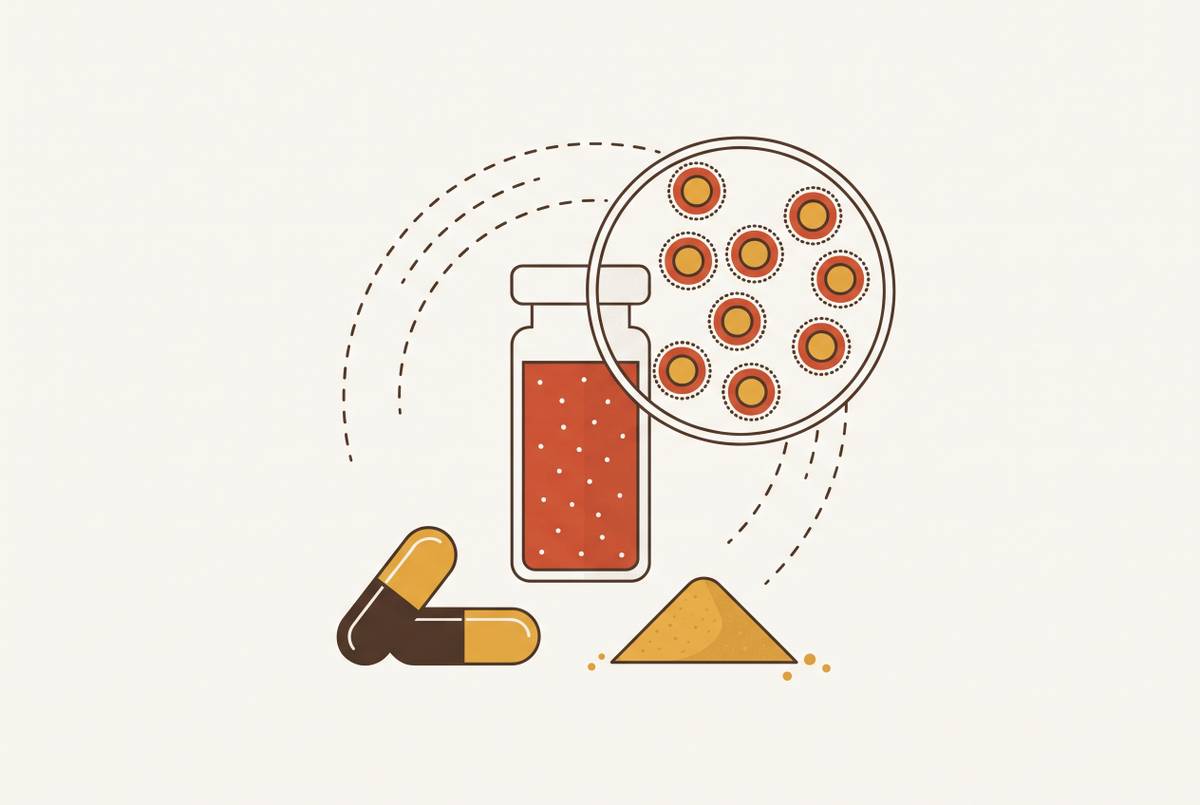
Ranking Daily Nootropic Shots by Absorption Architecture Not Ingredient Lists
How your nootropic shot absorbs matters more than what's inside it.
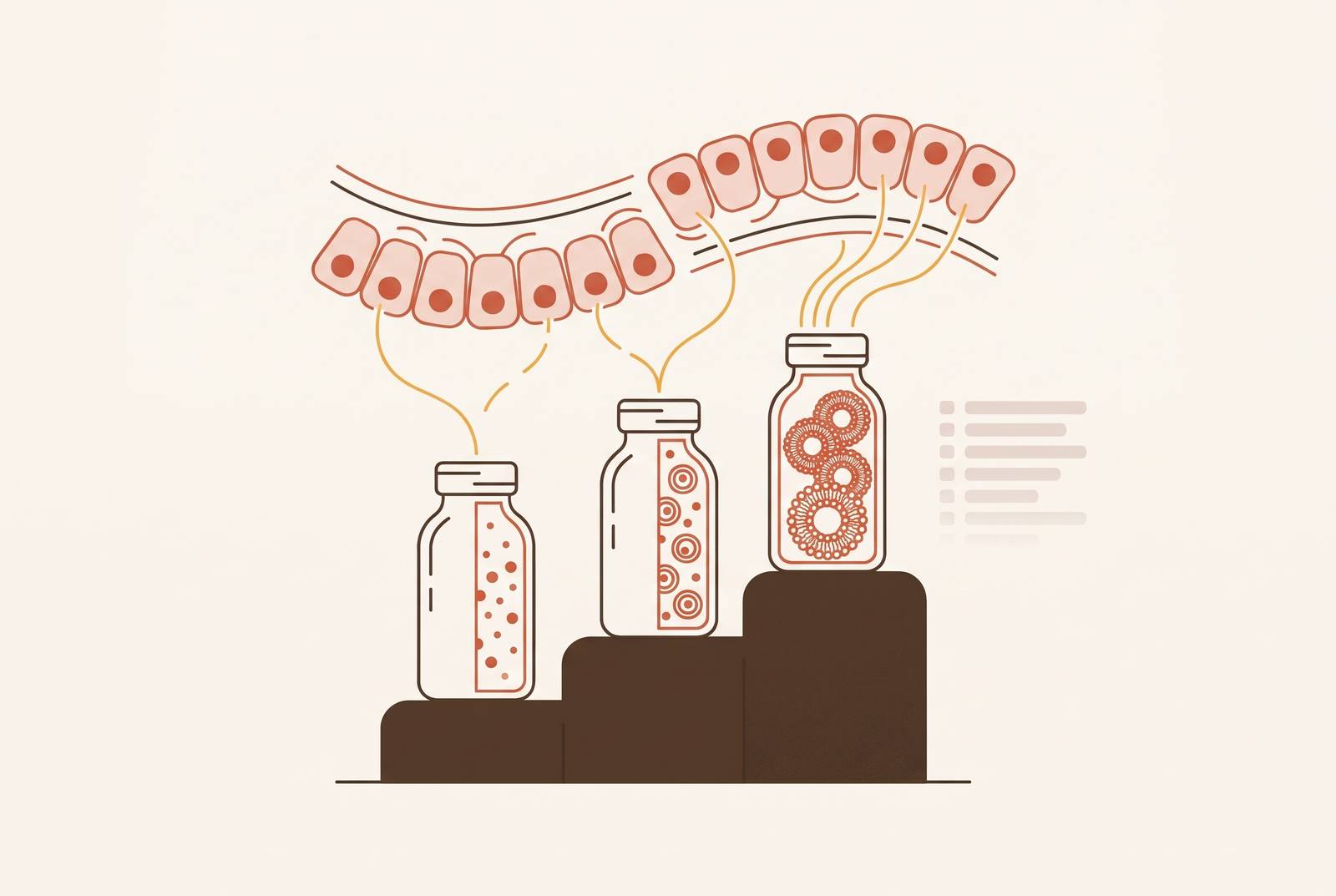
Daily nootropic shots should be ranked by absorption architecture. A nanoencapsulated shot with a lipid carrier may improve delivery of compounds that a plain liquid handles poorly, but the technology’s name is not proof of better absorption. The strongest choice is the formula with evidence that its delivery system gets its stated doses into circulation reliably, rather than merely putting impressive ingredients in a bottle.
Why ingredient lists are the wrong way to rank nootropic shots
There are plenty of shots with 20-ingredient lists on the shelf. The same problem comes up when scrolling through them. One formula looks more complete, another sounds more powerful, and neither label explains how much of its contents the body will receive. The list makes it easy to compare ingredient counts. Comparing ingredient counts is a marketing convention.
A label identifies the compounds inside the bottle. It does not establish how much survives digestion and metabolism, reaches the bloodstream, or gets to the brain. First-pass metabolism helps explain that gap. Swallowed compounds go through the digestive system and liver before they reach general circulation, and metabolism can leave less of them available. The loss is compound-specific, so a long list cannot reveal whether the formula delivers useful concentrations.
Being liquid does not remove that obstacle. A shot may avoid the time a capsule takes to dissolve while still exposing its ingredients to the same metabolic route. Its advantage depends on what the formulation does after it is swallowed. The necessary alternative to ranking labels is therefore to examine the delivery system, including which compounds it protects and which absorption problems it actually addresses.
What absorption architecture actually means for a daily shot
Absorption architecture means the formulation choices that shape how much of a compound reaches circulation, at what concentration, and how quickly. Five variables make that idea usable. They are the carrier matrix, particle or droplet size, first-pass bypass mechanism, onset speed, and dose integrity at the target tissue. Each answers a different question about delivery.
The carrier matrix is the material that surrounds or holds the active compounds. A fat-based carrier, lipid shell, or emulsification system can improve solubility and protect compounds in transit. Nanoencapsulation uses very small delivery particles, with lipid-shell systems offering one approach, but the word “nano” alone does not establish how a finished shot performs.
First-pass bypass concerns the route into circulation. Lipid-based nanocarriers can exploit intestinal lymphatic transport that bypasses first-pass liver metabolism, but that possibility is not proof that every encapsulated formula does so. Onset is a separate measurement. The time to peak plasma concentration is how long it takes for blood levels to peak, while reported onset is when a user says they notice an effect. Those measures should not be treated as interchangeable.
Dose integrity concerns whether enough of a compound is delivered to have the intended effect. Bloodstream delivery is not itself proof of delivery to brain tissue, and a studied oral dose is not automatically a known brain concentration. With better absorption, a smaller label dose may be enough to produce useful exposure. That comparison still needs evidence for the compound and formulation, rather than an assumption that smaller particles solve every problem.
How the compounds inside daily shots each place different demands on the delivery system
Caffeine and L-theanine illustrate where a liquid base fits naturally. Both are water-soluble, so they do not present the same carrier problem as lipophilic compounds. L-theanine reaches peak plasma concentration within roughly 0.8 hours after ingestion and has high bioavailability. It can also moderate caffeine’s subjective stimulant curve. A meta-analysis found that the combination improved attention-switching in the first and second hours after dosing, with a smaller benefit for unisensory visual attention in the first hour compared with placebo.
Bacopa Monnieri presents a different requirement because its bacosides need attention to lipid delivery, while its documented memory effects depend on repeated dosing over weeks. A water-only base leaves that delivery problem unresolved. If absorption falls short, including a studied label dose does not establish that the finished shot reproduces the exposure behind the research.
Lion’s Mane raises a similar carrier question. A fat-based system may help deliver more of its terpene fraction, which includes compounds that may play a part in its proposed effects. A 2025 systematic review of five RCTs found improvements in cognitive scores on validated assessments. A 2026 trial at 2 g/day found modest improvements in visual attention and working memory. Those findings came from controlled dosing conditions.
For Ashwagandha, the dose must match the research before a benefit can be assumed. KSM-66 is a standardized ashwagandha root extract. A randomized controlled trial published in Indian Journal of Psychological Medicine found that ashwagandha root extract significantly reduced serum cortisol compared with placebo. A shot must deliver a comparable amount before that finding can be used as evidence for its own effect.
Rhodiola Rosea shows why timing also belongs in the assessment. Single-dose studies report effects on mental fatigue and cognitive performance over a short time, while repeated-use research looks at what happens with more than one dose. Koozehchian et al.’s 2025 Nutrients RCT found significant improvements in the Stroop Word and Color-Word sections after repeated daily use, but not a significant improvement versus placebo in the Color section. Its lesson is specific. A delivery system must deliver the dose on the schedule behind the claimed benefit, even if its effects can be felt on the first use.
What nootropic shots actually absorb better than capsules or powder?
Liquids have a genuine timing advantage over capsules. They can begin absorbing within minutes of reaching the stomach, while a capsule must first dissolve. Reported onset for shots is typically within 15–30 minutes, which can be useful when performance is needed soon. Water-soluble caffeine and L-theanine fit that format well. But faster onset alone does not prove that more is absorbed in total.
The stronger case for an engineered shot concerns ingredients that plain water serves poorly. A 2oz format using nanoencapsulation and a lipid shell can extend the delivery advantage to lipophilic compounds, including Bacopa bacosides and Lion’s Mane terpenes. Particle sizing and the carrier mechanism explain why an advantage is plausible. Comparative absorption evidence is needed to establish its size.
Most clinical studies of herbs such as Bacopa, Lion’s Mane, and Rhodiola used capsule formulations, so evidence for the ingredients is not automatically evidence for shots. A well-formulated capsule may outperform a water-only shot for particular compounds. Powders also cannot be ranked below shots merely because they begin in a different format.
The emerging buccal-pouch challenge and what it clarifies about the absorption race
Buccal pouches challenge shots by changing the route. Compounds that cross the lining of the inner cheek and gum can enter circulation without first passing through the digestive tract and liver. Oral mucosal permeability research identified as PMC10220859 describes these tissues as highly vascularized routes into systemic circulation without hepatic first-pass processing. For suitable compounds, that is a meaningful distinction from a swallowed dose.
The advantage has limits of its own. Smaller molecules cross mucosal tissue more easily, while little of the high-molecular-weight polysaccharides and large peptide compounds is absorbed through that route. Contact time also affects the delivered dose, so removing a pouch early can mean taking only part of it. Highly acidic formulations can irritate the mucosa and reduce absorption efficiency with repeated use. Evidence for buccal absorption of alpha-GPC is also less established than for caffeine and L-theanine.
A pouch therefore cannot promise to deliver all the ingredients in a varied formula equally well. Neither can a shot. A lipid-based shot designed for lipophilic compounds addresses a different problem from a pouch optimized for compounds that cross oral tissue readily. The competition exposes the weakness of format-first rankings. Evaluate whether the route, with its limitations, fits the ingredients.
How to apply the absorption-architecture framework when evaluating any daily shot
To put the framework to work, start with the carrier. A shot containing Bacopa bacosides or Lion’s Mane terpenes should explain its fat-based delivery mechanism, whether that is a lipid carrier, emulsification system, or nanoencapsulation. A water-only base is a warning sign for those ingredients. It leaves the central solubility problem unanswered. Naming the herbs is not an answer.
Next, look for the delivery particle or droplet size and the mechanism attached to it. A nanoencapsulation claim should identify what is encapsulated and how the delivery system is meant to improve uptake. The label’s technology name is only a starting point. A credible claim of superiority over a standard capsule based on vehicle size or mechanism requires disclosure of those features.
Then examine the first-pass claim compound by compound. Caffeine and L-theanine already absorb well through the standard gut route, so bypass is not a universal requirement for a useful shot. A formula that claims bypass for lipophilic ingredients should explain which pathway they take. Lipid encapsulation and first-pass avoidance are not interchangeable terms. A claim about the entire formula needs more support than a mechanism relevant to one ingredient.
Onset needs the same discipline. Separate a documented comparison from a manufacturer’s claimed time to effect, and look for a mechanism that supports the claim. Then compare transparent ingredient doses with the doses and dosing schedules used in research. A large amount on the label does not show that enough is delivered. Conversely, a moderate dose should not be dismissed when the formulation has evidence of better absorption.
Broad third-party testing for contaminants including PFAS, heavy metals, and mycotoxins indicates attention to product quality. Testing for 56+ contaminants and independent certification can give more support to that signal, but neither measures how much reaches the brain. Proprietary blends create another obstacle because they hide individual doses. A fair evaluation needs named, dosed ingredients and a disclosed delivery technology, followed by evidence that the combination performs as claimed.
Why consistent daily use compounds the returns from good absorption architecture
Several ingredients in daily shots are studied over weeks. Bacopa’s documented effects require chronic dosing, while Rhodiola research over 3–16 weeks addresses adaptogenic effects involving stress regulation, neurotransmission, and immune and hormonal pathways. An immediate sensation cannot stand in for those outcomes. Consistent delivery is relevant because the research depends on repeated, adequate doses.
The longer-term argument also involves BDNF, which supports the formation and strengthening of connections involved in memory and learning. L-theanine, Bacopa, and Rhodiola have been associated with support for that pathway. That provides a rationale for examining sustained delivery. A mechanism is not a measured outcome. Claims of neuroprotective returns require more than evidence that an ingredient can influence a biological pathway.
For daily users, a 100-day consistent-use window offers a practical way to look beyond the first dose. It is a practical evaluation horizon whose length establishes neither a universal clinical threshold nor a promise that day 90 must feel better than day 1. The useful distinction is between acute stimulation and benefits studied with repeated dosing. Both depend on delivery, but they need different evidence.
The ranking criterion remains which formula is engineered (and shown) to deliver its ingredients reliably at concentrations relevant to their studied effects. A longer ingredient list cannot answer that question. Absorption architecture can, provided the claims are held to the evidence.