Half-Life of Caffeine and Its Implications for Sleep Quality
Caffeine lingers in your body far longer than you think, quietly sabotaging your deepest sleep.
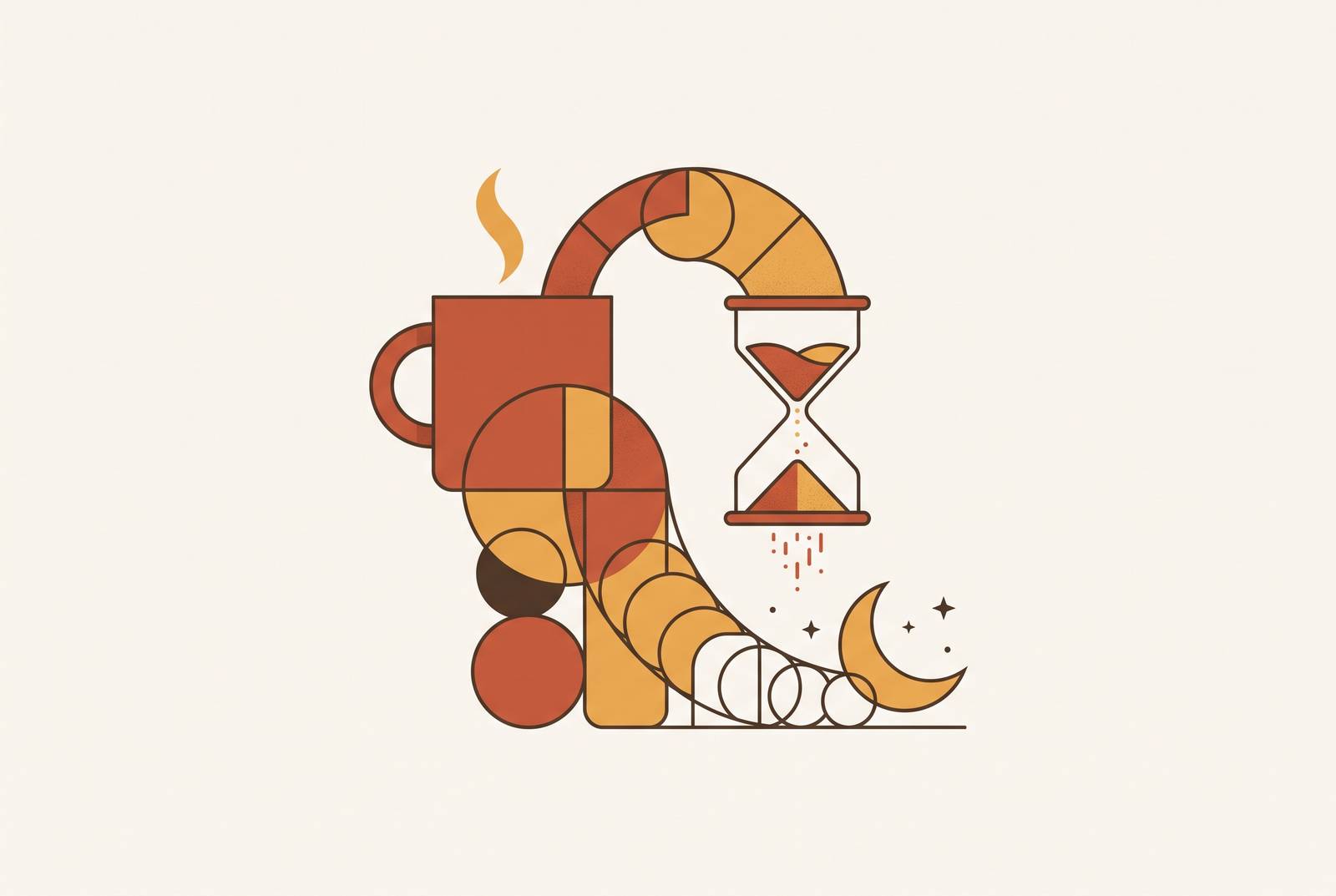
Caffeine's half-life is not a fixed number. It varies by a factor of five across healthy adults, between roughly two and ten hours, and that range is why so many people are carrying a stimulant load into bed without knowing it. This piece works through what that half-life actually means for sleep, why the damage from afternoon caffeine goes unnoticed for weeks at a time, and what someone can do about it without necessarily giving up caffeine entirely.
Why caffeine does not simply "wear off" (it fades on a variable clock)
Most people treat caffeine like a light switch: it's on, it keeps you alert, and by evening it flips off. The pharmacokinetics tell a different story. Caffeine clears the body on a decay curve, fading gradually the way a dimmer fades. Faded is not the same as gone.
Picture a 200 mg cup of coffee at 2 pm. A meaningful fraction of that caffeine is still circulating at midnight, quietly occupying the same receptors it was occupying ten hours earlier. Add a second cup at 4 pm, and instead of swapping one dose for another, the body stacks the new dose on top of what's left of the first, so the total load climbs instead of resetting.
The liver enzyme responsible for breaking caffeine down is CYP1A2, and how fast or slow it runs varies by genetics. This is the main reason two people can drink the same coffee at the same table and feel completely different six hours later: one has cleared most of it, and the other is still carrying half the dose. Smoking speeds CYP1A2 activity up, which is one reason smokers often report less sensitivity to late caffeine. Oral contraceptive use slows the enzyme down, because estrogen interferes with it, and pregnancy slows it further still. Age, liver function, and certain medications all push the needle in one direction or the other.
Caffeine's half-life is a personal range that most people don't know where they land on. That uncertainty is why the damage builds without anyone noticing it happen.
What caffeine does inside the brain
Caffeine does not generate energy. It blocks the brain's signal for fatigue, and the fatigue that gets blocked doesn't vanish, it waits.
Through the day, a molecule called adenosine builds up in the brain as a natural byproduct of neural activity, and that buildup is what produces the feeling of sleep pressure as the hours pass. Caffeine works by occupying adenosine's receptors in the brain, which stops the brain from registering how tired it actually is. Adenosine keeps accumulating the entire time those receptors stay occupied. Nothing about caffeine slows its production. It just blocks the alarm.
When caffeine finally clears and the receptors open back up, all that backlogged adenosine floods in at once. That's what produces the familiar crash, and it hits harder than ordinary tiredness because it arrives all at once.
The real cost appears during sleep itself, specifically in slow-wave sleep, the deepest stage and the one doing the most physical repair work. Tissue repair, the consolidation of declarative memory, and the clearance of metabolic waste from the brain all happen mostly during slow-wave sleep, while REM sleep handles procedural and emotional memory on its own. Compress slow-wave sleep, and a person can log a full eight hours and still wake up feeling like the repair work never happened.
With regular high-dose use, this mechanism creates its own trap. As the brain adapts to chronic blockade of its adenosine receptors, the cognitive lift from a given dose shrinks over time, pushing people toward higher doses just to recover the alertness they used to get from less. That tolerance is a neurological adaptation that people can't simply break through willpower, and it sets up the pattern the next section lays out.
How dose and timing together determine how much sleep damage occurs
The danger is a high dose landing inside a window still close enough to bedtime that a meaningful stimulant load is active while sleep architecture is trying to form.
A 2025 randomized clinical crossover trial published in the journal SLEEP tested this directly and found that a lower dose, taken further from bedtime, produced no measurable sleep impairment, while a higher dose taken closer to bedtime did. Dose and proximity work together to set the threshold. Neither one alone tells the full story.
A 2025 meta-analysis in the journal Sports extended the finding further: caffeine consumed well before bedtime still reduced both sleep efficiency and total sleep time. The effects don't stay confined to whatever hour follows the cup of coffee. They reach forward, sometimes by many hours, into the part of the night a person assumes is safe.
People can't feel this happening. A systematic review found that the brain's backlogged sleep pressure underlies people's poor judgment of caffeine's effect on their own sleep: someone can report sleeping fine on a given night while wearable data or lab measurement shows real compression of sleep architecture producing that mistaken self-report. This gap between what someone feels and what their brain actually did is what keeps the pattern running. If there's no felt signal that something went wrong, there's no reason to change behavior, so the compounding continues unnoticed.
As a rough guide, a low dose, around 100 mg or less, matters less for timing in most adults. A moderate-to-high dose, in the 200 to 400 mg range, pushes the window of concern meaningfully earlier in the day, particularly for anyone who metabolizes caffeine slowly. And stacking doses across the day, a coffee here, a tea there, an energy drink in the afternoon, compounds the total load even when no single dose looks large on its own.
The feedback loop that quietly grows a sleep deficit over weeks
Worse sleep leads to more fatigue, more fatigue leads to more caffeine, and more caffeine leads back to worse sleep. The cycle compounds over days and weeks rather than announcing itself in any single night, and people tend to blame the escalation on biology or a demanding schedule when a sleep deficit that caffeine is masking rather than solving is part of what's actually happening.
Two mechanisms keep the loop turning. The behavioral one: caffeine dulls the felt sense of accumulated sleep debt, which removes the pressure that would otherwise push someone to change their habits. The neurological one: as the brain adapts to repeated adenosine receptor blockade, the same dose delivers less effect over time, which pushes people toward higher doses or earlier starts to the day just to feel normal.
That pattern can look like a tolerance upgrade, as though the body has simply adjusted to handle more. It functions more like a debt instrument: a higher dose buys back the same alertness, and the payment comes out of deeper sleep compression each night.
The SleepSmart study, run at LMU Munich from July 2024 to January 2025, tracked participants with both wearable monitoring and self-administered questionnaires and found a consistent divergence between subjective and objective sleep measures. That divergence is the mechanism by which the loop runs invisibly for weeks: the data shows compression long before the person reports feeling it.
What chronic caffeine-disrupted sleep does to the brain's structure and cognitive output
Persistent caffeine-disrupted sleep doesn't just leave someone tired. It interferes with the brain's capacity to repair and rebuild itself, and the consequences appear in brain structure, not only in mood or energy.
PET-MRI research found that participants given 300 mg of caffeine daily, roughly equivalent to three cups of coffee, during a period of restricted sleep showed reductions in grey matter volume in the thalamus and the prefrontal cortex. A decaffeinated comparison group under the same sleep restriction showed increases in those same regions. The contrast suggests that when sleep is restricted, caffeine actively works against the brain's recovery process.
The cognitive effects follow a specific pattern. Sleep deprivation produces slower response times, more attentional lapses, and greater inconsistency across repeated tasks, which raises the stakes in any high-pressure or safety-critical setting. A 2025 review in Frontiers in Neuroscience found that sleep deprivation impairs accuracy more than reaction time, with cognitive flexibility and the ability to switch between tasks breaking down before raw speed does. Working memory and attention, both dependent on healthy cortical function, decline as well, and learning and memory consolidation suffer alongside them, the behavioral counterpart to the structural changes measured above.
Cortisol adds a hormonal layer to all of this. Caffeine itself raises cortisol acutely, and chronic sleep disruption keeps cortisol elevated over longer stretches of time. Sustained high cortisol further impairs cognitive function, degrades sleep quality, and weakens immune response, compounding the structural and cognitive damage already underway. Breaking this loop matters, and the next question is how someone does that without a one-size-fits-all rule that doesn't fit their biology.
Why genetics means no universal cut-off time works
The common advice to stop drinking coffee by 2 pm fails you in both directions. It's too permissive for fast metabolizers' slower-metabolizing counterparts and too strict for the fast ones. Timing still matters, but self-knowledge has to come before any timing rule can work.
The picture is more complicated than "caffeine always hurts sleep." A 2026 genetic epidemiology study found that higher daily caffeine consumption was associated with a lower likelihood of daytime sleepiness. That finding has to be taken seriously rather than explained away, because it cuts against the simpler narrative running through most of this article. The honest resolution is that population-level findings average over enormous individual variation, and the pattern that actually causes harm is chronic high-dose use late in the day, not caffeine use in general.
Without genetic testing, a few practical habits substitute reasonably well. Tracking sleep quality, whether through a wearable or a simple written log, against the timing and dose of the day's last caffeine for about two weeks reveals patterns that a single night never will. Paying attention to whether an afternoon dose feels necessary or merely habitual is a useful signal of tolerance. And noticing whether "harmless" afternoon caffeine lines up with waking unrefreshed after a full night's sleep points toward slow-wave compression, even without a lab measurement to confirm it.
Some factors push you toward the slow-metabolizer end of the range even without any genetic test. Oral contraceptive use, certain medications, age, and liver health all shift the picture, and knowing where any of these apply is useful immediately, with no lab work required.
How matcha's caffeine delivery differs from coffee
Matcha delivers caffeine through a different mechanism than coffee does, one that moderates the rate of absorption and pairs the caffeine with a compound that changes the neural experience without adding a second stimulant on top of it.
A prepared cup of matcha carries meaningfully less caffeine than a typical cup of coffee, and the dose matters here as much as the timing does, since dose is one of the two variables that determines how much sleep architecture gets disrupted. The amount of caffeine present isn't the only factor; what accompanies it matters too.
L-theanine, the amino acid found in tea, promotes alpha-wave activity in the brain, a state linked to relaxed alertness rather than jittery stimulation, and it does this without adding any stimulant load of its own. A randomized controlled study found that theanine suppressed caffeine-induced awakenings measured on EEG, blunting one of the specific ways caffeine disrupts sleep architecture at the neural level. At higher doses, L-theanine has also been linked to improvements in sleep quality on its own, separate from its interaction with caffeine. The same compound that smooths out caffeine's edge during the day may be doing supportive work for sleep architecture at night.
Addressing fatigue at its source (adaptogens that work without a half-life penalty)
Everything in this article points toward the same underlying problem: caffeine treats the symptom of fatigue by blocking its signal, while the underlying causes, accumulated stress, poor sleep architecture, and depleted recovery capacity, remain untouched and often get worse. Adaptogens approach the problem from the opposite direction. Rather than masking the sensation of tiredness, compounds like rhodiola and ashwagandha are studied for their role in modulating the body's stress response system, with the aim of reducing the physiological load that produces fatigue in the first place.
The structural advantage here is pharmacokinetic as much as it is physiological. Adaptogens don't carry a half-life that lingers into the night the way caffeine does, and they don't occupy adenosine receptors. They don't generate the same deferred crash or compress slow-wave sleep the way a stimulant dose taken too late in the day can. Addressing fatigue by supporting the body's stress response, rather than suppressing the brain's fatigue signal, sidesteps the entire mechanism this article has traced from the liver enzyme CYP1A2 through adenosine accumulation to grey matter volume in the prefrontal cortex. For anyone whose afternoon caffeine habit is driven less by genuine energy needs than by accumulated stress and poor recovery, a routine is worth building around that distinction.
Sources
- SLEEP, 2025, 48, 1–14 https://doi.org/10.1093/sleep/zsae230
- Exploring the Relationship Between Caffeine Consumption, Caffeine Metabolism, and Sleep Behaviours: A Mendelian Randomisation Study - Das - 2026 - Journal of Sleep Research - Wiley Online Library
- More awake, less rested: The hidden cost of caffeine on sleep quality
- Dose and timing effects of caffeine on subsequent sleep: a randomized clinical crossover trial
- Effects of Caffeine Intake on Self-Administered Sleeping Quality and Wearable Monitoring of Sleep in a Cohort of Young Healthy Adults
- The Effect of Consuming Caffeine Before Late Afternoon/Evening Training or Competition on Sleep: A Systematic Review with Meta-Analysis
- Received 08/18/2025 Review began 08/26/2025 Review ended 10/13/2025
- Caffeine and Sleep Review Suggests Consumption Guidelines